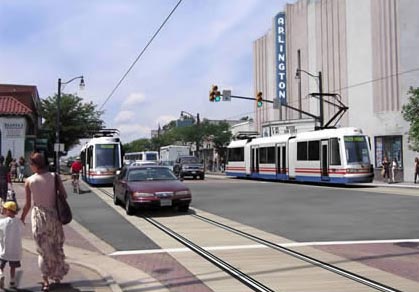
DEVELOPING — Pike Streetcar Cost Soars
Late this afternoon, Arlington County revealed that the estimated cost for the proposed Columbia Pike streetcar line has increased by as much as $100 million over a 2007 cost projection.
The five-mile Columbia Pike streetcar line will run from Pentagon City to the Skyline area of Fairfax, and cost between $242 million and $261 million, according to “a new, more detailed analysis.” In 2007, officials pegged the cost at about $161 million.
“Inflation, an increase in the scope of the proposed project, additional engineering requirements, and federal requirements for higher contingency funding and escalation accounted for the increase in projected costs,” the county said in a press release. “The $50 million per-mile cost now estimated for the proposed streetcar project is comparable to the costs of similar projects across the nation.”
Arlington and Fairfax counties are still pushing forward with the streetcar project, which will serve a transportation corridor that’s expected to add 2.2 million square feet of commercial development and 7,300 residents over the next 30 years. Officials are calling the streetcar an “innovative solution” to transportation challenges on Columbia Pike, which is currently only served by bus.
“Clearly, a streetcar-and-bus system is the best solution for people who live and work on the Pike and the people who travel along it between two major employment centers,” County Board Chairman Chris Zimmerman said in a statement. “A streetcar will enhance the Pike’s livability, help realize the vision that Arlington and Fairfax have for this vital corridor, and help ensure its long term economic and environmental sustainability.”
Construction on the streetcar line is currently projected to start in 2015, with streetcar service starting in 2017.
Artisphere Critics React to New Business Plan
Three outspoken critics of the Artisphere are giving a lukewarm reception to a new business plan created to help boost the money-losing, county-run cultural center’s finances.
Arlington County Board members on Tuesday expressed cautious optimism about the plan, which would cut Artisphere’s hours, close its restaurant, and generate more revenue via private event rentals. Critics we spoke to, by and large, agreed that the new business plan was an improvement over the flawed, original business plan. But they also questioned whether the County Board should have even bought in to the original business plan in the first place.
“In retrospect, it’s unfortunate the Board didn’t have the foresight presented in the task force’s business plan,” wrote Tim Wise, president of the Arlington County Taxpayers Association. “That said, it’s not clear the new business plan will fix what needs fixing. What is clear, however, is that government should restrict itself to core government functions such as police enforcement, and stay out of places where it doesn’t belong, e.g., the arts.”
“Was this all a mistake in the first place? I submit it was,” wrote Wayne Kubicki, another Arlington fiscal watchdog. “As currently projected, by the end of FY 2013, Artisphere will have cost Arlington taxpayers a total of $10.6 million in construction costs and unanticipated operating subsidies. How long can this go on?”
Kubicki also questioned whether a governmental entity should be actively competing in the private event rental business.
“The new plan… relies heavily on increased event rentals for corporate and social events,” he wrote. “Well and good, if it works — but, in truth, this would probably take this business away from Arlington’s private sector hotels, other conference facilities and restaurants.”
Green Party activist Audrey Clement, who ran unsuccessfully for the County Board this fall and is expected to run again in a special election this winter/spring, said that the county should try to speed along the eventual transformation of Artisphere into a self-sustaining non-profit.
“While the proposed solutions all sound reasonable, I am concerned that the task force still projects an operating deficit of $2.3 million for FY 2012 alone,” Clement told ARLnow.com. “In light of this report, I recommend that County Board follow the recommendations of the Artisphere Task Force with a view towards transferring its lease on the Artisphere to a trust or foundation better equipped to absorb the operating cost of the facility.”
County Board members were universally supportive of the new plan — Walter Tejada said Artisphere still has “a great deal of potential” — but some left open the possibility of eventually closing or significantly changing the venue if the plan fails to live up to expectations.
“I think that where we’ve gotten to at least gives us something that’s within reach,” said Board Vice-Chairman Mary Hynes. “Now we’ve got to get the people there, and the programming in place, to know whether we can make this work or not. And if we can’t, then we can’t, and we have to say that too. But I think we have a much better chance with this plan… than the one we saw three years ago.”
Electric Vehicle Charging Stations Installed at Mall
A ribbon-cutting ceremony was held this morning to unveil four electric vehicle charging stations that have been installed in the Pentagon City mall parking garage.
Arlington County Board Chairman Chris Zimmerman, Rep. Jim Moran (D-Va.), Rep. Janice Hahn (D-Calif.) and representatives from mall owner Simon Property Group were all on hand for the ceremony. Also present were reps from 350Green, the Los Angeles-based company that manufactures the charging stations.
The charging stations are located on level 2 of the mall parking garage. They can partially charge an electric vehicle in as little as 90 minutes, while the car’s owner shops.
Photo courtesy the Office of Rep. Jim Moran
Your Wine Guy: Understanding Terroir

Editor’s Note: This sponsored column is written by Doug Rosen, owner of long-time Arlington wine store Arrowine (4508 Lee Highway).
Why drink wine? If liquor is quicker and beer cheaper, what makes us go to such lengths to understand, collect and treasure wine?
The answer is simple: no other beverage — alcoholic or not — has the ability to convey the unique flavors of its birthplace. Wine and wine alone, when deftly made, speaks of the flavors of a unique plot, climate, and growing season.
Have you ever wondered why an Oregon pinot noir doesn’t taste like a Burgundy? Or why a Bordeaux doesn’t taste like a California cabernet or a Cahors like an Argentine Malbec? Terroir is the first place to look. It’s the expression of a unique signature, of an address that can’t be duplicated; the elusive specificity, driven by the confluence of grapes, soil, and sun. It’s the notion that only fermented grape juice has the ability to sign its own birth certificate.
Even identical grapes planted yards apart can yield different flavors. The undulating hills of Burgundy’s Côte d’Or (golden slope) are the world’s most famous example. Wine enthusiasts can spend lifetimes trying to understand and master the subtleties and nuances of each of the hundreds of parcels. Each of these parcels can have a slightly different soil structure due to its location on the slope, sun exposure and drainage, creates thousands of unique microclimates that affect everything from taste, to aromas, to longevity.
How to explore the notion of terroir? Taste, taste and taste some more, but don’t just taste one bottle at a time. Taste with a purpose. Select at least four different wines of the same varietal (e.g. cabernet, pinot noir or chardonnay) and taste them at one time (a great party theme), noting the differences in color, aromas, texture, flavors and finish. All four can be from the same viticulture area (e.g. Napa Valley, Willamette Valley or Burgundy) or you can choose to tour the world, and select one from each area (e.g. pinot noir from California, Oregon, Burgundy and New Zealand). For an even more challenging tasting, select four from the same village and note the differences that can be found within an area of only a few square miles (e.g. Chambolle Musigny in Burgundy).
Have fun, but pay attention to your preferences. Was it the aromas, mouth-feel or flavors that you especially liked? Try to dissect exactly what about those components drew you in. Armed with that information, your local fine wine merchant can serve you better on your next visit.
Harry’s Tap Room Becomes ‘Market Tavern’
Over Thanksgiving weekend, the former Harry’s Taproom in Clarendon (2800 Clarendon Blvd) quietly started serving customers under a new identity: Market Tavern.
The change follows several weeks of renovations, which followed the repurchase of Harry’s by one of its original co-founders. Michael Sternberg says he quit his job as an executive at the restaurant operator he sold Harry’s to in 2008, in order to follow his passion for running a restaurant up close.
“For the last 4 months, I haven’t been happier,” Sternberg said.
Sternberg decided to renovate the restaurant because it “needed some loving attention” and needed a better way to compete within the crowded Clarendon restaurant scene. When Harry’s first opened in 2003, he said, it was one of the only eateries in the neighborhood serving “modern American” cuisine. Now, newly-opened restaurant like Circa and American Tap Room have muddled the market, to the point where Sternberg says the old Harry’s menu would have been indistinguishable from the other local “modern American” restaurants.
“I have a theory,” he said. “If you put all the menus side-by-side, you wouldn’t be able to tell them apart.”
To buck the trend, Market Tavern is positioning itself as part steakhouse, part “modern tavern.” The upstairs of Market Tavern has been dubbed “The Chophouse” — an airy, upscale steakhouse serving steaks from $23 to $36; a selection of casseroles and entrees like a spicy lamb stew and Ahi tuna with citrus ginger glaze; plus soups, salads, appetizers, sides and a complementary bread bar.
Downstairs, Market Tavern is the “modern interpretation of a tavern.” The drink list has been expanded — with 26 beers on tap, 18 beers in bottles, 8 signature cocktails, and a revamped wine list. The bar menu at Market Tavern includes small plates, salads, burgers and sandwiches. Of particular note is the “Gold Standard Burger,” a $19 creation that features fresh ground beef short loin, beef short rib and brisket on a brioche roll, topped with bone marrow.
Burgers are not on the menu at the Chophouse, but are available to those who ask. The Chophouse will also feature a weekend brunch, largely unchanged from the Harry’s days. The restaurant will not be open for lunch on weekdays.
Sternberg has sunk a considerable amount of his personal wealth into Market Tavern despite the restaurant “saturation” in Clarendon, and the gamble is only compounded by the fact that he actually reduced the number of dining seats during renovations — from 275 to 155. Still, Sternberg thinks that Market Tavern will be able to win loyal customers with a combination of good food and personalized service.
“We know there’s business here,” he said.
New Remy Video Takes On Light Bulbs
‘Arlington Rap’ guy Remy Munasifi is out with a new music video.
Created for the libertarian Reason Magazine, the video is an homage to the soon-to-be-phased-out incandescent light bulb, set to the music from the Police’s “Every Breath You Take.”
The video debuted last night on the Fox Business Channel program Stossel.
Photos from Light Up Rosslyn
The 18th annual Light Up Rosslyn ceremony was held last night, under the WJLA Jumbotron at the corner of Wilson Boulevard and N. Lynn Street.
Dozens gathered to listen to live holiday music, to drink free hot chocolate, and to see County Board Chairman Chris Zimmerman flip the ceremonial switch to illuminate the rooftops of nearly 40 Rosslyn buildings. The annual event also featured a clothing drive for the Arlington Street People’s Assistance Network.
Morning Notes
Construction Progress in Rosslyn — Progress is being made on two major construction projects in Rosslyn. Despite a partial collapse of a retaining wall over the summer, the shell of one of the future Sedona and Slate apartment buildings (above) is nearing street level. We’re also told that the shell of the future 1812 N. Moore office tower is steadily making its way, floor by floor, toward the top of the construction pit and may be visible from street level in the near future.
Shirlington Lights Up the Village — Shirlington held its “Light Up the Village” holiday event last night, complete with angels on stilts, jesters on unicycles, horse-drawn carriage rides, live music and a Christmas tree lighting ceremony. [Shirlington Village Blog]
Puppies Help Stressed GMU Law Students — The Virginia Square-based George Mason University law school called in some cuddly support for its over-stressed students on Thursday. With exams approaching, students got to de-stress with 15 puppies from the Forever Home rescue organization. [Washington Post]
Another Possible County Board Candidate — Lyon Village Citizens Association president H.K. Park is mulling a run for state Senator-elect Barbara Favola’s Arlington County Board seat. If he does, he’ll be the seventh candidate to announce his or her candidacy. [Sun Gazette]
Tejada Endorses Bondi — County Board member Walter Tejada has announced that he’s supporting Melissa Bondi in the upcoming County Board special election. Bondi, who has been active in local Democratic politics for more than a decade, is also being supported by Delegate-elect Alfonso Lopez, Clerk of the Circuit Court Paul Ferguson and School Board member James Lander. [Bondi for County Board]


