This reporting was supported by the ARLnow Press Club. Join to support in-depth local journalism — and get an exclusive early morning email with a preview of that day’s planned news coverage.
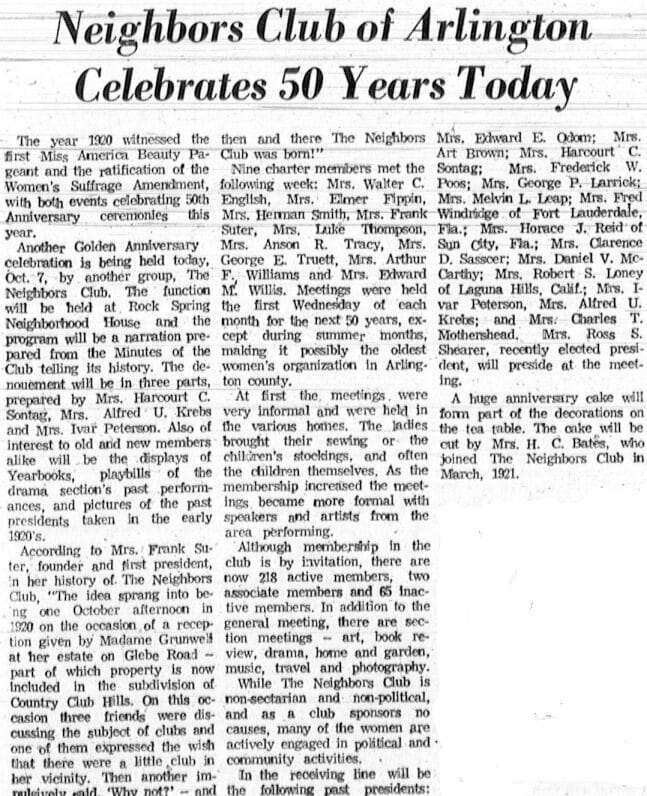
On an October day in 1970, Rock Spring Neighborhood House came alive with history.
It had been a half-century before, in October 1920, that the Neighbors’ Club was founded as a way for women living in neighborhoods around and north of Lee Highway — now Langston Blvd — to share camaraderie.
Membership initially was drawn from the neighborhoods of Country Club Grove, Country Club Hills, Golf Club Manor, Lee Heights, Livingston Heights and Rock Spring. A 1947 article about the club noted that, in the 1920s, “bad roads and a lack of transportation” for residents of those communities previously had “made a social gathering of any kind” difficult.
At the time of the club’s founding, those communities remained somewhat remote from others in Arlington, but were growing rapidly since World War I — which had recently concluded — resulted in a major expansion of the federal government. New neighborhoods were beginning to sprout in the northern part of the county with some regularity.
The Northern Virginia Sun’s coverage of the 50th-anniversary celebration quoted from the club’s history, written by its first president, “Mrs. Frank Suter.”
(A brief aside: Nearly all the leaders of the organization throughout its formative years appear to have been married, and as was the custom of the time, were referred to in news coverage as “Mrs.” followed by their husbands’ names. Archival materials from the club itself do the same.)
According to Suter:
“The idea [for the club] sprang into being one October afternoon in 1920 on the occasion of a reception given by Madame Grunweld on her estate on Glebe Road, part of which property is now included in the subdivision of Country Club Hills.”
“On this occasion, three friends were discussing the subject of clubs, and one of them expressed the wish that there were a little club in her vicinity. The other impulsively said, ‘Why not?’ — and then and there, the Neighbors’ Club was born.”
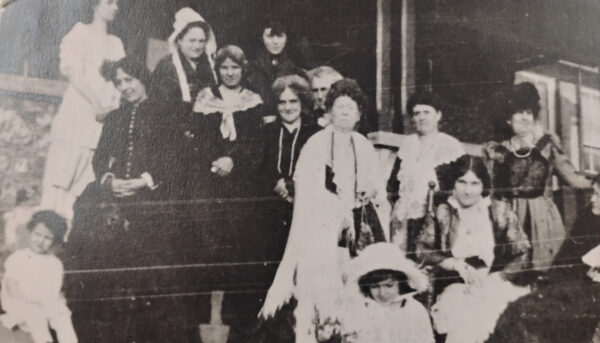
The nine charter members met the following week. In addition to Suter, they included Mrs. Walter English, Mrs. Elmer Fippen, Mrs. Herman Smith, Mrs. Luke Thompson, Mrs. Anson Tracy, Mrs. George Truett, Mrs. Arthur Williams and Mrs. Edward Willis.
Although it appears none of those charter members attended the 50th-anniversary ceremony — if indeed any were still alive — the honor of cutting the large anniversary cake in 1970 was bestowed on Mrs. H.C. Bates. She had joined the club in March 1921, just a few months after its founding.
The anniversary celebration, presided over by President Mrs. Ross Shearer, attracted nearly 20 past presidents, some traveling from as far as Florida and California.
The formative years
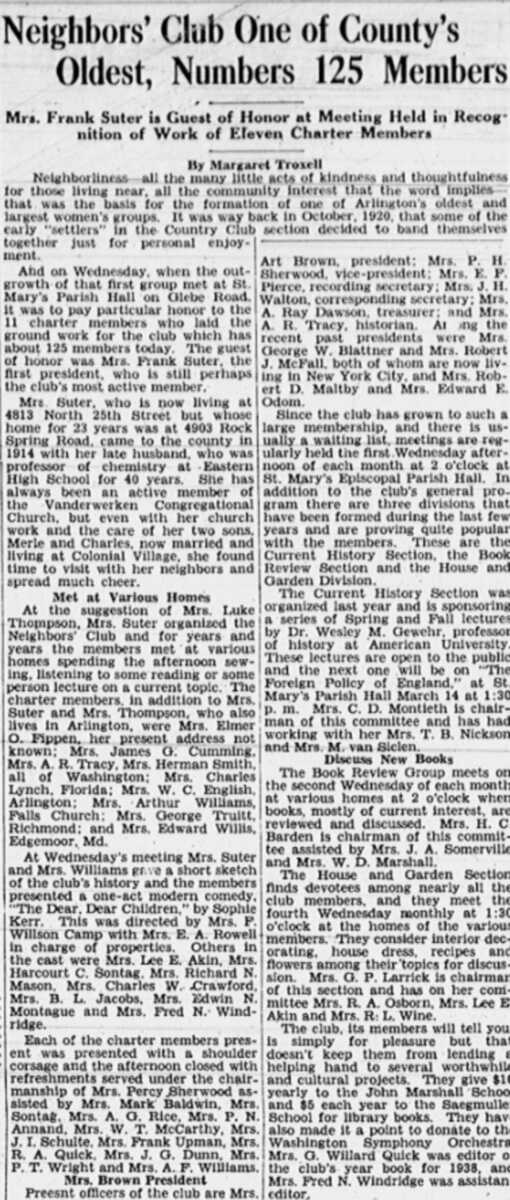
A 1939 article on the club, penned by Margaret Troxell of the Northern Virginia Sun, provided some background on the earliest years and its founding president.
It noted that Mrs. Suter lived at 4903 Rock Spring Road at the club’s founding, having come to the county with her husband in 1914.
Frank Suter was a longtime chemistry teacher at Eastern High School in D.C., while Mrs. Suter focused on raising their sons and supporting her church, Vanderwerken Congregational.
The club initially met at members’ homes before finding a semi-permanent gathering place at St. Mary’s Episcopal Church.
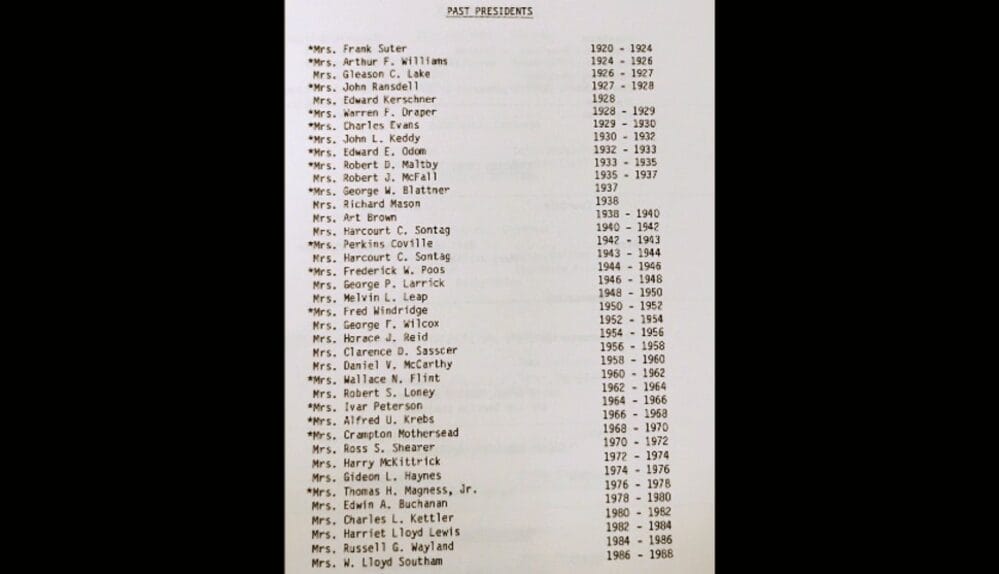
Mrs. Suter served as president from 1920-24 and Mrs. Williams from 1924-26. After that, leadership rotated annually, with the officers’ corps including a president, vice president, recording secretary, corresponding secretary and historian.
Dues in the early times were $1 per year, payable in May. Those who brought guests to luncheons at Washington Golf & Country Club were asked to pay a small stipend — 35 cents in the 1939-40 club year — to cover the costs.
In addition to general membership meetings, the Neighbors’ Club organized several special-interest clubs for members. In the early years, they included a book club, a dramatics club, a current-history club and a home-and-garden club. In the early 1940s, a music section would be added.
By the late 1930s, membership was being limited to no more than two new members per month, to keep the body of a manageable size.
As for the club’s name, there seemed to be little consistency over the decades on where to place the apostrophe — or whether to use one at all.
News articles and even the club’s own documents refer to it variously as the “Neighbors’ Club,” the “Neighbor’s Club” and the “Neighbors Club.” The first of those is the one most frequently used.
A little more on Mrs. Suter
A perusal of Family Search online provided more information on the life of Mrs. Frank Suter, including the first name that rarely, if ever, was mentioned in media coverage.
Eloise Ophelia Carhart was born on Oct. 29, 1871, in Brooklyn, N.Y., the daughter of Lyman Carhart and Ophelia Merle D’Aubigne. She married Frank Suter in 1904.
Eloise Suter died in 1960 at age 89 and is buried in Columbia Gardens Cemetery in Arlington.
In a 2002 article in the Arlington Historical Magazine, her son Charles noted that their home on Rock Spring Road was dubbed “Sunnyside” by his mother.
“I don’t recall it ever being called ‘a farm,’ but certainly our place was a small farm,” Charles Suter wrote. “The barn had a box stall for our horse, Prince, space to store the carriage and stalls for three cows.”
“We also raised vegetables for our family use and for sale,” he recalled. “Our best customer was Washington Golf & Country Club. One of my chores was to pick raspberries and strawberries. We raised potatoes, watermelons, squash, beets, carrots, string beans, lima beans and okra. We raised 10 or 15 chickens.”
As for the establishment of the Neighbors’ Club?
“Several of the housewives in our area got a little bored not seeing people other than their own families,” Charles Suter wrote in his remembrances.
“It was considered an honor for a lady to be invited to join and prestigious to be a member,” he wrote, but noted that it wasn’t everyone’s cup of tea.
“My wife and sister-in-law were members for years, but when the club got to be very upscale … both dropped out,” Suter wrote.
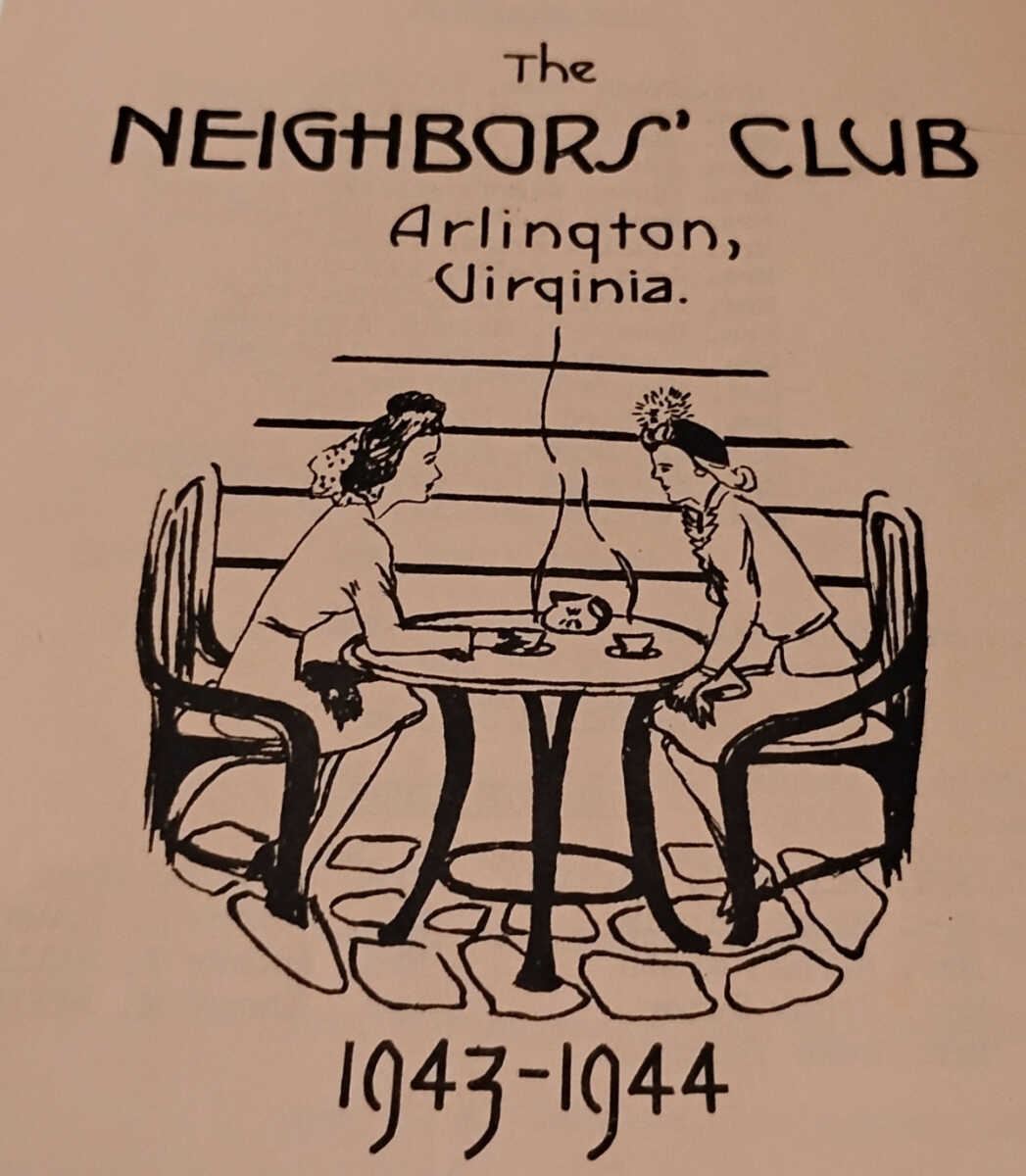
The heyday of women’s clubs
The 1930s-40s may have been the high point for membership in women’s groups across Arlington.
On May 8, 1937, much of the front page of the Commonwealth Monitor newspaper was given over to their activities.
In addition to coverage of the Neighbors’ Club, then under the presidency of Mrs. George Blattner, there were articles on groups including the Women’s Club of Arlington, the Arlington Hospital Auxiliary and the Ashton Heights Women’s Club.
The same edition of that newspaper noted the appearance of Postmaster General James Farley to help lay the cornerstone of the new Arlington post office, constructed in Clarendon for $150,000.
The ceremony was followed by a community parade and then a banquet at Army Navy Country Club.
Keeping up on world events
The club’s current-events group met frequently. In February 1937, members heard about ongoing national labor disputes, and in December of that year, Dr. Wesley Gewehr of American University discussed the situation in Germany and Italy.
Professor Gewehr appears to have been a popular speaker among group members. In November 1938 he returned to discuss “The Situation in Palestine.” In February 1940, he presented “The Balkan Area,” a talk that was open to the public for a small admission fee.
In March 1938, club members heard about “Russia Today.”
Club members also presented programs. In January 1940, Mrs. Walter Laudermilk discussed her recent 18-month travels to Europe and North Africa.
Even during the war years, it wasn’t all seriousness. In October 1942, the club held a Halloween party. And attention was paid to technological advances; in January 1946, the Arlington Daily reported that about 75 members gathered at St. Mary’s for “a very interesting talk” on the Kodachrome film process.
The phrase “interesting meeting” cropped up in many Arlington Daily snippets about the club’s activities. In January 1947, the paper reported on a “most interesting meeting” related to federal meat inspection.
Theater takes center stage
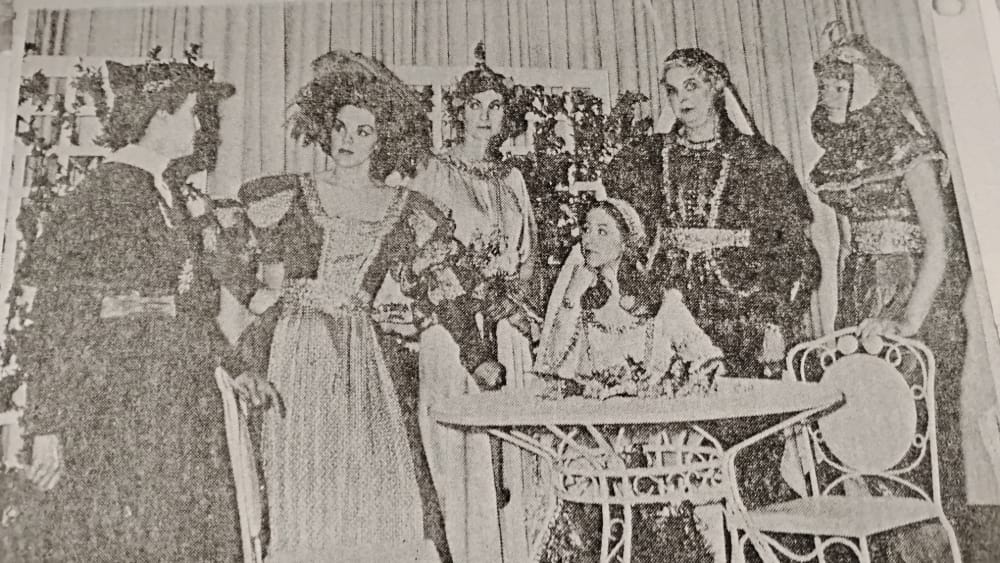
Club members frequently put on theatrical performances, according to news coverage of the era.
In September 1940, the Sun reported that Mrs. Edmund Campbell — also known in local history as Elizabeth Campbell — hosted a gathering of club thespians preparing to stage the one-act play “Beauty for Sale.”
For guest night, held in March 1941, club members presented “Pearls,” directed by Mrs. Wilson Kemp, and “Over the Tea Cups,” directed by Mrs. Frank Wilkerson.
In February 1944, the club’s annual guest night featured two shows, including the skit “The Painless Dentist” and Gilbert & Sullivan’s “Trial by Jury.” The coverage noted that, at intermission, guests would be treated to “an acrobatic dance by Mollie Brown.”
A pair of one-act shows was also on the bill for the 1946 guest night, held in March at St. Mary’s Episcopal. The Sun recorded that the shows “Low Bridge” and “Murder at the DeSoto” would be presented, with Mrs. Herbert Sontag directing.
In March 1947 coverage, the Arlington Daily noted the club’s annual guest night would feature two plays: “An Evening by the Radio,” written by club member Mrs. Harcourt Sontag, and “Some Women are Talking” by John Kilpatrick.
“The cast for both is composed of club members who have been rehearsing for weeks,” coverage noted.
In 1958, club members presented “Egad, What a Cad!” at the Rock Spring Neighborhood House.
For the younger crowd
The Neighbors’ Club also had an affiliate for younger, unmarried local residents, known as the Young Neighbors’ Club.
In January 1945, Winifred Munson was elected president, with Ann Davis as vice president and Walter Stephan as secretary/treasurer. Induction ceremonies were held at Rock Spring Congregational.
Similar name but no relation
An article in the May 15, 1945, edition of the Columbia News noted that there was another Arlington group with “Neighbors” in its title.
The Good Neighbors Club was based in what was then known as Nauck and has since returned to its original name, Green Valley. It supported residents in that neighborhood, one of the few where Black residents lived in Arlington during Virginia’s rigidly enforced era of housing segregation.
According to the news article, the Good Neighbors Club was “a strong supplementary force in the county’s welfare organization.”
Post-war growth
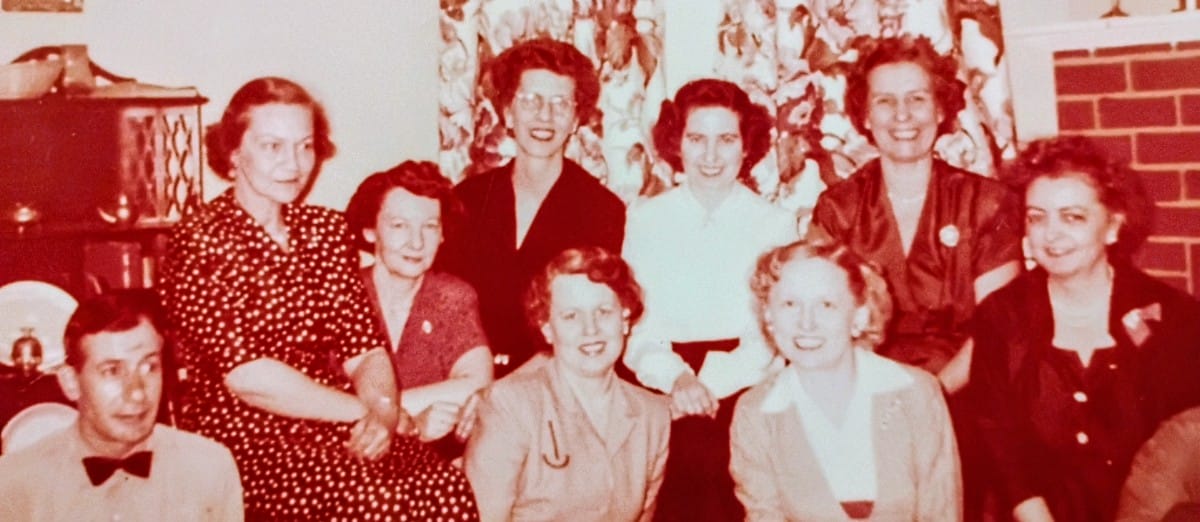
Having been born in part out of growth related to World War I, the Neighbors’ Club saw a boost in the aftermath of World War II.
The club’s 25th anniversary drew about 90 members to St. Mary’s Parish Hall on Oct. 9, 1945.
In addition to celebrations, there was a discussion of how to use funds raised in the Community War Fund Drive, and a talk by a representative of the Czechoslovakian Embassy.
Three charter members — Suter, English and Williams — were in attendance.
Turning 30 in 1950
In 1950, the Washington Star reported on the Neighbors’ Club’s planned 30th-anniversary festivities, and gave an update on its progress in the post-World War II era.
“Today, the club has a membership of 180, and it probably would be much larger if all applicants were accepted,” the coverage noted, continuing:
“For fear that it might lose its character as a neighborhood group, however, it was decided several years ago to limit the addition of new members to women living in the area bounded by the Fairfax County line, N. Florida Street, Lee Highway and Military Road.”
“The congeniality of the group is maintained further by the requirement that new applicants be sponsored by three members,” the news article noted.
In its 30th year, the club temporarily relocated from St. Mary’s Church to Spring Spring Congregational Church while St. Mary’s was undergoing renovation.
Club’s status in 1955
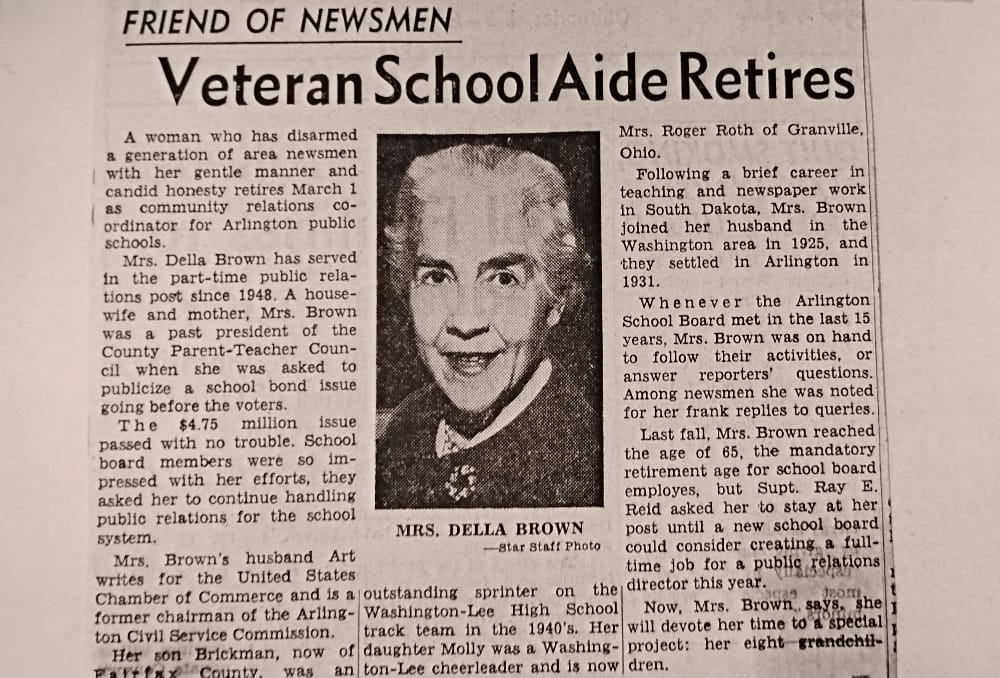
As its 35th anniversary approached, Della Brown, who had served as president in 1940, penned a retrospective on the club’s history.
Brown had begun her career in the news business, and beginning in 1948 became the “community-relation coordinator” for Arlington Public Schools.
She held the post until 1964. Upon her retirement, several daily newspapers profiled her career, with the Washington Star noting that “among newsmen, she was known for her frank replies to queries.”
Perhaps because the articles referenced her professional career, they used her given name — Della — rather than the more formal “Mrs. Art Brown.”
In her 1955 retrospective, Brown noted that it “used to be very easy to get in” to the Neighbors’ Club.
“One member could recommend half a dozen friends in a year if she cared to,” she said.
Despite changing membership rules, “it was a wonderful place to meet old friends and make new ones,” Brown said.
The 1960s arrive
The Neighbors’ Club boasted a membership of about 275 in 1963, including associate members.
A year later, to mark the 400th birth of William Shakespeare, club members performed “When Shakespeare’s Ladies Meet,” written for them by Charles George.
By the time of the 50th anniversary in 1970, the club had nearly 300 active, inactive and associate members. After years of using street addresses to determine membership eligibility, the club eventually decided that the boundaries should match the 22207 ZIP code.
As the 50th anniversary arrived, the Northern Virginia Sun’s editorial page honored the club and its leaders for their efforts through the years.
Flash forward to the 1980s and beyond
The Neighbors’ Club continued strong for years after its 50th anniversary.
In 1988, the club brought in six new members and marked the addition of a travel group within its ranks.
In the club’s 1988-89 yearbook, it reaffirmed that it was “nonsectarian and nonpolitical, and as a club sponsors no causes.” Instead, the goal was to “bring together a congenial group of women in this locality for the purpose of enjoying their mutual interests and developing their talents in a harmonious atmosphere.”
Archives of the club, which were donated to the Charlies Clark Center for Local History, run through the early 21st century.
In December 2002, the club presented the Cantabile Flute Trio, continuing its tradition of supporting the arts.
Keeping history alive
In November 2012, former Neighbors’ Club president Mary Henderson donated much of the club’s archives to the Charlie Clark Center for Local History at Arlington Central Library.
The records, contained in eight archival boxes, span the period 1920-2009. While not complete, they provide ample assistance to researchers investigating the club’s history and impact.
Materials consist of yearbooks, minutes, budgets, annual reports, club histories, membership files, newsletters, correspondence, clippings, scrapbooks and loose photographs.
The holdings also include a number of original scrapbooks compiled by club members, which showed that members “took part in a wide variety of activities including trips to museums and government facilities, French and art lessons, musical programs and other cultural events,” according to library officials.
“Annual events pictured in scrapbooks include the May Book Luncheon, often with well-known figures such as Jim Lehrer and the June Garden Party and Art Exhibit,” archival staff noted. “Elaborate table decorations with artfully arranged flowers and refreshments suited to holidays such as Christmas and Easter are a regular feature of the monthly meetings.”
The library system also holds the archives of several similar women’s groups, including the Women’s Club of Waycroft, spanning 1960-89, and the Williamsburg Women’s Club.
Thanks to the Charlie Clark Center for Local History and the Virginia Chronicle initiative of the Library of Virginia for assistance with research.