

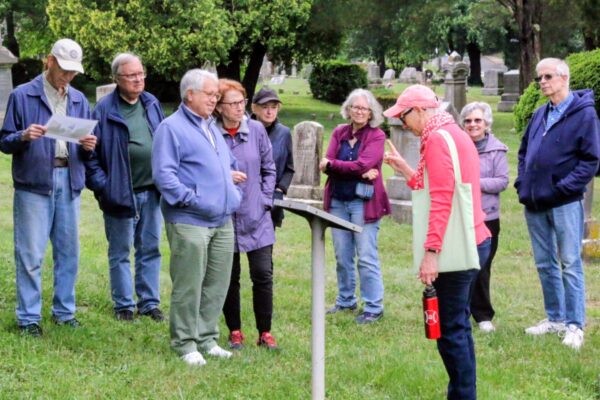
A dozen hardy souls braved the threat of thunderstorms and hordes of gnats on May 24 to learn more about the history of a local burial ground.
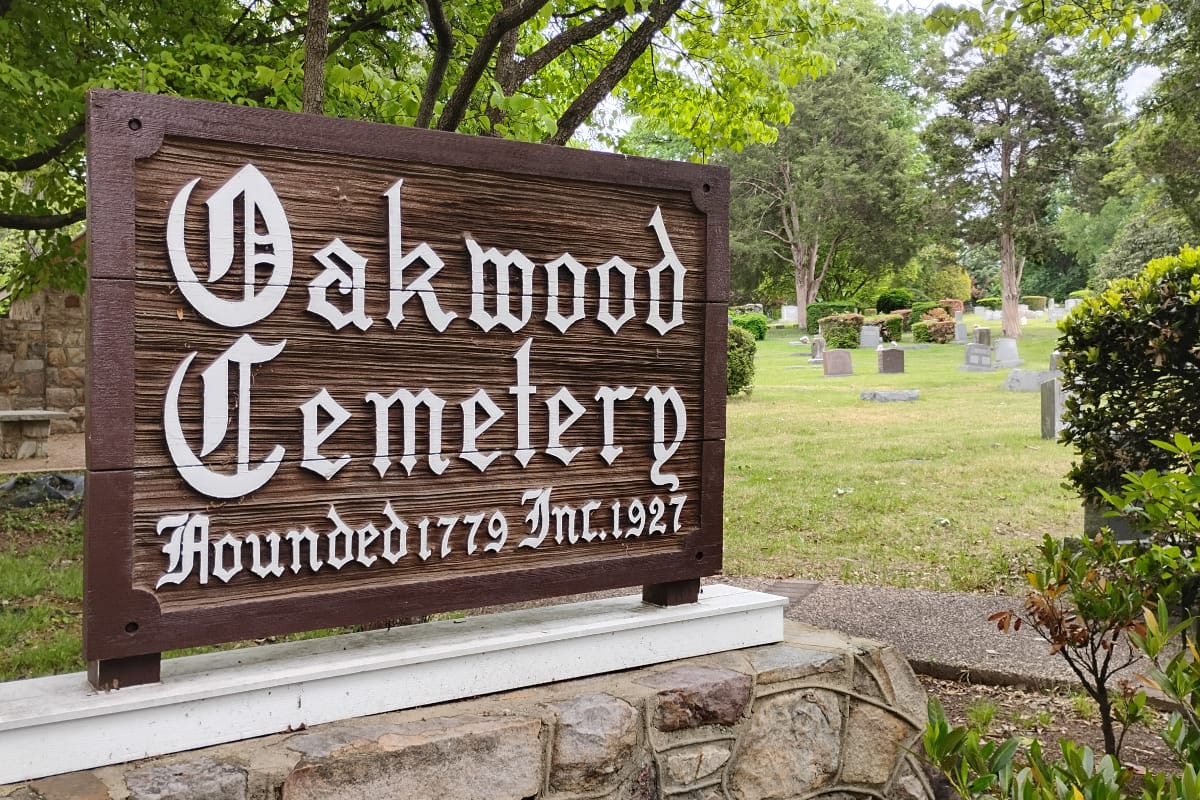
The 90-minute tour covered nearly 250 years of history at Oakwood Cemetery, located in Falls Church. It was the first of what will be monthly tours, part of the city’s celebration of the nation’s 250th birthday.
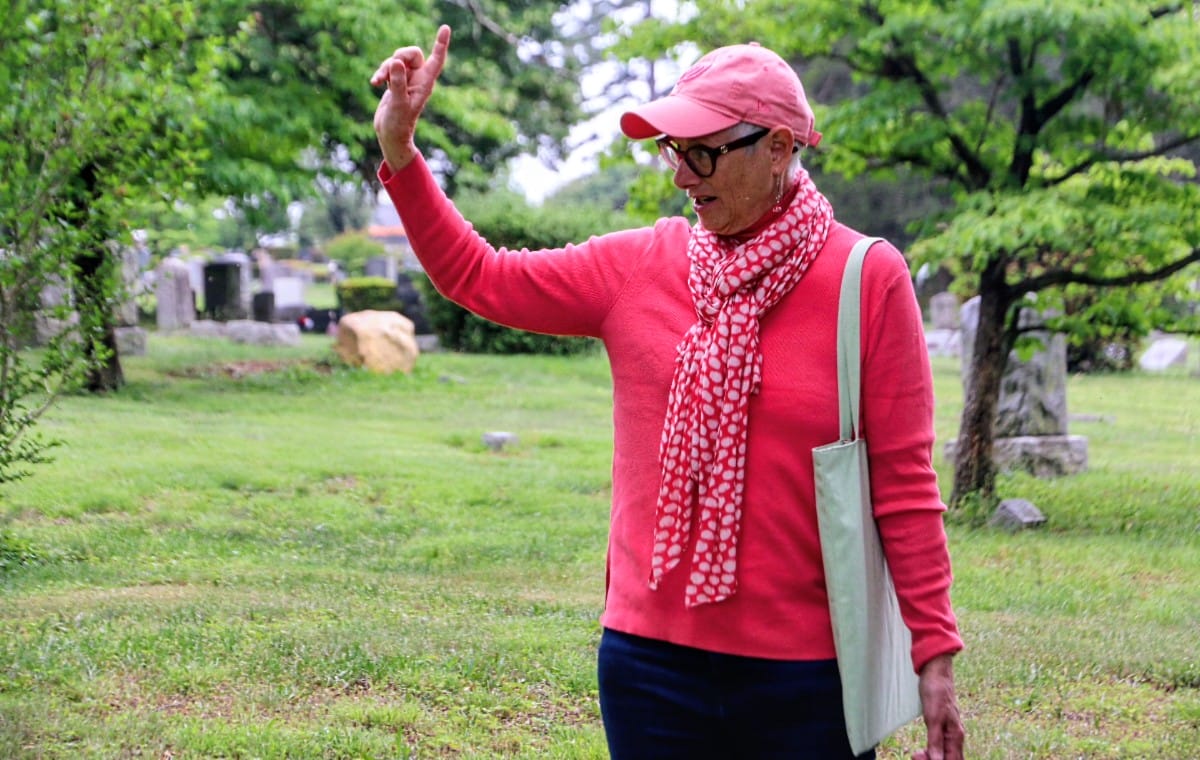
“I love cemeteries,” said Carol Ann Siciliano, a member of the Oakwood board of directors and the creator of a new website focused on its history.
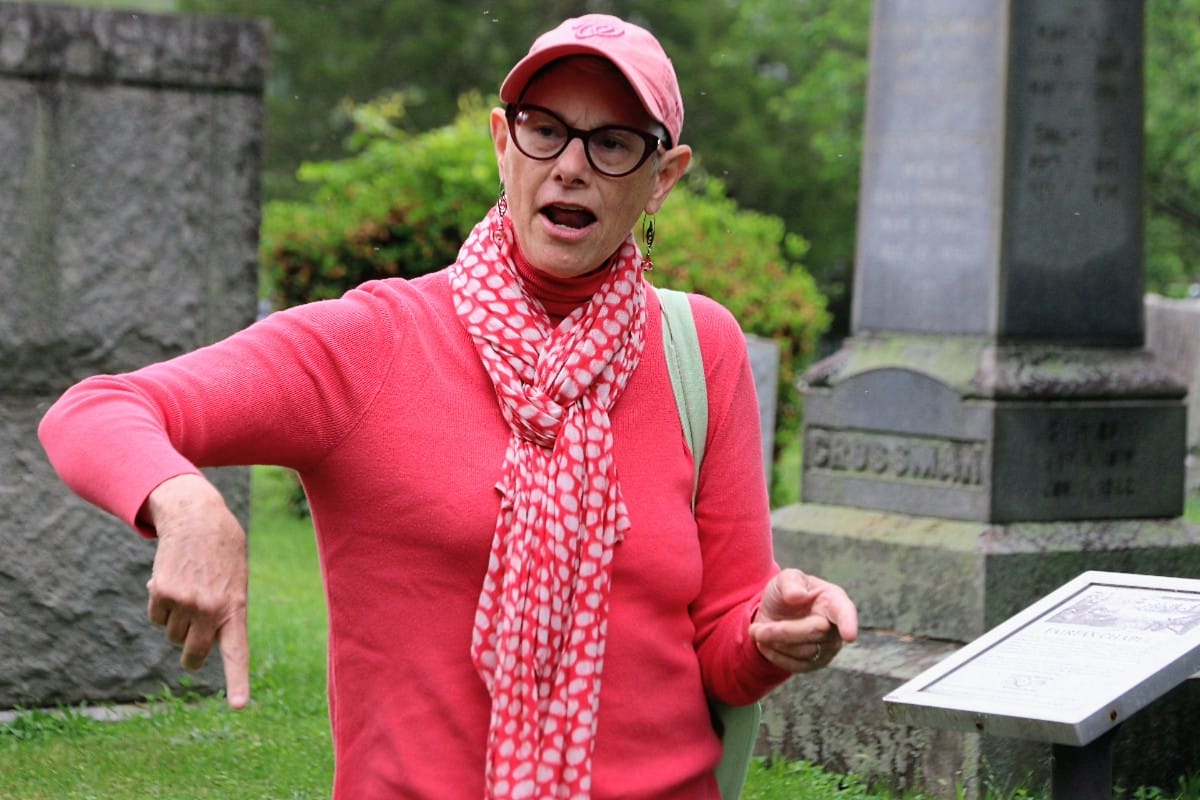
She led the group across the cemetery grounds, stopping to relate historic anecdotes along the way.
Burials in the area began in the late 1770s, when the site was home to Fairfax Chapel, the first Methodist church in Northern Virginia.
The original wooden church burned in 1819 and was replaced by a brick one measuring 60 feet long by 40 feet wide and rising 20 feet high.
In 1862, Union soldiers dismantled the church to provide construction materials for Fort Taylor and Fort Buffalo nearby.
For the same reason, they also removed nearly all the headstones placed over the preceding 80 years. Just one remains — that of Samuel Hyson, which peeks out of the grounds near where others are believed to have been interred.
In 1882, five Protestant churches serving white congregations banded together to formally create Oakwood Cemetery. The partners in the endeavor were the Falls Church (Episcopal), Dulin United Methodist, Falls Church Presbyterian, Christ Crossman United Methodist and Columbia Baptist.
During that era, most Catholic residents of the area were buried at St. James Church, and most Black residents were interred at Galloway United Methodist Church. Today, Oakwood “welcomes people of all religions, or no religion at all,” Siciliano said.
Oakwood was incorporated in the 1920s. Like all Virginia cemeteries, operations are regulated by the Code of Virginia.
A longtime attorney and administrator with the Environmental Protection Agency, Siciliano joyfully proclaims herself a “taphophile” — an enthusiast of all things related to cemeteries and graveyards.
She told tour participants there is a difference in the types of burial grounds: A graveyard contains final resting places on the grounds of a church, while a cemetery is an independent entity that may or may not be connected to one.
Both burial spaces and niches on columbariums remain available for purchase at Oakwood. “It is very much a ‘living cemetery,'” Siciliano said.
One of the most intriguing stops on the tour was at the burial place of Mary Edwards Pultz Riley (1843-1927).
As a teen, she was arrested by Union forces and charged with being a spy for the Confederacy — a crime for which the penalty could have been hanging.
Known as Mollie, she was paroled after spending 12 days incarcerated in the notorious Old Capitol Prison after agreeing to swear an oath of allegiance to the United States. During her brief stay, she befriended another Confederate spy, Belle Boyd.
After the war, Mollie married Joseph Riley and settled with him in Falls Church. They and their growing family lived at Cherry Hill Farm, today a historic site owned by the city government.
One of Mollie’s children, Mary Riley Styles, became a prominent advocate for education and literacy, and is the namesake of the city’s library. Her grave is among many of the Riley family found at the cemetery.
Although not buried at Oakwood, Harry Hosier also played a role there.
Hosier (c.1750-1806) was never ordained a minister, but was one of the most prominent Methodist preachers of his time. His appearance at Fairfax Chapel in 1781 reportedly marks the first time in the U.S. when a Black man preached in front of a predominantly white audience.
Hosier preached a sermon called “The Barren Fig Tree,” drawing from the Bible’s Gospel of Luke. Benjamin Rush, a signer of the Declaration of Independence, declared it to be the greatest sermon he had ever witnessed.
Not all of the cemetery’s stories are so uplifting.
Oakwood marks the final resting place of Bazil and Elizabeth Hall, two of the most notorious slaveowners in Arlington’s history.
Elizabeth Hall’s treatment of those the couple enslaved was so notorious that, in 1857, she was burned to death by one of them, Jenny Farr. Farr was convicted of murder and hanged, with her five young sons left in possession of Bazil Hall.
Even after emancipation came to Virginia in 1864, Hall continued to treat the youths as his property, and eventually was convicted by a military judge of cruelty in connection with his treatment of them. Ultimately, President Andrew Johnson ordered the military to turn the case over to civilian courts, where charges were dropped.
This Saturday, May 30 at 10 a.m., the Memorializing the Enslaved in Arlington project will unveil “stumbling stones” honoring Jenny Farr and family members.
Two stones from the brick Fairfax Chapel, along with the Hyson headstone, are all that remain from pre-Civil War times on Oakwood’s grounds. Siciliano said cemetery leaders are hopeful of embarking on archeological studies that might shed more light on the earliest part of its history.
Most monthly tours have been fully booked through the end of the year, but individuals can inquire about openings, or be put on the mailing list for future information, by emailing Siciliano.
