

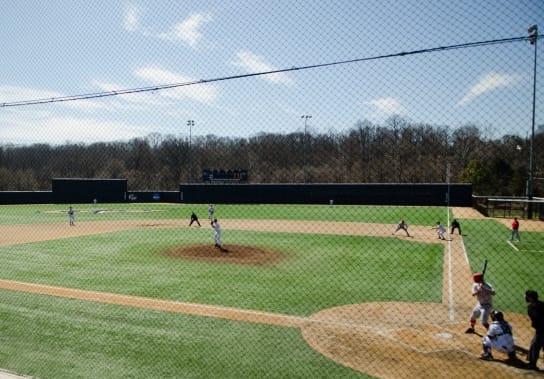
Arlington County parks officials plan to renew efforts to determine how often sports leagues actually end up using the fields that they reserve in advance.
The initiative has been ongoing for nearly two years but remains “a work in progress,” said Ignacio Rodriguez, manager of sports leagues and athletic-field management for the Department of Parks and Recreation.
Sports leagues have the ability to reserve field space in advance through a permitting process. But when the scheduled time arrives, “that [permit] information isn’t necessarily 100% accurate,” Rodriguez told members of the Sports Commission at its Jan. 22 meeting.
A pilot program working with sports leagues was launched in the spring of 2024. Leagues were asked to have representatives use QR codes on signage at parks to show activity was taking place — but “we had a lot of issues” with that plan, Rodriguez said.
“We struggled with the response rate,” he said, adding that sometimes signage was removed or defaced, making the QR codes unusable.
New approaches will be tried for the upcoming spring season.
The county government operates 96 athletic fields. Partner sports leagues have priority for scheduling on many of them; when leagues are not using them, they are open for drop-in play.
The Jan. 22 meeting also looked at parks and recreation’s process for determining when fields are playable and when they are out of service.
Decisions are based on the type of field and conditions, such as inclement weather. During the winter months, most natural-turf fields are unavailable, but fields with synthetic turf are available unless weather conditions dictate otherwise.
Sports Commission members had praise for the county government’s efforts to include local sports leagues in the evaluation process.
“The county’s very nice to talk with some of the people who are involved in the sports leagues to see whether they’ve been out to look at fields, to provide a little bit of information,” said commission chair Elizabeth Stell.
That input can be vital, vice chair Hamilton Humes said. County staff “can’t be everywhere” to evaluate conditions, he said.
As a result, “sometimes they say there are fields that are open that should not be,” Humes added.
Stell pressed for a more individualized approach to decision-making, which she said often happens for baseball/softball facilities but not for the county’s other fields.
When it comes to rectangular fields used for soccer, lacrosse and other sports, the decision often is that “all or none” are open, she said.
“That has caused us some difficulty,” Stell said.
Rodriguez acknowledged decisions could lead to “contentious” responses from local leagues.
Currently, those who have booked fields can call a government phone line to hear a recorded message listing closures. Residents also can sign up to receive text or email alerts related to closures.
At the Jan. 22 meeting, there was a request for an online option.
Adam Rasmussen, a liaison to the Sports Commission from the Park and Recreation Commission, said other local jurisdictions have made that transition.
“Montgomery County is a good example of that,” Rasmussen said. “They have a website that shows individual field status.”
