

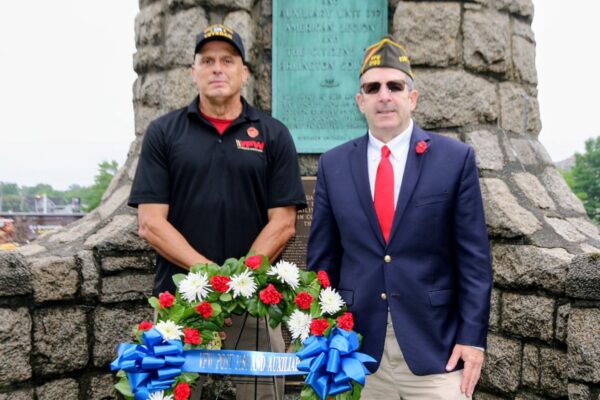
The new commander of an Arlington Veterans of Foreign Wars (VFW) post wants to maintain what is working well while expanding the organization’s footprint in broader civic life.
During a Memorial Day open house, Fritz Gottschalk succeeded Mike Cantwell as commander of John Lyon VFW Post 3150.
“What I really want to do is build on the momentum Mike has put in place, and have more of a presence in the community,” Gottschalk told ARLnow.
A 25-year U.S. Army veteran, Gottschalk served as senior vice commander during Cantwell’s year as commander.
One of Gottschalk’s goals is to reach out to universities in the county and region, connecting with organizations at those institutions that serve military veterans.
“We want to make sure they are fully supported,” he said.
In remarks at the Memorial Day ceremony at the Clarendon War Memorial, Cantwell said VFW members “lead a life of purpose, of giving back to the community.”
Cantwell encouraged both prospective members and the public to visit the post. “We do a lot of great things,” he said.
The John Lyon VFW post was founded in 1934. It was named in honor of U.S. Army 1st Lt. John Lyon, a member of a prominent Arlington family who was among three soldiers killed in action in France on Oct. 15, 1918 while serving with the 116th Infantry of the Army’s 29th Division.
For his heroism in attempting the rescue of a wounded officer, Lyon was posthumously awarded the Distinguished Service Cross.
Lyon is buried in a family plot in Petersburg, but a memorial stands in Cherrydale. As with the Clarendon War Memorial, the VFW post holds a commemorative ceremony each Memorial Day and Veterans Day at the Cherrydale site.
There, the names of Lyon and four other Cherrydale residents who died during World War I military service are remembered on a commemorative tablet.
Three years before his death, and two years before the U.S. entry into World War I, Lyon had volunteered to serve as a Red Cross ambulance driver in Belgium.
It was there, in a 1915 letter back home, he expressed the futility of war in describing conditions of the men who had been injured and transported to an aid station.
“All is grim, and the poor wrecks who tumbled in or straggled down the gutted roads have no story to tell,” Lyon wrote. “They sing no songs and bring no captured banners back. They have seen war and know what it is like, so they do not smile anymore.”
