

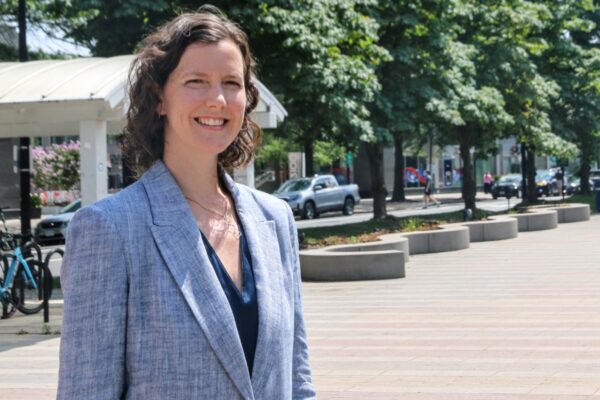
The Clarendon Alliance’s new executive director plans to spend the coming months learning about the neighborhood.
“I’m on a listening tour,” Galin Brooks told ARLnow. “I want to understand what the priorities are, the challenges and the opportunities.”
Brooks most recently served as president/CEO of the Rochester Downtown Development Corporation in New York. She held the post for four years, with a focus on bringing in new funding and launching signature programming.
“I really love place-based corridor work,” she said. “Clarendon is like the main street of Arlington — a special market to be part of.”
Brooks said she plans to spend about three months working to “learn, absorb and listen” before proposing any significant new initiatives.
The end of that 90-day period will coincide with Clarendon Day, the Alliance’s most significant annual event. It is slated to take place Saturday, Sept. 26.
To understand the role of the Clarendon Alliance, it’s helpful to look at the neighborhood’s history. By 1900, Clarendon existed as a semi-autonomous town within what was then known as Alexandria County, but later lost that distinction when the Virginia Supreme Court ruled no towns could exist within the county.
Throughout the 20th century, the Clarendon neighborhood saw cycles of boom and bust. At one time it was among the most important retail centers of the D.C. region, and in the 1970s became home to shops run by South Vietnamese refugees in what became known as Little Saigon.
Remnants of the earlier eras remain, but the arrival of Metro service in 1979 launched a slow but steady repackaging into an urban corridor anchored by transit service.
The Clarendon Alliance was formed in 1984, during that early Metro period, with a focus on bringing commercial and retail tenants back to the corridor.
The organization is governed by a board of directors composed of representatives from the business community, county government, property owners and civic associations representing Ashton Heights, Clarendon-Courthouse, Lyon Park and Lyon Village.
Casey Nolan, who chairs the board, said Brooks comes equipped with “extensive economic development, placemaking, fundraising and planning expertise.”
“Her track record of building strong organizations, securing investment and activating public spaces makes her exactly the right leader to carry our work forward,” Nolan said.
