

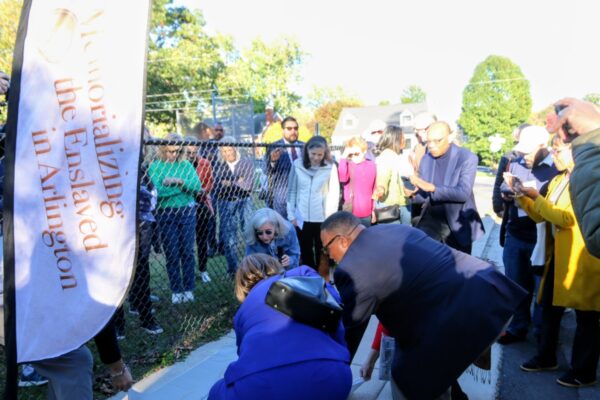
The Leeway Overlee Civic Association marked its centennial on Saturday with the installation of 11 “stumbling stones” honoring people enslaved during the 18th and 19th centuries.
The markers include seven members of the Branson family — Julia, Louis, William, Mary Ann, Horace, James and Frank. They are honored with memorial brass markers on the sidewalk along 24th Street N., behind the community center building and adjacent park.
Additional stumbling stones embedded in neighborhood sidewalks honor Moses Bennett and three people whose last names remain unknown: Fedro, Harry and Mariah. All 11 people were enslaved on farms in the area.
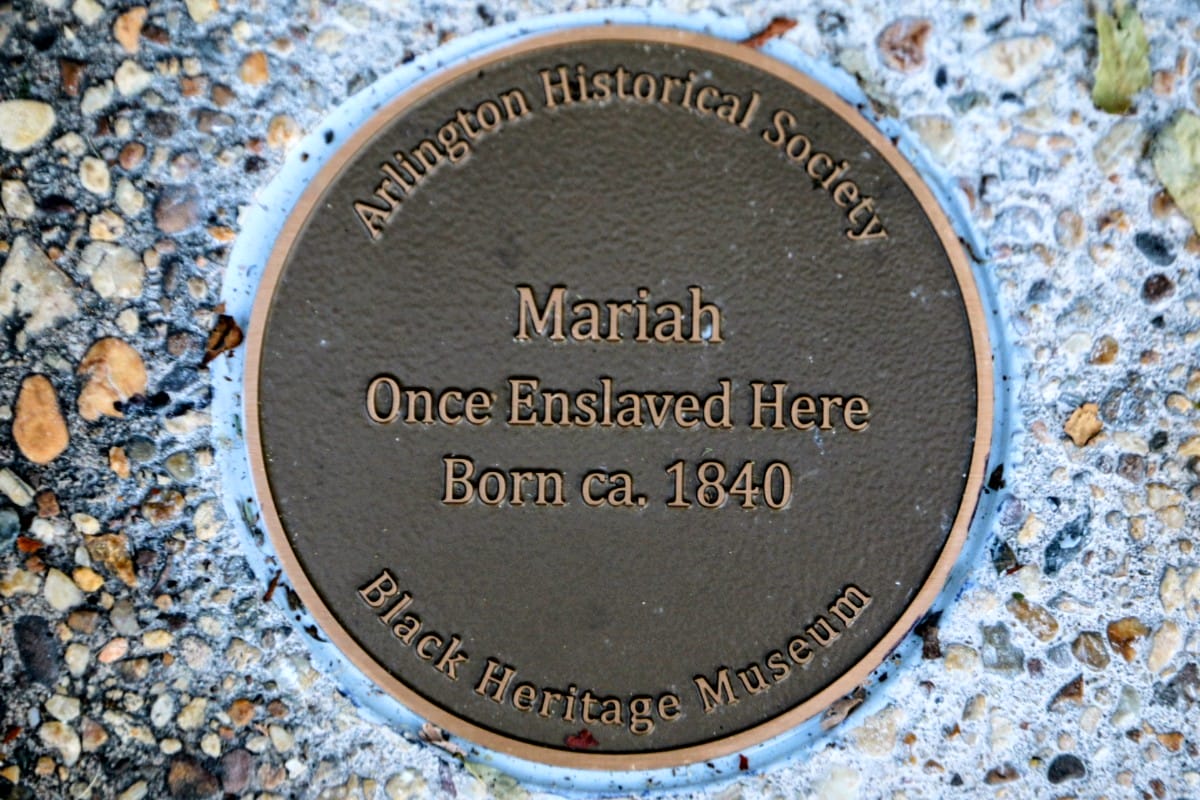
Their stories “were nearly erased” from history, said Tim Aiken, a leader in the Memorializing the Enslaved in Arlington initiative that has uncovered details about more than 2,000 people held in slavery in Arlington from the late 1600s until the Emancipation Proclamation of 1863.
More than 100 stumbling stones have been placed throughout the county in recent years in a joint effort from the Arlington Historical Society and Black Heritage Museum of Arlington.
“When we speak the names of those who were enslaved, we are not just talking about history — we are talking about human beings,” said Craig Syphax, a speaker at the event.
“Do something that matters: remember,” Syphax told audience members. “Their stories deserve to be told and their names deserve to be remembered.”
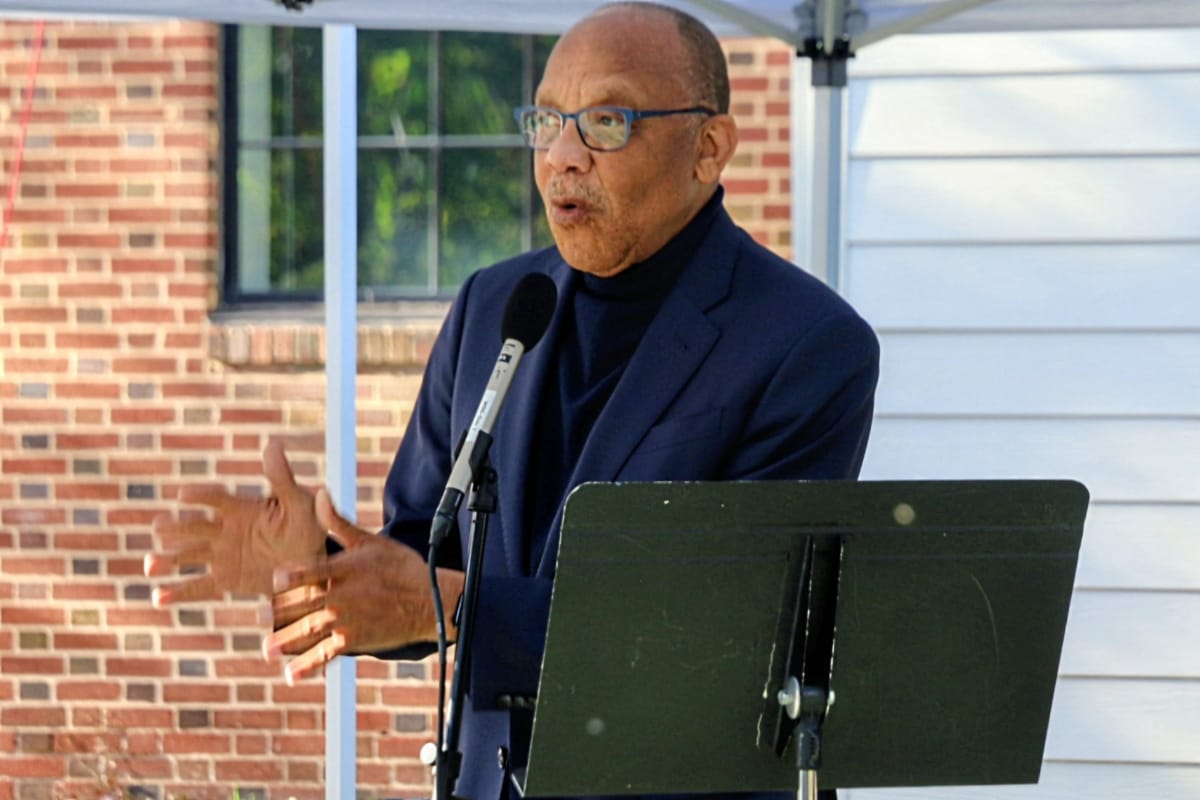
The keynote speaker at the centennial was journalist Eugene Robinson, a Leeway Overlee resident.
Robinson said that efforts like the stumbling-stone ceremonies are needed for communities to acknowledge the past and move forward into the future.
“It’s an act of reclaiming history that enriches our community,” Robinson said, noting that “there’s no American history without African-American history.”
Robinson recently authored “Freedom Lost, Freedom Won: A Personal History of America.” It tells the story of his family beginning with his great-great-grandfather, Harry, who was enslaved in Charleston, S.C.
For his family and the broader Black community, progress has been measured “three steps forward, two steps back; three steps forward, four steps back,” Robinson said.
Progress is “a product of generations of hard work,” he said. “That’s not fair, but it had to be done.”
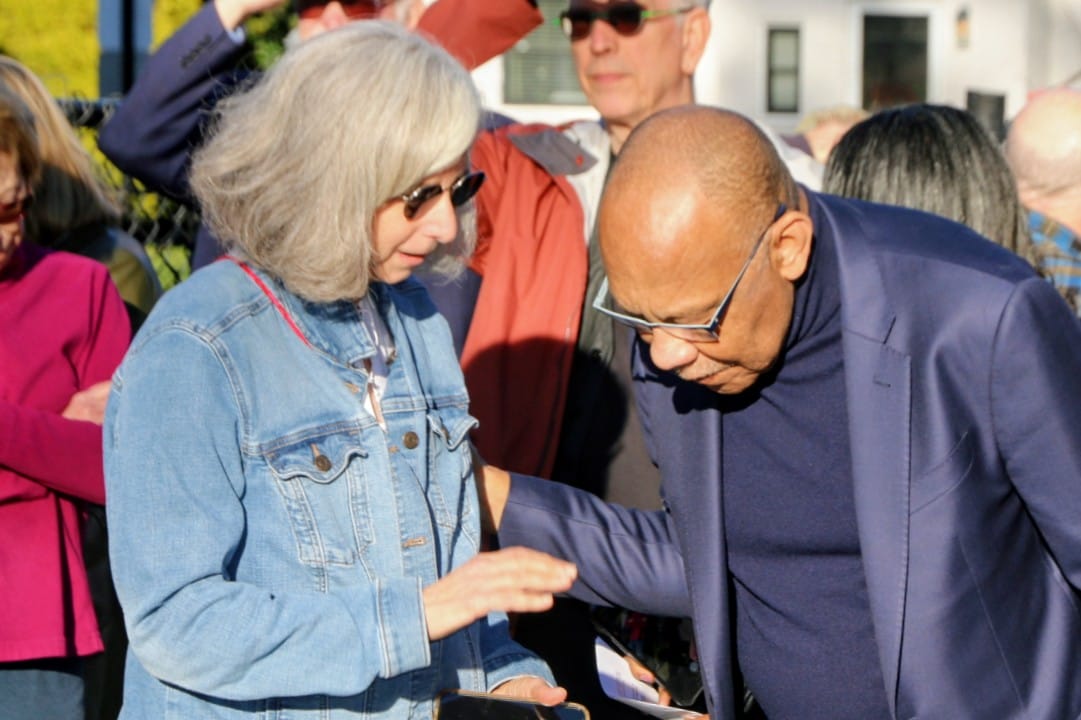
“A part of our struggle is reclaiming our history,” said Robinson, whose father was born in deeply segregated southern Georgia in 1916 but lived to see Barack Obama’s election as president in 2008.
The 90-minute centennial celebration was held behind what most recently was known as the Lee Arts Center. It is shuttered as county officials try to find an appropriate use for it and how to prioritize the needed renovation funding.
At the Oct. 24 event, County Board member Julius “JD” Spain, Sr., said he would press county leaders to support the neighborhood’s wishes for the building’s future.
From its opening in 1925 until 1971, the building was home to Robert E. Lee Elementary School. It was designed by Percy Crowley Adams, architect of the original Washington-Lee High School building and the Rixey Mansion at Marymount University. Adams also designed the Longworth House Office Building.
In 1972, the building became a community center and later added a senior-center component. In 2020, it was closed except for arts programming, which moved out in 2025.
One possibility floated at the Oct. 24 event was using a portion of the building as a permanent home for the Black Heritage Museum of Arlington, which currently occupies a leased space in a storefront on Columbia Pike.
Were that to happen, it would be a homecoming of sorts for Scott Taylor, who heads the Black Heritage Museum. As a child in the mid-1960s, Taylor was bused to what then was Lee Elementary when the formerly all-white school was first integrated.
