

Novara Recovery Center in Fairfax, Virginia provides addiction treatment, PHP, IOP, dual-diagnosis support, and outpatient detox management when appropriate.
Medically reviewed by Dr. Carl Williams, PhD, LCADC
For families in Arlington and nearby Northern Virginia communities, the search for addiction treatment often begins with a practical question: What kind of help is actually appropriate?
The answer isn’t always obvious. A person may be working full time, caring for children or maintaining a household while substance use becomes increasingly difficult to control. Another person may need a more structured level of care because of medical, psychological or safety concerns.
Recent local data show progress in reducing opioid overdose deaths, but they also show why access to treatment remains important.
Northern Virginia’s Opioid Numbers Are Moving in the Right Direction. The Crisis Hasn’t Disappeared.
Arlington County recorded 29 opioid overdoses in 2025, including three fatal overdoses. That was a substantial decline from 53 total opioid overdoses and 10 fatal overdoses in 2024, according to Arlington County’s opioid incident data.
The numbers represent meaningful progress. Arlington’s Addiction Recovery Initiative, or AARI, continues to coordinate prevention, treatment access, harm reduction and overdose-response efforts across the county. Arlington also provides a substance-use resource line to help people connect with treatment, support groups and other services.
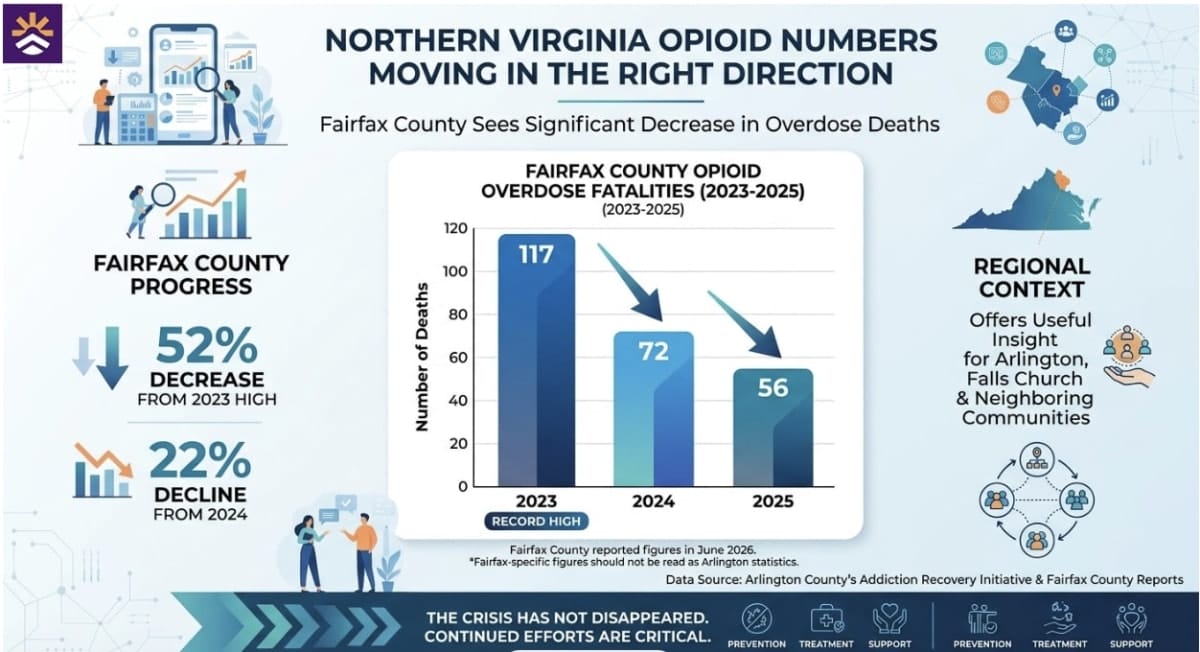
The broader Northern Virginia picture shows a similar direction. In the Fairfax Health District, there were 56 opioid overdose fatalities in 2025, down 22% from 72 in 2024 and 52% from the record high of 117 in 2023. Fairfax County reported the figures in June 2026.
Fairfax-specific figures shouldn’t be read as Arlington statistics. They do, however, provide useful regional context for families in Arlington, Falls Church and neighboring communities who may be comparing treatment options across Northern Virginia.
The Data Behind the Decline
Several factors can influence overdose trends, including wider access to naloxone, treatment services, medications for opioid use disorder, public education and changes in the illicit drug supply. Local prevention and response systems can also make it easier for people to receive help after an overdose or other substance-related crisis.
But overdose statistics capture only one part of substance use. A person doesn’t have to experience an overdose to have a substance use disorder, and someone can struggle for years without entering formal treatment.
Fairfax County’s treatment numbers illustrate the continuing need. More than 2,105 people with opioid use disorder received assessment and treatment services through the Fairfax-Falls Church Community Services Board in fiscal year 2025.
For families trying to decide whether treatment is necessary, the question is therefore broader than whether an overdose has occurred.
Why “Functional” Addiction Is the Hardest to See
Substance use can be difficult to recognize when a person continues meeting visible responsibilities.
A professional may continue showing up for work while drinking or using drugs in private. A parent may continue managing school schedules and household responsibilities while relying increasingly on substances to cope with stress. Someone can appear successful to friends and colleagues while privately experiencing cravings, loss of control or repeated attempts to cut back.