

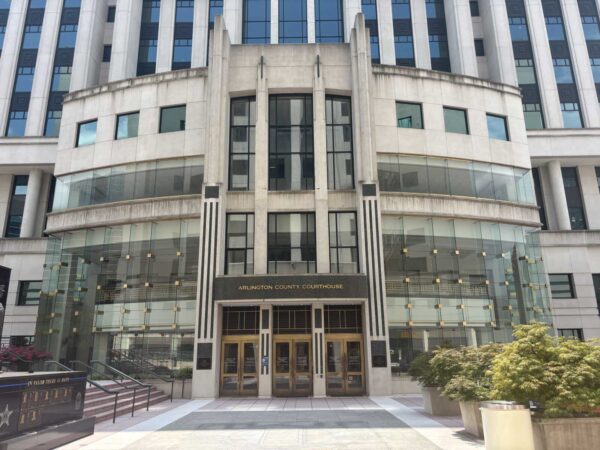
The search and seizure of a cell phone belonging to an Arlington activist has set off a tug-of-war involving Arlington’s top prosecutor and state and federal authorities.
As partial allies in the legal action, seeking to limit an investigation of the phone belonging to 66-year-old retired academic Barbara Wien, are Commonwealth’s Attorney Parisa Dehghani-Tafti and Wien’s attorney, former Chief Public Defender Brad Haywood.
On the other side, seeking an extensive search of possible evidence, are Virginia Attorney General Jason Miyares (R) and federal authorities including the FBI.
Virginia State Police (VSP) took hold of Wien’s mobile device on Oct. 1 following concerns about fliers and other activism around the North Arlington home of Stephen Miller, President Donald Trump’s deputy chief of staff for policy.
Noting a brief confrontation between Wien and Miller’s wife, Katie Miller, as well as the politically charged fliers that listed the Millers’ home address, state law enforcement argued that they had cause to investigate a potential attempt to “coerce, intimidate or harass” the official and his family. They secured a warrant to review a broadly defined range of “relevant evidence” that was “created, modified, or accessed” on Wien’s phone over the past several months.
Since then, Dehghani-Tafti, Haywood and Miyares have all squared off in legal proceedings over whether or not such a search is justified.
Haywood and Dehghani-Tafti — both known for their progressive politics — have said that the FBI and Secret Service were present when VSP seized the device, raising concerns about how federal authorities might use information like messages and contacts on the phone. They argued that the search warrant, as originally approved, could violate Wien’s privacy and provide dangerous political weapons against her and her fellow activists.
“The greatest potential harm in this case is disclosure of the nature of political advocacy, the names and contact information of those participating in it, and statements made to and by allies which could be grounds for unjust political prosecutions,” Haywood wrote in a memorandum seeking to void the warrant. “Once this information is accessed, those who wish to use it nefariously have what they want.”
At the attorneys’ request, Arlington and Falls Church Chief Circuit Court Judge Judith Wheat temporarily ordered police to stop searching Wien’s phone. That prompted a legal response on behalf of VSP from Miyares, as well as a petition on behalf of the FBI to search the phone, Axios reported.
The judge has since re-activated the search warrant, but she has granted a request from Dehghani-Tafti to restrict what parts of Wien’s phone VSP can access — and has forbidden the agency from sharing the information with anyone outside of the Commonwealth’s Attorney’s office. Meanwhile, a magistrate judge in the Eastern District of Virginia has blocked the U.S. Department of Justice’s petition.
As of today (Monday), the cell phone remains in law enforcement’s hands.
Documents in this case were unsealed last month and the story has attracted significant national media attention, scooped by The New York Times last week and since picked up by other outlets.
Why police took the phone
Wien, a former lecturer at the School of International Service at American University, is part of a network of local activists who have been placing pressure on Trump administration officials with ties to Arlington.
“My Showing up for Racial Justice (SURJ) chapter in N. Virginia intends to make [Miller’s] life hell,” Wien texted in a closed messaging group in April, according to a search warrant affidavit. “We have set up a carefully vetted Signal group. Let me know if you are interested in being a part of our campaign.”
The affidavit describes one instance when Wien walked past the Millers’ house while Katie Miller was on the porch. She reportedly pointed at her own eyes and then at Katie Miller’s in an “I’m watching you” gesture.
Additionally, according to the affidavit, fliers with the Millers’ address were distributed around the neighborhood on Sept. 11. They listed numerous political grievances against the White House official, who they accused of being a “Nazi” guilty of “crimes against humanity.”
Protesters returned to the Millers’ home three days later to conduct a sidewalk chalk protest with messages like “hate has no home in Arlington,” “no white nationalism” and “Stephen Miller is destroying democracy,” although this isn’t mentioned in the affidavit.
Activism at the Millers’ house became a talking point for powerful Republican voices in the following days, folding into GOP discourse on the limits of free speech after Charlie Kirk’s assassination on Sept. 10. Katie Miller appeared on Sean Hannity to call the fliers and chalk messages “terroristic threats,” and Vice President JD Vance appeared to reference the same incidents in a podcast episode of “The Charlie Kirk Show.”
The Millers have since moved from their home in Arlington to military housing in D.C.
Noting a Virginia statute that makes it a misdemeanor to intimidate or harass someone by sharing their personal information, VSP approached Dehghani-Tafti’s office and received a search warrant from Judge Wheat on Oct. 1.
The coming days and weeks saw a series of testy and sometimes pointed court filings.
Judge Wheat ordered a stay on the search warrant on Oct. 2, prompting an emergency motion to reconsider from Miyares’ office. Deputy Attorney General Theo Stamos — Arlington’s former commonwealth’s attorney who was defeated by Dehghani-Tafti in the local Democratic primary in 2019 — was one of the authors of the filing, arguing that such a decision lacks legal precedent.
“In evaluating the relevant statutory provisions and caselaw, there is simply no legal mechanism under Virginia law or the United States Constitution to pause the execution of a search warrant once a judicial officer has determined that the search warrant is supported by probable cause,” the motion says.
Dehghani-Tafti, meanwhile, asserted that VSP had omitted essential information when consulting with her office about the search warrant.
While “our office was assured that the investigation was local and the purpose of the search was related to local charges only,” the prosecutor said that the Secret Service and FBI accompanied state authorities in serving the warrant. She added that VSP had said they only “intended to review communications on the phone and not the entire contents of the phone.”
Additionally, Dehghani-Tafti bristled at Miyares weighing in on the case at all, arguing that his office lacks standing and presented “meritless and irrelevant” claims.
“The break-things-and-ask-questions-later approach of the [Office of the Attorney General] puts the rule of law in jeopardy: once downloaded, the contents of Ms. Wien’s phone are no longer private,” the commonwealth’s attorney wrote on Oct. 9. “An over-reaching government entity can easily probe her entire life for the purpose of obtaining information that would infringe on her constitutional rights and those of her friends and contacts.”
Dehghani-Tafti requested to modify the search warrant to allow VSP — and only VSP — to review only the Signal, email and text conversations referenced in the search warrant affidavit. Haywood, meanwhile, sought to quash it entirely.
Wheat sided with Dehghani-Tafti in an Oct. 10 ruling, forbidding VSP from sharing data from Wien’s phone with any agency other than the Commonwealth’s Attorney’s office without Dehghani-Tafti’s permission.
The tug-of-war continues
More than a month after VSP seized Wien’s cell phone, agencies are still fighting over who can access its contents.
The FBI has petitioned for a warrant to search the phone. U.S. Magistrate Judge Lindsey Vaala denied the agency’s request last week, but the Justice Department plans to appeal, according to Axios.
Meanwhile, Haywood told ARLnow that a judge ordered Wien’s cell phone returned on Thursday. However, the 66-year-old — who still has not been charged with any crime — is still waiting to get it back.
“I don’t think this is over,” Haywood said. “Which is unsettling, to say the least.”
