


The two newest “stumbling stones” memorializing people enslaved in Arlington are located near a historic cemetery where the honorees are laid to rest.
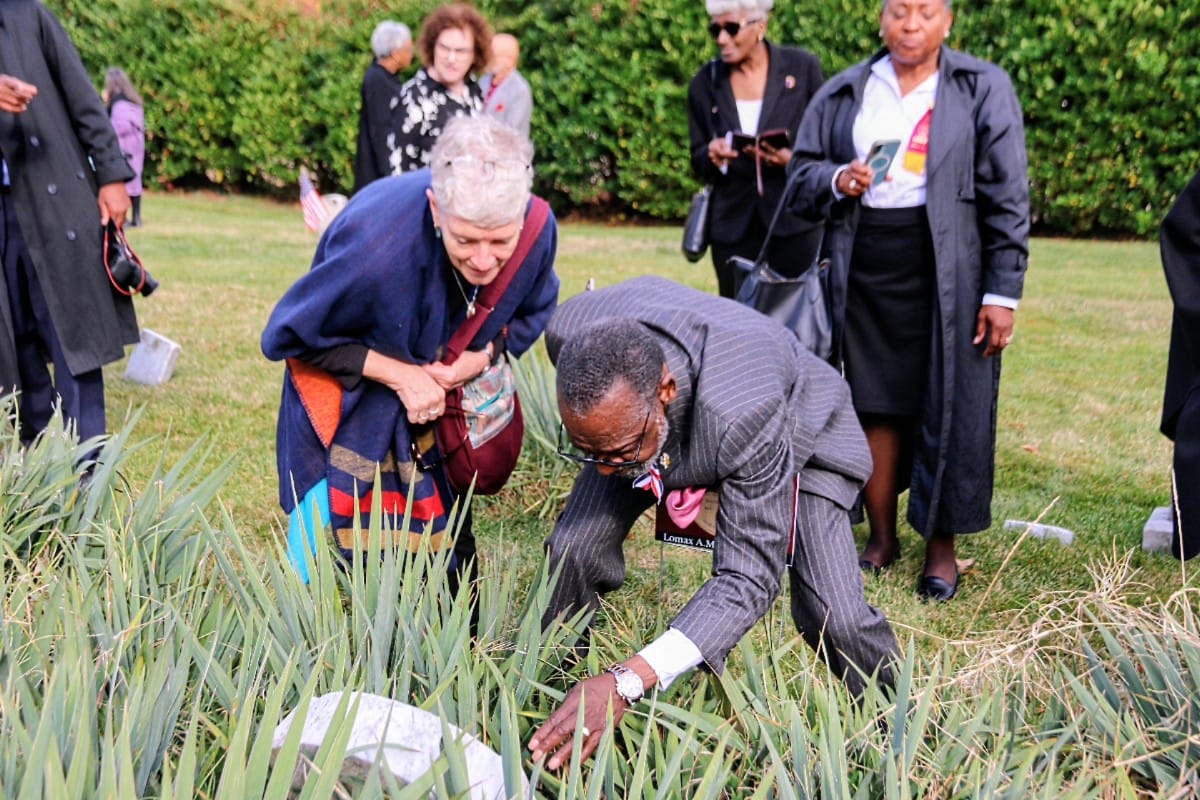
The congregation of Lomax AME Zion Church was joined by community members on Nov. 9 to unveil the two new markers outside the church entrance on 24th Road S. in Green Valley.
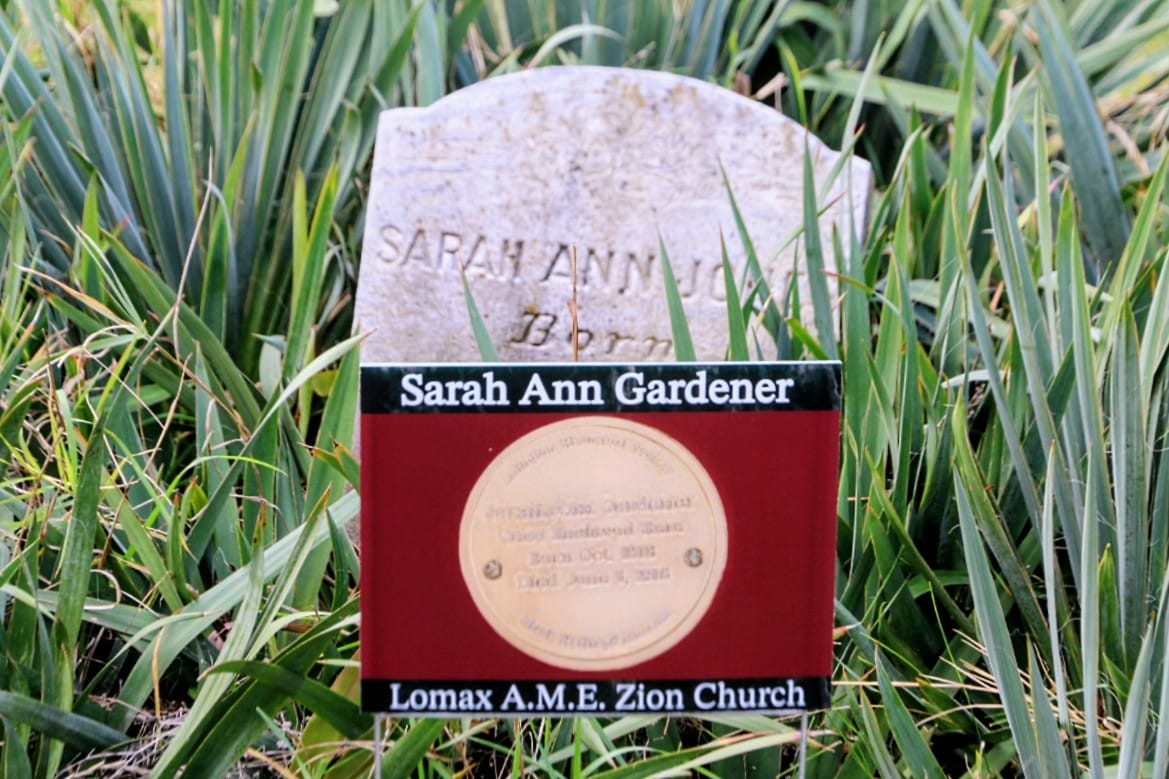
The plaques, embedded in the sidewalk, mark the lives of Sarah Ann Gardener (1818-1915) and one of her sons, Isaac Jones (1845-1917).
Though married to a freed Black man — Levi Jones — Gardener was enslaved on a 1,000-acre estate located near the present-day intersection of 23rd Street S. and Arlington Ridge Road.
Originally enslaved in Montgomery County, Md., she had been brought across the Potomac River when her enslaver’s daughter, Presha Lee, married Anthony Fraser and moved with him to Virginia.
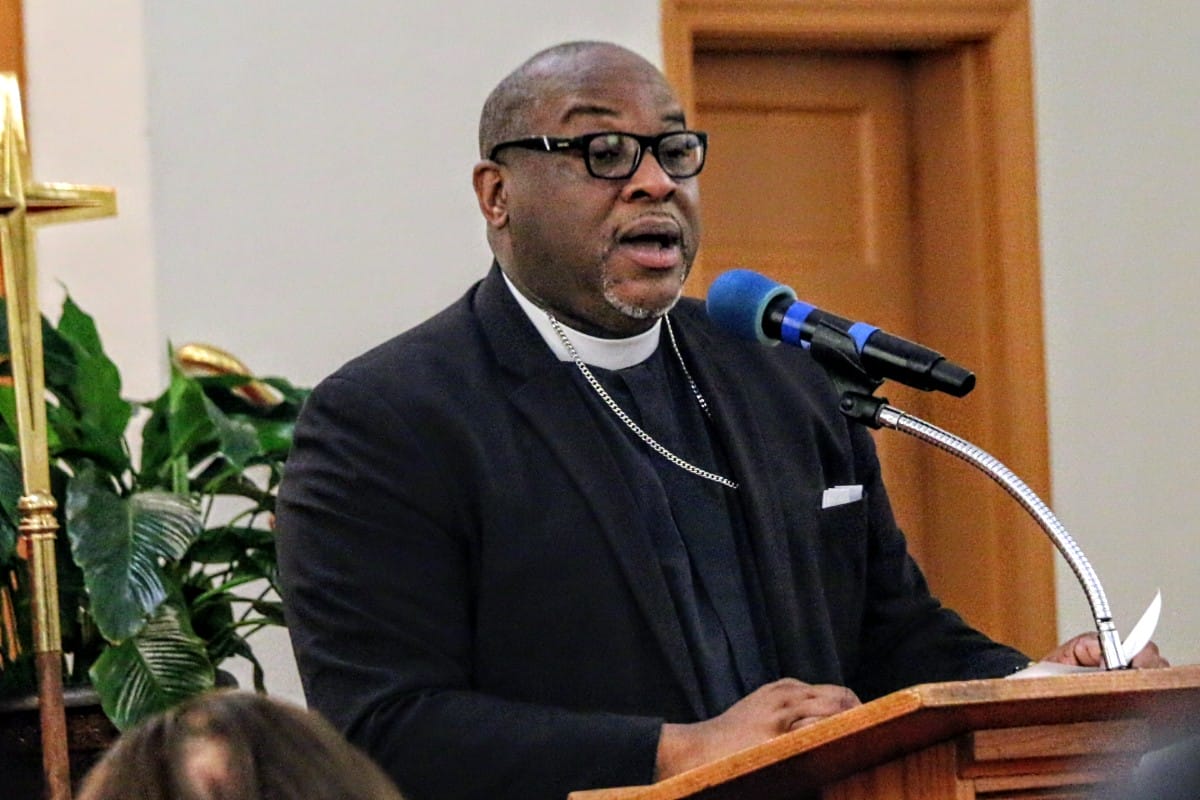
Gardener “came to Arlington not by choice, but by force,” said the Rev. Adrian Nelson II, pastor at Lomax AME Zion Church.
Each of her seven children, born between 1845 and 1862, also was enslaved until all were freed as a result of the Civil War.
After the war, the whole family could live together for the first time on the 14-acre parcel near today’s intersection of Shirlington Road and Four Mile Run Drive, which Levi Jones had owned since 1844.
They rebuilt the family home, which had been damaged by Union troops during the war, and hosted church services there. The family also lobbied for a local school for Black children and sold land in today’s Green Valley to other Black families.
Levi Jones, who died in 1886, had been born to parents enslaved on the Mount Vernon estate but freed after the deaths of George and Martha Washington.
Like his father, Isaac Jones was a farmer. In 1865, he married Maria Frazier; the couple had 10 children born between 1866 and 1883, according to research conducted for the Memorializing the Enslaved in Arlington project.
Gardener, her husband, Isaac Jones and other relatives are among those interred in the church cemetery. It serves as a resting place for more than 100 identified local residents buried between 1894-1982, with others buried underneath unreadable headstones or in unmarked areas.
The stumbling stones are an outgrowth of Memorialized the Enslaved in Arlington, a joint initiative of the Arlington Historical Society and Black Heritage Museum of Arlington. They have been placed across Arlington in a series of events throughout the year, with more events slated for coming weeks and in 2026.
Many of the markers have been crafted by students at the Arlington Tech program at the Arlington Career Center.
The new installation will give local youth a glimpse into the past in a more personal way than history books can convey, School Board member Zuraya Tapia-Hadley said.
“Nothing is more important for a child than to know where they came from. Even in adversity, we can lead and grow,” said Tapia-Hadley, a Green Valley resident.
During the lengthy period of segregation in Virginia, Green Valley was one of the few Arlington neighborhoods open to Black residents. The community has taken steps in recent years to memorialize its history, which dates back to the pre-Civil War era.
“We are not just looking back. We are lighting a path forward,” said Inumidun Obikoya, the historic-preservation manager for the Green Valley Civic Association.
The new markers will play a role in telling a “story that stretches from struggle to strength,” Obikoya said. She praised the stumbling stones initiative for “keeping alive the stories that define who we are.”
Lomax AME Zion Church was founded in 1866 to serve formerly enslaved individuals living in Freedman’s Village, where Arlington National Cemetery is today. The congregation moved to its current location in the 1870s.
“This church is a part of the history of our country,” said Brenda Cox, Lomax’s historian and one who has been a member since 1951, when she was a child.
During the struggle for civil rights, the church’s elders worked to ensure children achieved their full potential, Cox said. She recalled a banner hung in the fellowship hall that said “Strive for Excellence.”
“They knew the struggle and they wanted us to have it better,” Cox said. “I wouldn’t give anything for my journey.”
The church hosted Arlington NAACP meetings for four decades. The Rev. Martin Luther King Jr. and the Rev. Ralph Abernathy preached in its parking lot the day before the 1963 March on Washington, and the congregation housed a delegation from Mississippi attending the event.
Scott Taylor, president of the Black Heritage Museum of Arlington, said the stumbling-stone effort aims to unify, not to divide.
“Recognizing the past is not about assigning guilt,” he said. “It’s about honoring the resilience and humanity of enslaved people. Truth-telling is necessary.”
Arlington is one of the first communities in the United States to use stumbling-stone markers in an effort to tell the story of those enslaved.
The initiative is a derivative of Stolpersteine, an effort that began in Germany in the 1990s to honor victims of the Nazi era with brass plaques placed in the ground at their last place of residence. To date, more than 116,000 of those plaques have been installed in more than 30 European countries.
