


The Arlington County Board has tapped the brakes on discussing any changes to the county’s governance structure, agreeing to return to the issue after some preliminary steps.
The 5-0 decision on Wednesday night, which deferred a vote on setting up a governance task force for at least seven months for further public outreach, represented a compromise between a deeply divided Board.
Board member Julius “JD” Spain, Sr., who was the biggest booster of moving forward immediately but ultimately didn’t have the votes, said the decision represents “the art of the possible.”
“We’re not kicking this can down the road — we’re going to come back in July,” Spain said. “We have to learn how to compromise. We found ways to find a common thread.”
The vote proved a win for Board members Maureen Coffey and Susan Cunningham, who in recent months expressed the most doubts about moving forward immediately on setting up the task force.
Laying the groundwork first will result in a better outcome, regardless of what that outcome is, Coffey predicted.
“Slowing down isn’t saying ‘no’ — it’s saying ‘get it right,'” she said, adding:
“Even the people who want us to do this as quickly as possible want us to do this with care. They want us to do it right and they want us to get it right.”
Cunningham spoke along the same lines.
“We’re going to need to move purposely but not necessarily speedily to broaden the engagement, deepen the engagement,” she said. “There is a lot of education to be done.”
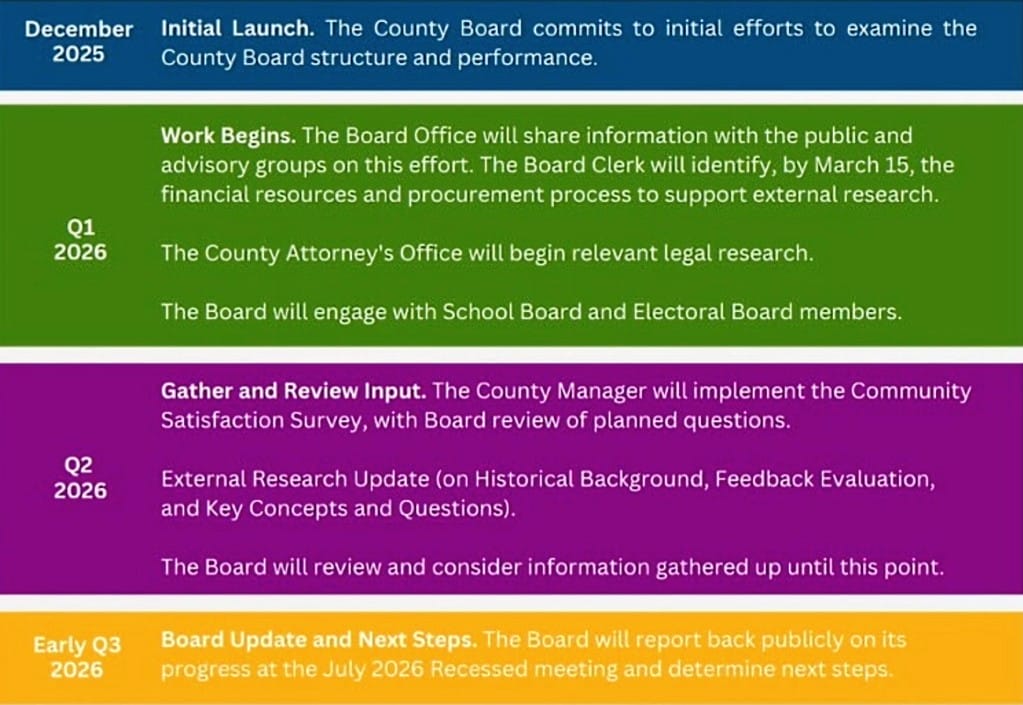
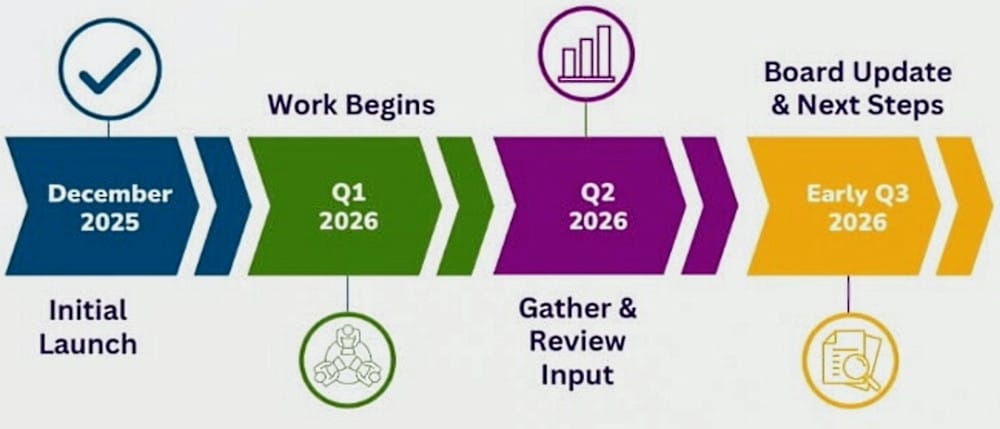
As part of the unanimous vote, Board members adopted a list of responsibilities for various bodies and individuals leading up to revisiting the matter in July.
Duties were assigned to the county manager, clerk to the board, county attorney and a research consultant likely to be hired.
A clear delineation of next steps had been the desire of Dave Schutz, one of the most ardent advocates of a change to Arlington’s 93-year-old governance structure.
“I hope the coming six months will be used to write background material to best orient [potential] task-force members to the work ahead of them,” Schutz said at the public hearing preceding the Dec. 17 vote.
Schutz has been a key player in advocating for governance changes, which have been promoted by the Arlington County Civic Federation. Groups such as the Arlington NAACP, Arlington Coalition of Black Clergy and We of Action also asked Board members to move forward sooner rather than later.
Several dozen speakers, on all sides of the issue, testified at the hearing.
They ranged from Allan Gajadhar, a former Civic Federation president, who urged the Board to “seize the moment” and empanel the task force as soon as possible, to former Planning Commission member Daniel Weir, who urged the issue be deferred until doing preliminary planning.
“We need clear-headed, robust outreach” before moving forward, Weir said.
So many former elected officials were in the room that the gathering seemed like a political reunion, Board Chair Takis Karantonis said.
Among them was Mary Hynes, who from 1995 to 2015 served first on the School Board and then the County Board.
Hynes spoke for a coalition of former elected leaders that included Mary Margaret Whipple, Judy Connally, Bob Brink, Elaine Furlow, Jay Fisette and Katie Cristol.
“Some of our group are open to exploring structural changes in how the Board works; others do not think there’s a problem,” Hynes said.
Like some other speakers, Hynes said moving forward with governance change is not the most important item on the community’s to-do list.
“Most of us think the Board has far more pressing matters,” she said, urging a cautious approach to moving ahead.
Tannia Talento, who like Hynes served both on the School Board and County Board, thought the process should move forward more quickly. But like Hynes, she expressed concerns that the School Board had not thus far been involved in the process.
“It is imperative we include the School Board,” Talento said. “We cannot function without each other.”
Lobbying on both sides of the issue had been intense in the weeks leading up to the Dec. 17 vote. Some speaking at the public hearing expressed disappointment that a final decision was punted into mid-2026.
“This conversation has been kicked down the road many times before,” said Janmarie Pena, who is active with the Arlington NAACP.
Del. Patrick Hope (D), whose district includes the northwest part of Arlington County, also expressed strong support for a change in a letter to County Board members prior to the meeting. He argued that the current structure was established based on “racial exclusion.”
“The fact that this decision is even in question is troubling,” Hope wrote. “A government that claims to value equity, inclusion, and democratic participation should not hesitate to examine its own structure, especially when that structure is rooted in a history of racial exclusion. That is Arlington’s inconvenient truth.”
Hope argued that “Jim Crow politics shaped Arlington’s governance,” alluding to steps taken nearly 100 years ago to forego a map-based representation for at-large membership, and said that those efforts were “not an accident.”
“It was a deliberate tactic used across the South to dilute and disenfranchise Black voters. And it worked,” Hope wrote. “Arlington did not elect an African American to the County Board until 1987 — nearly sixty years later.”
Others felt taking time was the best course of action.
“You’re on the right course — don’t rush it,” said former County Board member John Milliken.

Arlington’s current governance structure, with a five-member at-large governing body overseeing an appointed county manager, has been in place since 1932. For the 60 years before then, the county had been governed by a district-based Board of Supervisors of three members that collectively wielded legislative, executive and some quasi-judicial powers.
At a November Board meeting, it appeared that Spain, who has solidly backed the governance-change proposal, had pulled together a 3-2 majority in favor of moving forward by the end of 2025.
But the other two supporters — Matt de Ferranti and Board Chair Takis Karantonis — seemed at least a little hesitant, while Coffey and Cunningham outlined significant reservations.
The split was perhaps the most significant among County Board members since 2014’s decision to abandon the Columbia Pike streetcar project. None of the current five Board members served on the body then.
If a governance panel ultimately is set up, issues it is likely to be tasked with include:
- Whether there should be more than the current five seats
- If Board members should be elected in districts, at-large or via a hybrid method
- Whether there should be an independently elected chair
- The timing and structure of Board elections
- Whether to move permanently to ranked-choice voting
- If the county should attempt conversion to city status
- Potentially, the future relationship between the County Board and county manager
Many of those changes would require authorization by the General Assembly.
Coffey noted that while few were likely to come away entirely satisfied with the decision to defer action on the governance panel, nobody could accuse Board members of marching in lockstep toward a preordained outcome. Karantonis said taking incremental steps on governance represents a “way forward for our community.”
“We haven’t been sitting on our hands, resisting change,” he said.
Spain and Cunningham, who worked to craft the compromise acted on during the Dec. 17 meeting, have been designated as liaisons to the planning process.
Cunningham said she hoped the coming months would bring “a foundation of inclusive engagement” to figure out the appropriate next steps.
“That’s great to say; it’s hard to do,” she said.
The Dec. 17 meeting is expected to be the last of the year for the County Board. Members will reconvene Jan. 5 for the body’s 2026 organization meeting, at which a chair will be chosen and other administrative tasks completed.
Jared Serre contributed to this story.
