

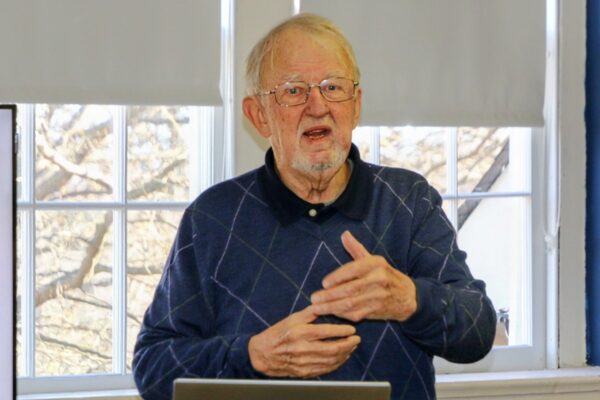
A recent presentation from a former local official examined Virginia’s three-decade statewide transformation from politically red to purple to now (maybe) blue.
John Milliken, former County Board member and Virginia Secretary of Transportation, explored the Old Dominion’s political evolution at the gubernatorial level from the narrow 2001 election of Mark Warner to the 2025 landslide bringing Abigail Spanberger into office.
“It’s not about who won — you know that,” he said in a Jan. 11 presentation to the Arlington Historical Society. “It’s about why: What changes drove those outcomes?”
In the 2023 book “The New Dominion: The Twentieth-Century Elections That Shaped Modern Virginia,” Milliken, in collaboration with Mark Rozell, analyzed six key statewide races showing how the commonwealth’s politics evolved over time.
Milliken’s remarks looked at the gubernatorial elections of 2001, 2005 (Democrat Tim Kaine), 2009 (Republican Bob McDonnell), 2013 (Democrat Terry McAuliffe), 2017 (Democrat Ralph Northam), 2021 (Republican Glenn Youngkin) and 2025 (Democrat Spanberger).
In the 45-minute forum, he distilled those races through the lens of five localities: Arlington, Loudoun, Chesterfield and Wise counties and the city of Norfolk.
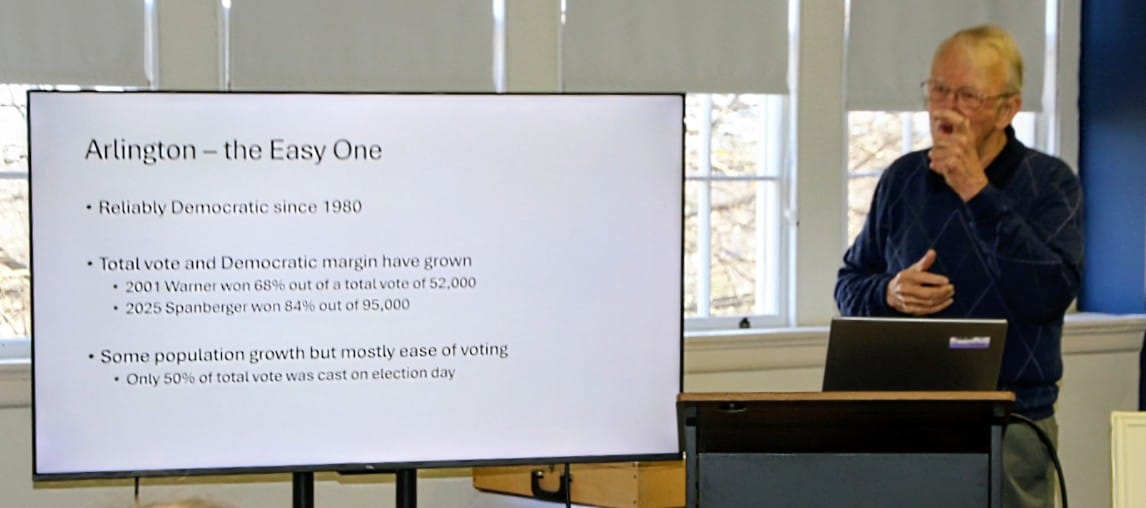
“Arlington’s the easy one,” Milliken said of explaining its political trajectory.
The county had moved into solidly Democratic territory by the early 1980s, but more recent growth in voting totals during non-presidential elections has helped Democrats in statewide races. Rolling up big Democratic margins of victory in Arlington helps blunt Republican strength in some downstate areas.
“Arlington alone can offset those [Republican] numbers because it turns out,” Milliken said.
Loudoun County appears to be following Arlington’s path in the 2020s, although the stakes are higher.
While Loudoun “went back and forth” for years in statewide races, Spanberger won 65% of the vote in 2025.
In the quarter-century since 2000, Loudoun’s population has exploded from about 170,000 to more than 420,000. As a result, Spanberger piled up 50,000 more votes than Republican nominee Winsome Earle-Sears.
“That’s hard [for Republicans] to offset,” Milliken said.
From 1960 to 2020, Northern Virginia’s population followed a similar trend — growing more than 450% — while much of the south-central and southwestern areas of the commonwealth posted declines.
Chesterfield County, southwest of Richmond, also has seen growth — from about 260,000 in 2000 to nearly 400,000 today.
“Republicans used to count on Chesterfield County for big margins,” Milliken said, but in 2025 Spanberger won 30,000 more votes than Earle-Sears.
It helped Spanberger that she lives in nearby Henrico County. As a result, voters “felt like she was someone they could relate to,” Milliken said of Chesterfield, which gave the Democrat 100,000 votes to 70,000 for Earle-Sears.
But Milliken, who also serves as a senior fellow in residence at George Mason’s Schar School of Public Policy and Government, said it is too soon to put Chesterfield permanently in the Democratic camp.
“I would still classify Chesterfield as a very purple area, depending on the candidate,” he said. Youngkin won about 52% of the vote there in 2021.

Norfolk represents a case of a locality starting the new century largely Democratic in its leanings, and moving further in that direction as time progressed.
The 65% vote total for Warner in 2001 evolved into a 74% vote for Spanberger in 2025.
Rural Wise County is on Milliken’s list because it represents Virginia’s most southwesterly corridor, long one of the strongest Republican bastions in the commonwealth. Parts of that region are more westerly than Detroit and have more in common with neighboring Kentucky, Tennessee and West Virginia than with much of the Old Dominion.
“They are beautiful places, but very remote to the rest of the commonwealth,” he said. “There has always been a certain anti-Richmond ethic.”
Wise County turned out for Earle-Sears, giving her 80% of its votes. But with a population of just 35,000, such a large victory didn’t provide much in the way of raw numbers.
More interesting to Milliken is how different Democrats approach areas like Wise County in their election calculus.
Warner was the last Democratic candidate for governor to carry the county in 2001. Since then, most Democratic statewide candidates have spent their energy trying to roll up vote totals in the D.C.-to-Richmond and Richmond-to-Hampton Roads corridors.
Although Spanberger made some effort to connect with Republican areas of the commonwealth, doing so is not a priority for most Democratic candidates.
“Nobody has done it since [Warner] because, for Democrats, the payoff is not that great,” Milliken said — though those parts of the commonwealth can make a difference in a close statewide race, like in 2021.
Despite the demographic and economic changes, Milliken doesn’t count Republicans out of future statewide races. To win, however, GOP candidates have to run up votes in Republican-leaning areas while building enough support in Northern Virginia and Hampton Roads to pick up more voters than the party typically does.
McDonnell and Youngkin “did exactly that — they had credibility enough to cut into [voting] tradition,” Milliken said.
Milliken’s presentation was another in a series of “15-Minute History Talks” offered on Sundays by the historical society.
“We wanted to make this more of a living, breathing museum” after its recent refurbishment, said society president David Pearson.
Next Sunday, Jan. 18, at 2 p.m., Pearson will present a program on the 65th anniversary of the creation of Arlington’s General Land Use Plan and its impact on subsequent transportation planning.
