


The following in-depth local history feature was supported by the ARLnow Press Club. Join to support local journalism and to get an exclusive version of our afternoon newsletter, plus an early look at what we’re covering each day.
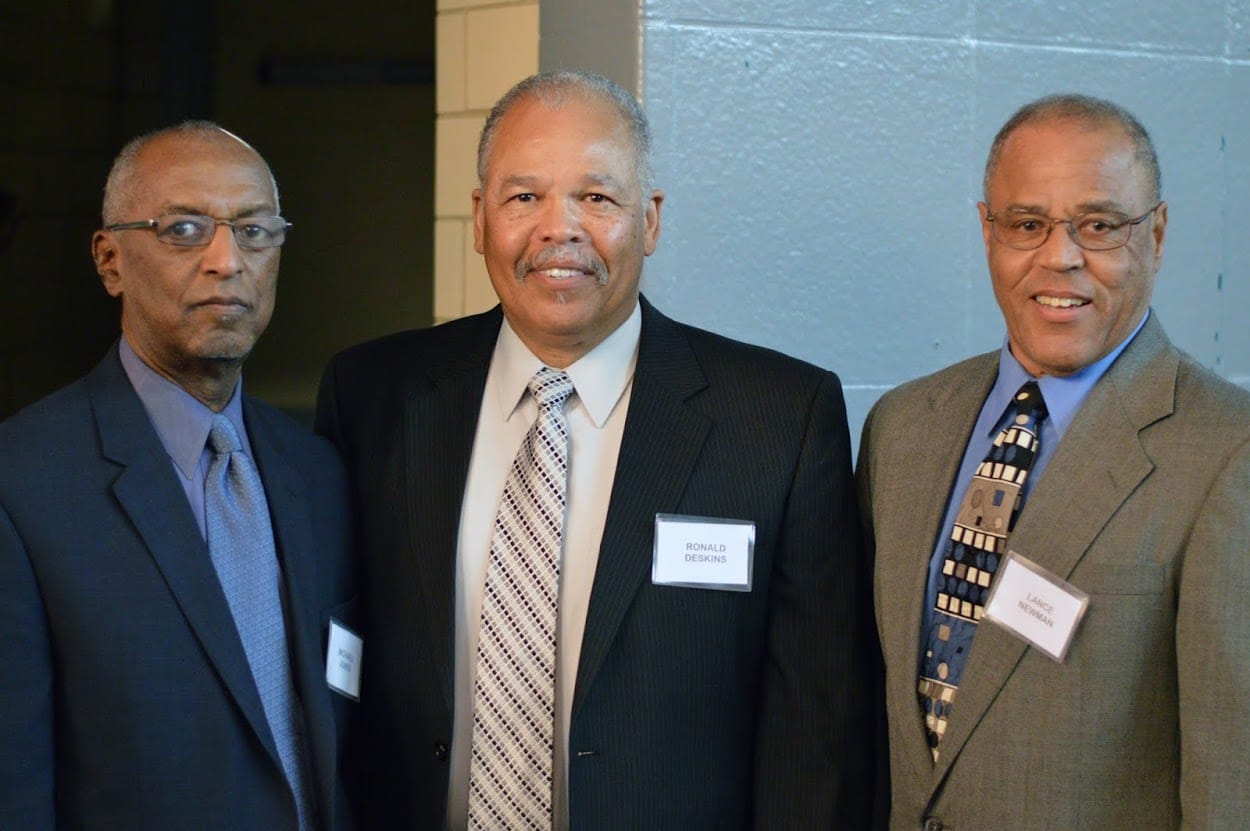
This week marks the 67th anniversary of the integration of Arlington’s Stratford Junior High School by four Black seventh-grade students: Lance Newman, Michael Deskins, Gloria Thompson and Michael Jones.
Together with a group of Black students in Norfolk, these students broke the color barrier in Virginia public education on Feb. 2, 1959, marking the beginning of the end of state leaders’ “Massive Resistance” efforts to circumvent court rulings designed to dismantle institutional segregation in the Old Dominion.
To mark the anniversary, ARLnow looks back at events through the eyes of Newman (1946-2018), one of the four Arlington 12-year-olds thrust briefly into the national spotlight as symbols of the nascent civil rights movement.
Coverage is based on the following sources:
- An oral history with Newman conducted Feb. 13, 2016, by Joanna Dressel and Judith Knudsen for what is now the Charlie Clark Center for Local History
- A community forum that took place the preceding week in 2016 at the former Stratford Junior High, featuring participation by Newman, Jones and Deskins
- Coverage reported in the Washington Evening Star and Northern Virginia Sun in 1959 and archived in the Virginia Chronicle project of the Library of Virginia and at the Library of Congress
From those sources, particularly the oral history, it becomes clear that later in life, Newman took a nuanced, at times complicated, view of the events of 1959. He would use the experience as a springboard to a successful life both professionally and personally.
NAACP files suit in spring of 1956
According to a 1996 Arlington Historical Society article penned by Alison Bauer Campbell, Arlington’s population in the immediate postwar era of the 1950s was approximately 5% Black. That modest percentage was significantly smaller than some other localities in Virginia and across the South.
In May 1956, the NAACP filed suit in federal court, demanding Virginia follow the U.S. Supreme Court’s 1954 Brown v. Board of Education ruling. The lawsuit sought integration of public schools in Arlington, Front Royal, Charlottesville and Norfolk.
Arlington, at the time, was the only jurisdiction in Virginia that the General Assembly allowed to elect its School Board. In January 1956, the Arlington School Board approved an integration plan to implement at the start of the 1956-57 school year.
State legislators immediately began counter-maneuvers to prevent that from happening. One result was the state government ultimately removing Arlington’s ability to elect its School Board members, an authority that didn’t return until the 1990s.
Thrust into all the controversy was not just the School Board, but Arlington’s superintendent of schools, Ray Reid.
Reid was relatively new in the position, having been appointed in May 1958.
In his years in education before and during his Arlington service, Reid had taken a middle-of-the-road approach to integration that seemed to endear him to neither side:
- Though serving as assistant superintendent of public instruction for Virginia before his selection to lead Arlington’s schools, Reid’s appointment to become superintendent of public instruction had been quashed by Gov. Thomas Stanley and pro-segregation elements in the General Assembly
- After being appointed superintendent of schools in Arlington in 1958, Reid drew criticism from pro-integration forces for what they saw as foot-dragging, but what he viewed as methodical, practical steps forward
Reid would remain superintendent until his retirement in May 1969 — another tumultuous year in the county’s education history.
Born in D.C. but raised in Arlington
Lance Newman was born Sept. 24, 1946, in D.C. to Samuel Newman Sr. and Audrey Thomas Newman. Their growing family called the Halls Hill neighborhood of Arlington their home.
He had attended Arlington’s segregated Langston Elementary School. The next logical step for Newman was attendance at Hoffman-Boston School, the county’s segregated secondary school for Black students. He arrived in the fall of 1958 to begin seventh grade.
While Lance Newman agreed to seek placement at all-white Stratford, a slightly older brother declined the opportunity, opting to stay at Hoffman-Boston.
“He was a couple grades ahead of me, so he had been there, and he had all his friends, so that’s why he didn’t want to go,” Lance Newman recalled in the oral-history interview. “I had my friends, too, but my running buddies, shall we say, were Mike and Ronnie at the time, so I didn’t mind.”
While Newman’s parents left it up to their children to decide, Jones said that his parents were a little more forceful in encouraging his participation in the integration effort.
“They basically never asked — basically they said, ‘you’re going to do this,'” he said to audience laughter at the 2016 community forum.
“I don’t know why they got me involved,” said Jones, one of seven siblings. “They were busy enough. My mother was nine months pregnant at the time.”
Hard-line response from state government
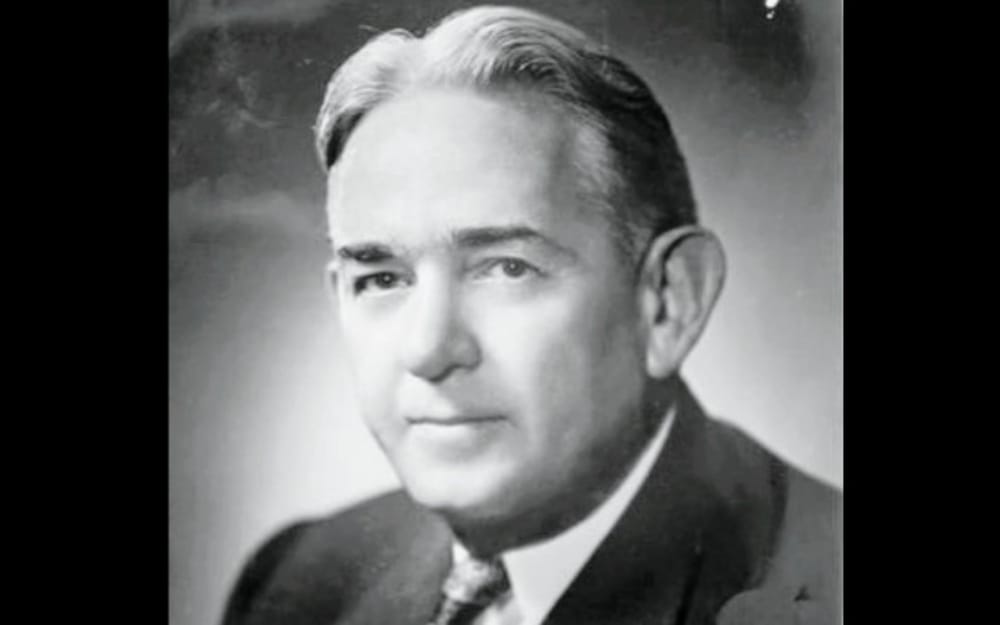
J. Lindsay Almond had been elected governor in 1957 as a firm supporter of the political machine operating under Sen. Harry Byrd Sr. (D-Va.), which used the governorship as a reward for loyal service. Virginia’s one-term rule for governors was a way to ensure none who occupied the post would get too independent of the machine.
Almond’s early tenure was marked by condemnation of court efforts to undermine the segregation policies enshrined in Virginia’s 1902 constitution, and efforts to get around the rulings of both state and federal courts insisting on integration. That political response would become known as Massive Resistance.
As it became clear that politicians in Richmond wouldn’t be able to stop the courts, Almond and legislators shifted tactics.
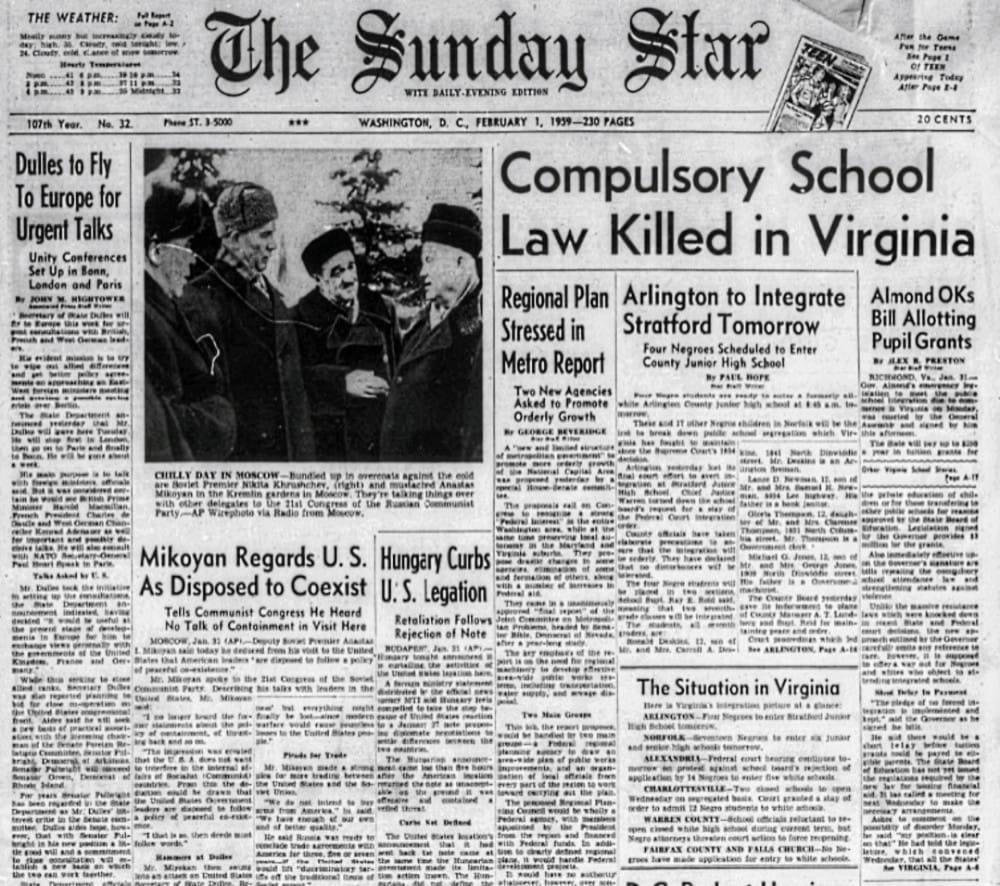
A day before the Feb. 2, 1959, integration in Arlington and Norfolk, the governor signed legislation eliminating the requirement for compulsory education in Virginia, and also setting up a fund that would give parents $250 a year for each student that they could use to send their children to private schools that were not subject to integration orders.
Democratic leaders in Richmond swore the intent was not to preserve segregation, but to give both Black and white parents options. Their comments convinced few that the plan was anything but an end run around integrating all-white schools.
State Sen. Theodore Roosevelt “Ted” Dalton, the leading Republican legislator in the General Assembly, called on Democrats to ease their pro-segregation stance.
But Dalton had little power, being one of just three Republicans in the 40-member Senate, while there were just six from the GOP in the 100-member House of Delegates.
Judge loses patience over delaying tactics
Designated to handle the court case was Albert V. Bryan Sr. (1899-1984), a graduate of the University of Virginia law school who had served as commonwealth’s attorney in Alexandria from 1928 to 1947 before being nominated by President Harry Truman as a federal judge for the Eastern District of Virginia.
In a 1952 ruling — Davis v. County School Board of Prince Edward County — Bryan had upheld the constitutionality of segregation in Virginia’s public schools. But the Supreme Court’s Brown v. Board of Education decision two years later led him to reverse course.
Between 1954 and 1958, Bryan moved cautiously in implementing the Supreme Court directive. While favoring an incremental approach, his patience was tried by state and local leaders’ efforts to delay, and at times defy, the court.
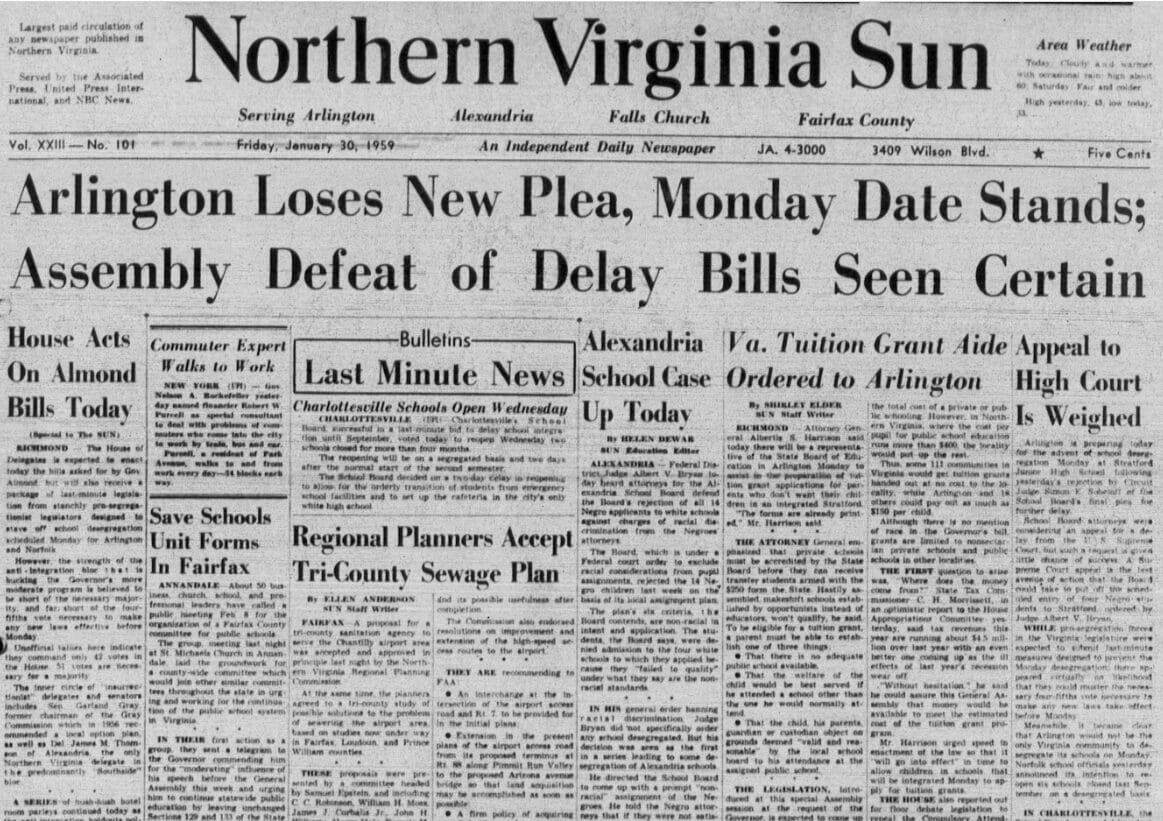
In January 1959, Bryan ordered integration to begin immediately, albeit in limited doses, in Arlington and Alexandria public schools. He ordered the admittance of four Black students to Stratford Junior High.
Caught in the middle of battles in courtrooms and in the court of public opinion, the Arlington School Board made an emergency appeal of Bryan’s order to the U.S. Supreme Court. On Saturday, Jan. 31, Chief Justice Earl Warren delivered a terse, two-paragraph response.
Warren rejected the appeal, saying the parties needed to have the matter addressed by the 4th Circuit U.S. Court of Appeals. Until the appeals court acted, Bryan’s ruling remained in place.
With that, the stage was set for integration to begin.
Media outlets converge on Stratford
January 1959 had been unusually warm in the D.C. area, with temperatures breaking 70 degrees on Jan. 21 and highs in the 60s on Jan. 31. But by the time Feb. 2 arrived, winter had returned. Morning temperatures were below freezing.
On hand to await the arrival of the four Black students at Stratford were a host of media outlets.
Among them were reporters and photographers from two afternoon daily papers, the Northern Virginia Sun and Washington Evening Star. They were happy to scoop The Washington Post, which in those long-before-the-Internet days would have to wait until the next morning before its presses rolled.
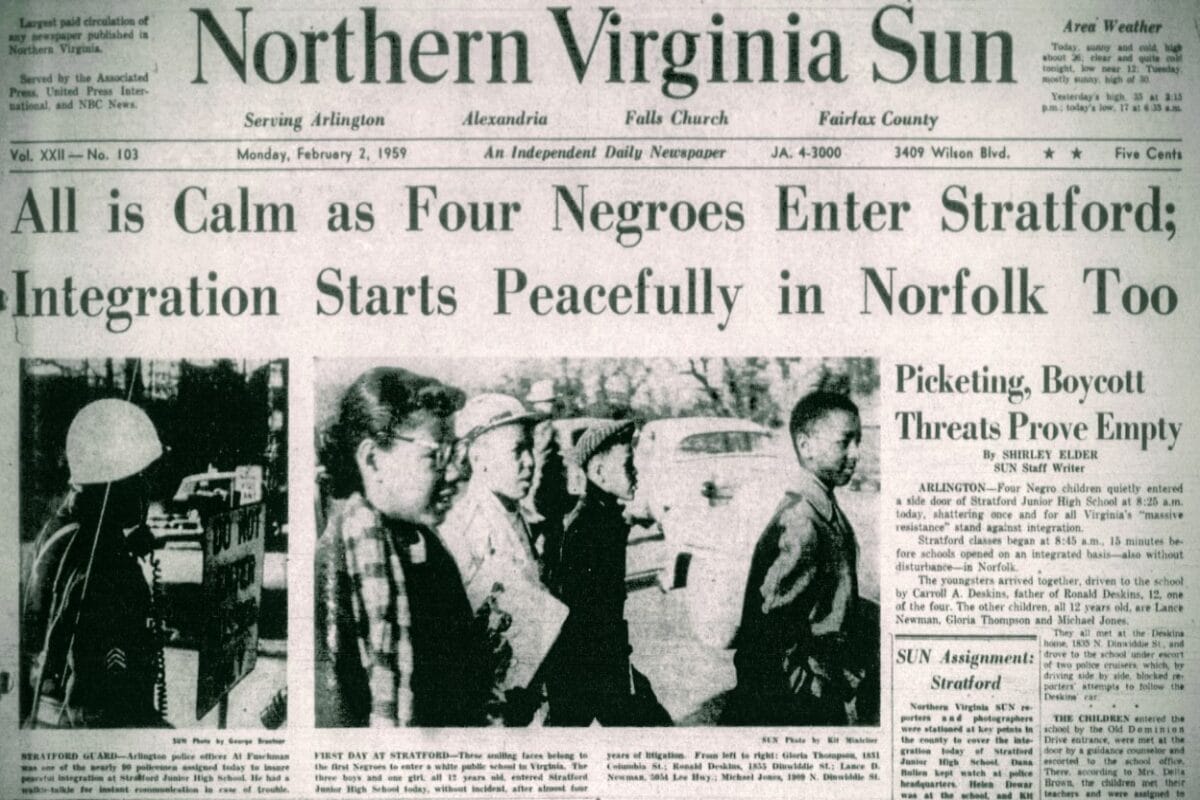
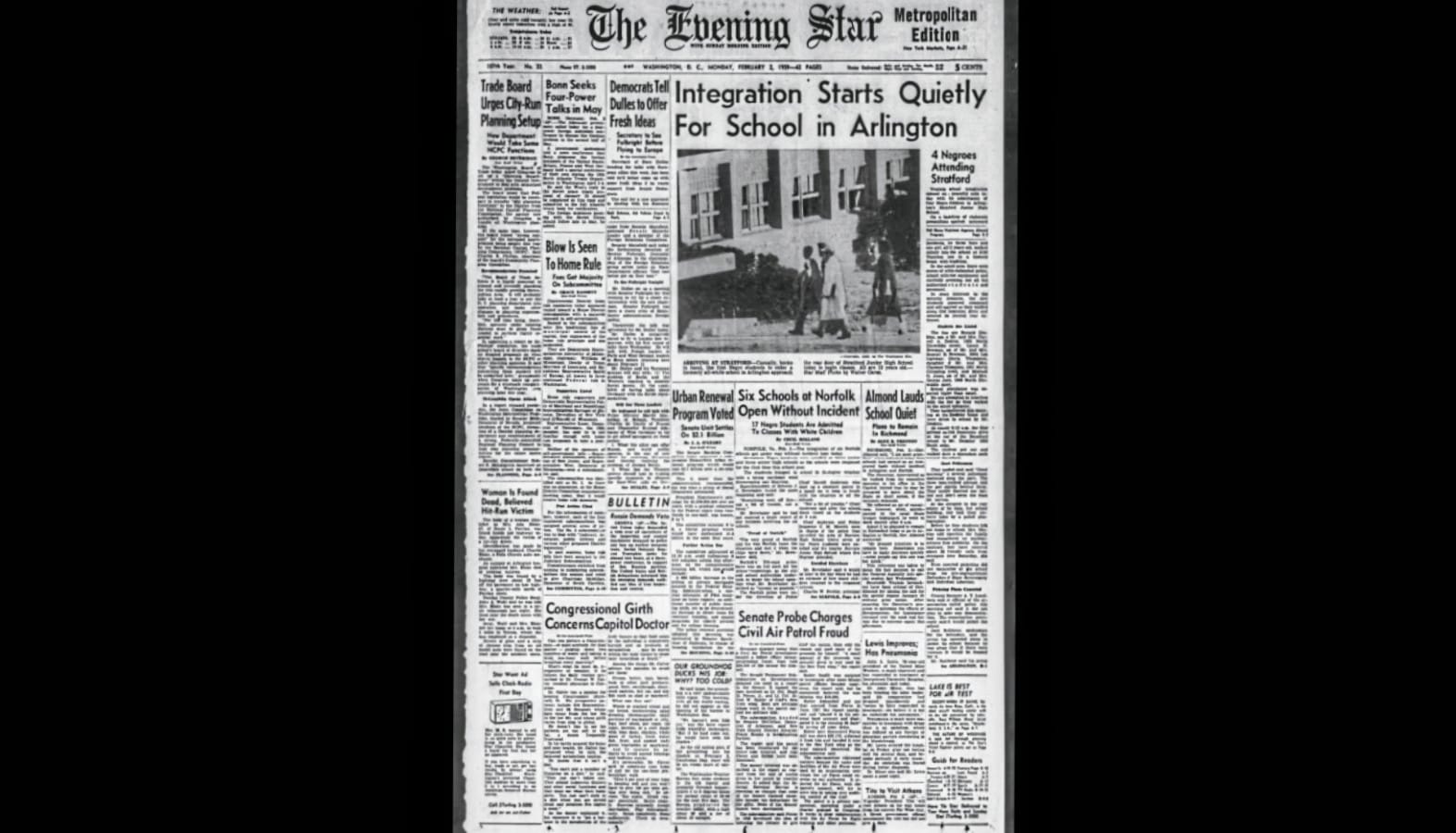
Both the Sun and the Evening Star plastered coverage across the front pages of their Feb. 2 afternoon editions.
The Star’s coverage was without a byline, but gave readers a flavor of what had transpired as Newman, Deskins, Jones and Thompson arrived — their arrival timed to be after other students already were in class:
“At exactly 8:15 a.m., the four arrived on Old Dominion Drive at the rear of the Stratford school in Mr. Deskins’s 1953 Buick sedan. The children got out and walked down a macadam path toward the school. They nodded and said ‘good morning’ to several policemen stationed along the path. They neither hurried nor dallied and didn’t seem the littlest bit nervous. The new students appeared composed and self-assured as they walked along Old Dominion Drive and entered the central rear entrance.”
The Sun’s front-page coverage was penned by reporter Shirley Elder, whose lead paragraph noted the broader significance of the event:
“Four Negro children quietly entered a side door of Stratford Junior High School at 8:25 a.m. today, shattering once and for all Virginia’s ‘massive resistance’ against integration.”
During that era, newspapers remained the public’s dominant source for information. They also could prove immensely profitable — the Star’s Sunday edition, which came out the day before integration, landed with a heavy thud on doorsteps, as it totaled 220 pages plus dozens of advertising inserts.
Even the Sun, a six-day-a-week local paper at that point in its history, had the resources to position a corps of reporters and photographers at the school, at police headquarters and other areas as part of blanket coverage.
Among the Sun’s reporters at the scene was Helen Dewar (1936-2006).
Dewar had started her journalism career at The Washington Post in 1958 after graduating from Stanford University. Assigned to the paper’s women’s section, she quit after just two weeks, moving to the Sun to handle education coverage.
In 1961, Dewar was recruited back to The Post with the promise of more substantial assignments.
Remaining with the paper nearly to the end of her life, Dewar would cover the Virginia state government, the unlikely success of Jimmy Carter’s 1974-76 quest for the presidency, and for 25 years was the paper’s chief congressional correspondent.
First day from students’ perspectives
At the 2016 community forum, Newman picked up the story of that first day:
“We went to Mr. [Claude] Richmond’s office, the principal’s office, and he gave us some instructions. We went to class … they opened the door to the class, there was a quietness. It was nervous but it wasn’t overwhelming. There wasn’t any real hostility; people were curious. There were some stares. It was somewhat uncomfortable but, all in all, I must say things went very well, considering.”
In the subsequent oral history, he noted that some of his new classmates had been designated to help ease the transition for Newman, Jones, Deskins and Thompson. In particular, one student stuck close to Newman:
“His name was Charles Allegrone. He had volunteered, from what I found out, to kind of befriend us and all that kind of stuff. They asked kids beforehand, and he was one of them. I actually got to be pretty good friends with him and his father. His father was a captain in the Navy and worked at the Pentagon.”
Deskins surmised that Allegrone and other ready-made friends had been plucked from among students whose families had military or State Department connections.
“Because they’d been around other areas, not just the South, they would probably be more at ease with the whole process,” he told interviewers Dressel and Knudsen.
Allegrone was sitting in front of Newman in one class that first day.
“He cracked this joke and kind of broke the ice on the whole thing,” Newman recalled. “And from sort of that time on, people were friendly and stuff — so it made that experience a lot more palatable. And I wish I could remember what he said, but for the life of me, I can’t.”
(To skip ahead in the story’s chronology, Charles Allegrone would go on to join the Foreign Service and spend his career in Department of State postings in D.C. and around the globe.)
Newman said he and his three Black classmates were ready for anything that might transpire on their first day.
“We had been told what could happen, but none of that happened,” he said.
Overall, Newman said the first day proved “an enlightening experience.”
“I didn’t really realize the significance of it at the time,” he said. “Of course, I was only 12 years old.”
The school year rolled forward as 1959’s winter turned to springtime. Speaking at the 2016 community forum, Newman said a routine was established:
“As the semester progressed, we got more and more comfortable and started making some friends, a few in particular. At the end of the year, I think most of us can say we were pretty comfortable, for the most part, in our environment at Stratford.”
In the oral-history interview, Newman expanded his comments, noting that by eighth grade, he had picked up more friendships. He mentioned a student named David Ferguson, with whom he bonded.
“I kind of hung around with him quite a bit. We became good friends,” Newman said.
There were, however, limits in the societal environment the classmates found themselves in.
“We were friends in school, but we never did socialize [outside of it],” Newman said. “You didn’t really socialize with the white kids and stuff, so you felt kind of isolated. As time went on, the ice broke more.”
Black or white, then or now, middle school can be a confusing and unnerving experience for students until they get into a rhythm.
At the community forum, Newman related the story of spending a long evening writing up lengthy sentences — ones that would have made Lord Tennyson proud, he said — for the next day’s English class, where the works would be read out loud and carefully dissected.
White students apparently had not taken the assignment as seriously, Newman noted. Their submissions were short and uninspired, hardly worthy of the assignment.
“I realized, these kids are just dumb as I am,” Newman said to laughter. “That was a wakeup.”
Protesters fail to materialize
The events in Arlington of Feb. 2, 1959, went down in history as “the day nothing happened” because expected protests against integration failed to materialize.
One group that had promised to show up was the pro-segregationist Defenders of State Sovereignty and Individual Liberties. That group’s leader, Jack Rathbone, called County Manager A.T. Lundberg early that morning to tell him the protest was off.
“The group had canceled plans to picket the school because [Rathbone] was afraid that if there were violence, he would be blamed for it,” Evening Star coverage noted.
Despite the lack of any immediate problems and the students’ overall nonchalance, adults remained on edge.
“My parents went through a lot. All the parents,” Newman said in the oral-history interview. “They were frightened — they were very nervous because it was their kids and stuff. And once you start having kids, you get a different perspective on that. And my mom told me that she was scared to death.”
Political fallout across Virginia
A follow-up is in order about the post-1959 lives of two politicians, one Democrat and the other Republican, who played statewide roles in the integration battle.
Gov. Lindsay Almond (1898-1986) left office at the start of 1962, constitutionally prohibited from seeking a second consecutive term.
Somewhere along the way, he and Sen. Harry Byrd had a major falling out, and Byrd began to take what some said was a vindictive delight in forcing President John F. Kennedy to pull back on a plan nominating Almond to a vacant U.S. District Court judgeship.
Byrd later relented just enough to be away from the Senate when it voted to confirm Almond in mid-1963 as an associate judge on the U.S. Court of Customs and Patent Appeals. It was a rather obscure ending for a one-time governor.
Although Almond would distance himself from the most reactionary segregation factions by the end of his tenure in elected office, he is not recorded as ever having expressed regret for his role in pressing to maintain segregation policies.
His death in 1986 came just three years before Virginians elected Democrat L. Douglas Wilder as the commonwealth’s first, and to date only, Black governor.
Ted Dalton (1901-89), who in addition to serving in the Virginia Senate had twice (1953, 1957) been the Republican nominee for governor, also ended up in the federal judiciary.
In 1959, President Dwight Eisenhower nominated him as a judge of the U.S. District Court for the Western District of Virginia. The nomination sailed through the Senate, with Sen. Byrd presumably thrilled to see Dalton move out of the political limelight.
Dalton later would be selected chief judge of the court, and was responsible for ordering the integration of public schools in Roanoke. In 1977, his nephew John Dalton — whom he adopted as his son — was elected Virginia governor as a Republican, serving until 1982.
Another participant in the events of 1959 — Judge Albert V. Bryan Sr. — was nominated by President Kennedy for a newly created seat on the Fourth Circuit Court of Appeals in 1961.
Whatever Byrd may have thought about Bryan, the appointment won Senate confirmation.
In 1969, two years before his retirement, Bryan ruled in Griffin v. State Board of Education that Virginia’s tuition grants for students to attend private schools were unconstitutional when used to avoid integration. It was, in effect, the last nail in the coffin of the decade-long Massive Resistance effort.
Harry Byrd Sr. retired from the Senate in late 1965, citing ill health. Virginia’s dominant political force for more than 30 years, he died in October 1966.
Byrd was succeeded in the Senate by his son and namesake, Harry Jr., who ultimately would serve until early 1983, marking nearly a half-century of continuous father-son service in the body.
Harry Byrd Jr., who left the Democratic Party in 1970 to become an independent, died in 2013 at age 98.
Stratford building evolves with the times
Stratford Junior High School later was converted by the county school system into the H-B Woodlawn Secondary Program. When that program moved to a new home in Rosslyn, the building returned to its original use as a general-purpose middle school.
With the original name coming from the Lee family’s Stratford Hall plantation, county school leaders opted to rename the facility Dorothy Hamm Middle School in honor of one of the community leaders involved in the integration effort.
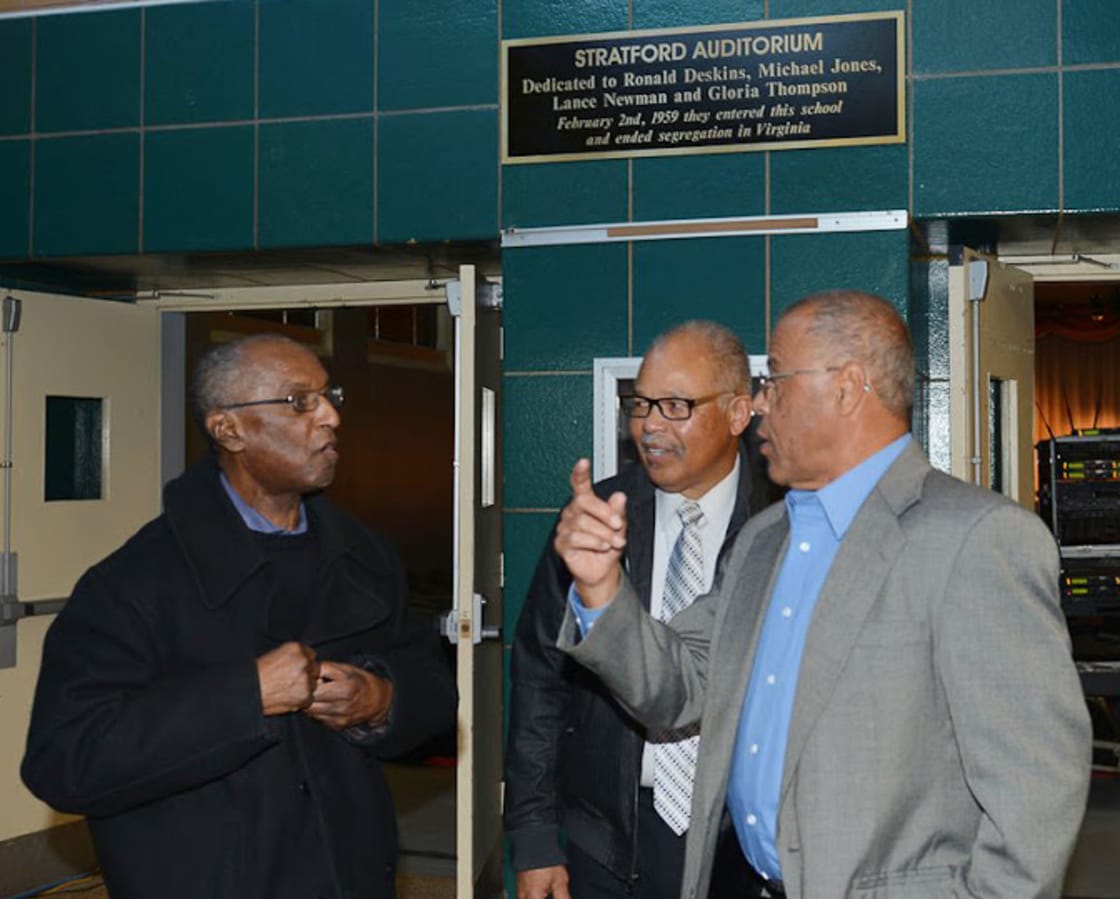
In part because of its role in the integration of Virginia schools, Dorothy Hamm Middle in 2016 was designated a local historic district. It is also part of the National Register of Historic Places and the Virginia Landmarks Register.
In a February 2009 ceremony at the school marking the 50th anniversary of integration, Thompson — the lone female student among the four — recalled attending the Virginia NAACP convention later in 1959, where she met Jackie Robinson.
At the 2009 event, Thompson told H-B Woodlawn students that she, Deskins, Newman and Jones in 1959 had a hard time understanding why Virginia separated students based on race.
“I didn’t think I was different. We didn’t feel like our skin mattered,” she said. “Apparently, the state government felt like our skin color mattered.”
Her view on the U.S. of 2009 compared to the U.S. of 1959?
“It’s amazing how much the country has changed, how much the schools have changed,” Thompson said. “I can’t believe it.”
Reflections by one of the participants
After Stratford, Newman went on to attend and graduate from Washington-Lee (now Washington-Liberty) High School. He helped to integrate the high school’s football team, a state powerhouse in the early 1960s.
In 1968, Newman graduated from Howard University with a degree in electrical engineering, moved to California, earned a master’s degree from UCLA and spent the ensuing 35 years in the engineering field, beginning with North American Rockwell.
His father had been a janitor, Newman said at the 2016 community forum.
“He said, ‘I want you to go a lot farther than I did,'” Newman said. “That stuck. That defined me. [My parents] prepared me well and are a part of my identity.”
In 1981, Newman married Virginia “Ginni” Wiggins and became stepfather to her children while helping to raise his step-granddaughter. In his free time, he enjoyed traveling with family and remained active both professionally and in community and youth sports.
In 2018, Newman became the first of the four Stratford students to die. He was just 71 and his death came unexpectedly following a brief illness, according to family.
At the time of his death, Newman had been planning to attend an upcoming forum in Arlington about the desegregation of high-school sports in the county. The event instead was dedicated to his memory.
“It is always painful to see history pass away,” said Annette Benbow, a historian long active with the Arlington Historical Society.
Not all impacts were positive
The end of state-mandated segregation — in education, housing, marriage and other basic rights — is seen as a positive step on the journey to what the nation’s Founding Fathers described as a more perfect union.
There were, however, downsides to the beginning of integration, Newman told researchers in 2016, particularly when it came to impacts on the tight-knit, family-centered Black neighborhood of Halls Hill.
“Some people have bad memories,” he said of that era. “The community did change, integration was good for us, but I don’t know if this is directly a result of integration or just the changing times.”
“I think as the years went by, the so-called discipline or the family — I mean the family unit, respect for your elders and all that stuff — kind of waned, and that could be just general society. But I think it had something to do with integration, because kids got more, I want to say, independent.”
He also lamented leaving school environments at Langston and Hoffman-Boston, where the students and teachers all had similar life experiences, particularly since the educators had a vested interest in seeing students succeed.
“Our elementary-school teachers at Langston really prepared us” for future success, Newman said at the 2016 community forum.
In the oral history, he added: “All of them knew my name. A lot of them, most of them, lived in the community, too, and attended the same churches and all of that. So you knew them, and they were really good, I must admit, and they cared about the students.”
In the oral-history interview, Newman also said the ultimate success of the 1959 integration effort was due to those who put aside fear to do the right thing:
“I believe the community leaders — the parents, especially, and the community leaders, the NAACP, and even the white community that supported us — deserve 90% of the credit. I firmly believe that.”
Asked in the 2016 interview to sum up his experience at Stratford, Newman was positive, if not effusive.
“All in all, I had a fairly good experience,” he said.
Thanks to the Library of Congress, Library of Virginia and Charlie Clark Center for Local History for assistance with coverage.
Photo (1) via Arlington County/Facebook
