






While questions around congressional redistricting will remain unresolved for months, campaigns for two seats that could represent Arlington are in full swing.
For now, all eyes are on an April 21 statewide referendum on whether to authorize dramatically redrawn districts for the U.S. House of Representatives. But that isn’t stopping candidates, political parties and officials in Arlington from launching into election season.
“At this point, the election is moving forward full steam ahead,” county elections director Gretchen Reinemeyer said at a Feb. 13 Electoral Board meeting.
The referendum takes election officials into “unprecedented” territory, Reinemeyer said.
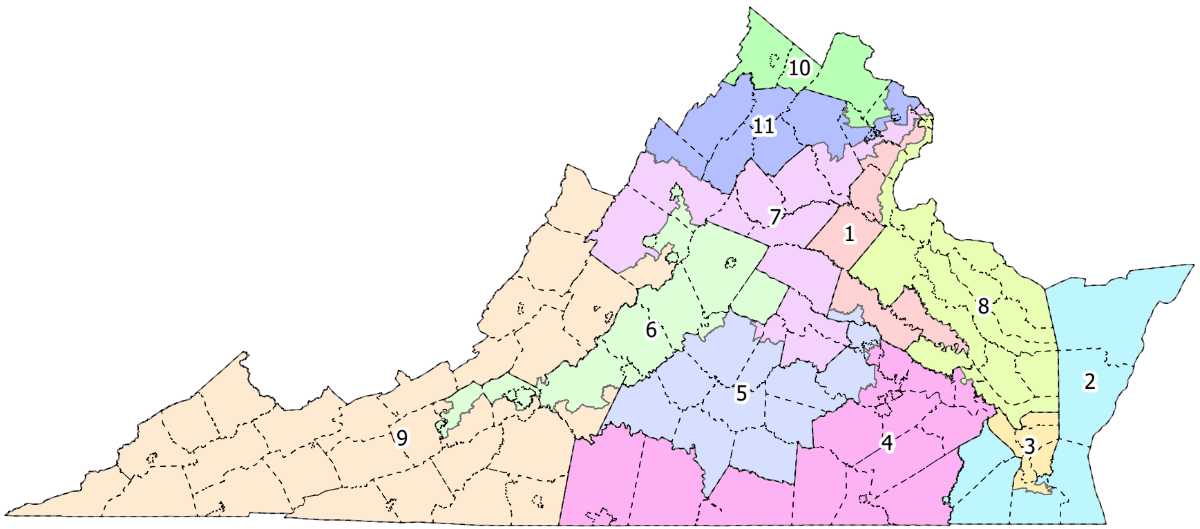
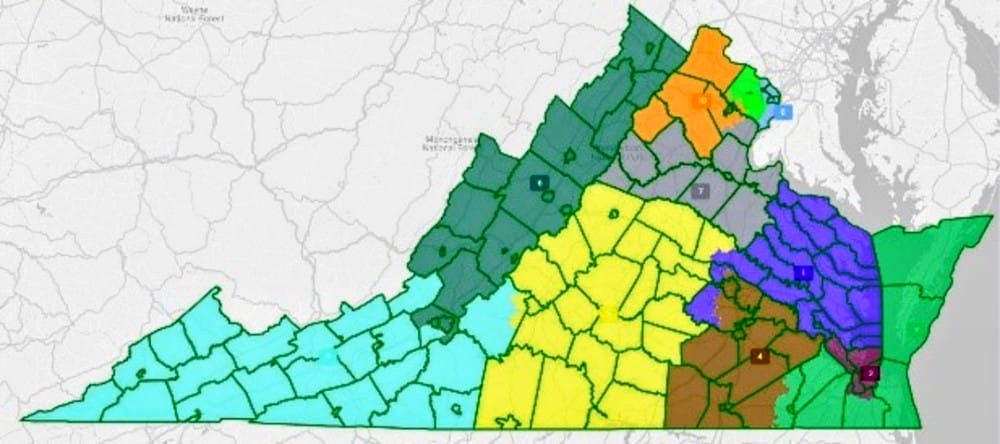
If the proposal by Democrats in Richmond survives a court challenge and wins approval by voters, Arlington would be cleaved into two congressional districts. The southernmost part of the county would remain in the 8th District — which currently contains all of Arlington — while northern areas would move into the 7th District.
The 7th District would wander west and the 8th District would plunge south, both going to parts of the commonwealth far away from Arlington both politically and geographically.
The Arlington County Democratic Committee is planning get-out-the-vote efforts in either case, while the Arlington County Republican Committee is urging voters to reject the redistricting plans. Meanwhile, campaign announcements in both congressional districts are rolling in.
Legislation currently pending in Richmond would move all state primaries, not just those for House of Representatives, from mid-June to Aug. 4, and would delay the filing deadline for U.S. House races until late May.
Democrats ‘prepared for either scenario’
In a statement to ARLnow, the Arlington County Democratic Committee said it would be ready whether the districts change or stay the same.
“Arlington Democrats are prepared for either scenario and will be fully engaged in organizing voters, regardless of the final congressional maps,” the statement read, adding:
“Whether Arlington remains entirely in the 8th District or is divided between two districts, our focus is the same: ensuring voters are informed, organized and ready.”
Party chair Paul Ruiz has launched a redistricting campaign committee, which will coordinate voter education and communications.
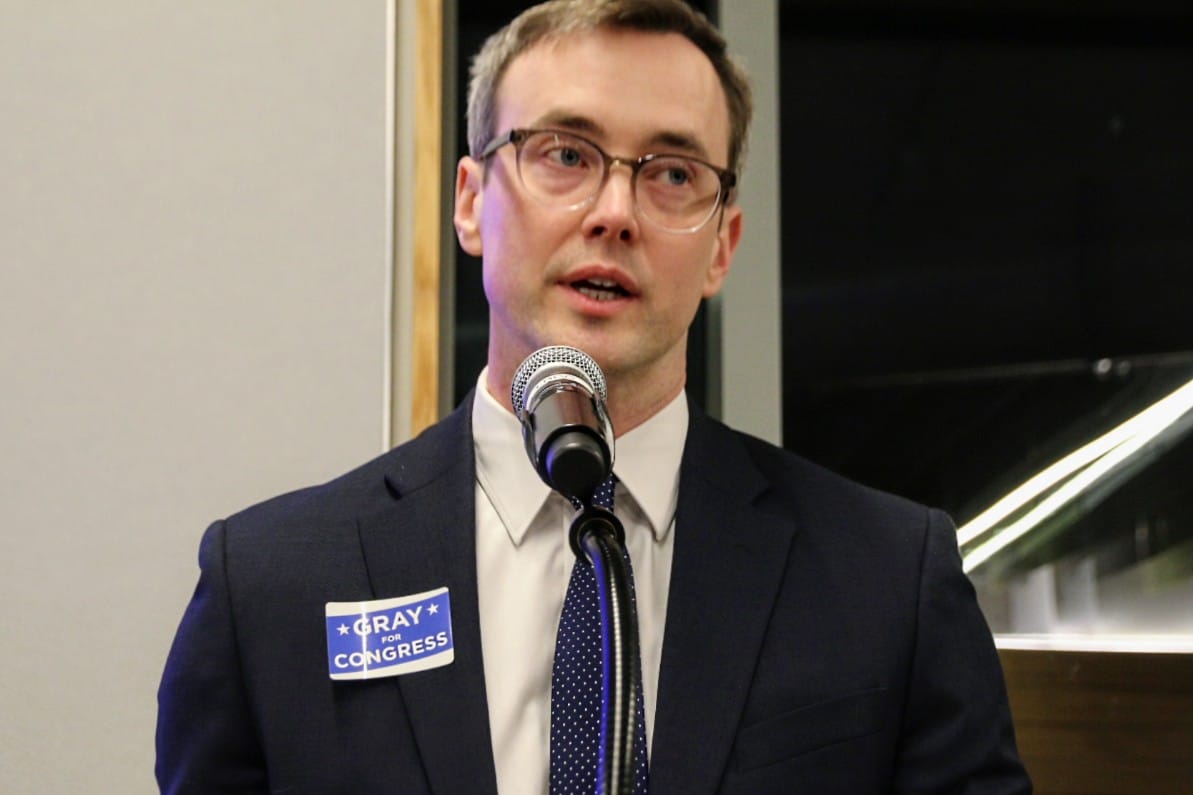
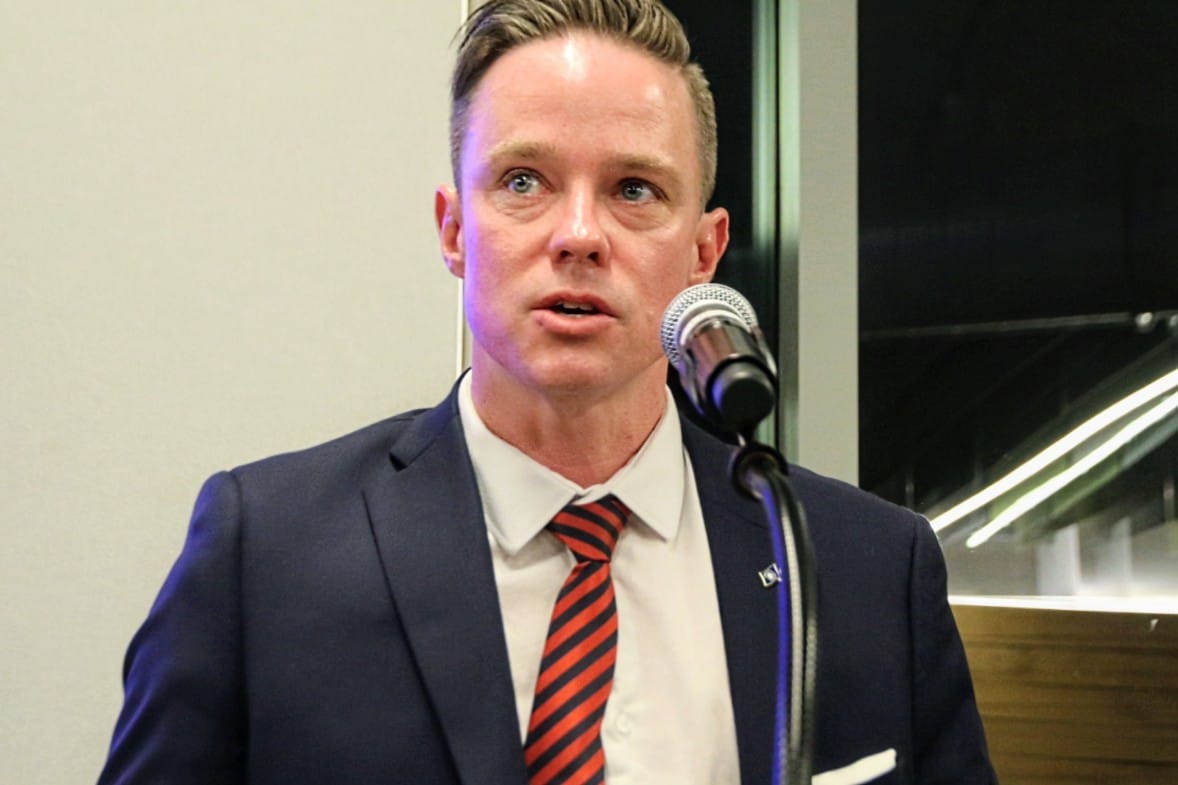
Arlington Democrats already have heard from four of their party’s candidates vying to represent the 8th District.
Mohamed “Mo” Seifeldein delivered remarks at the committee’s January meeting, while Adam Dunigan, Daniel Gray and incumbent Rep. Don Beyer spoke at the February meeting.
A fifth announced candidate, Michael Duffin, told ARLnow he plans to deliver remarks before Arlington Democrats at their March meeting.
Duffin was an employee of the U.S. Department of State whose job was eliminated last year. On Feb. 9, he made remarks to the Alexandria City Democratic Committee, focusing much of his fire on the Trump administration.
“Where I grew up, we didn’t run from bullies. We stood our ground and fought,” he said.
Duffin’s remarks in Alexandria didn’t reference Beyer, but complained about the general Democratic response to workforce cuts.
“I was disappointed by the lack of fight by most Democrats on the Hill,” he said.
The current 8th District is compact, incorporating all of Arlington, Alexandria and Falls Church and about one-third of Fairfax County.
The proposed new 8th District would still include all of Alexandria, which has a voting-age population of about 130,000. Beyond that, however, its boundaries would be significantly altered.
The district would incorporate portions of Arlington, Fairfax and Prince William counties totaling about 76,000 voting-age residents in each of those three jurisdictions, according to the Virginia Public Access Project (VPAP).
As it wends its way downstate, it would pick up all or parts of 15 additional counties, according to VPAP: York, Gloucester, Stafford, Caroline, King George, New Kent, Westmoreland, Northumberland, Lancaster, Middlesex, Essex, James City, Richmond, Mathews and King & Queen.
Democratic gubernatorial candidate Abigail Spanberger won about 63% of the vote among the electorate in the redrawn district. In contrast, Spanberger won 80% of the vote over Republican Winsome Earle-Sears in the existing 8th District, according to the VPAP analysis.
Republicans: ‘Vote no’ in referendum
When it comes to the April referendum, Arlington County Republican Committee chair Matthew Hurtt told ARLnow his party will “work closely with every organization turning out voters to raise awareness for this issue and encourage Virginians to vote ‘NO!’ on this measure.”
“Virginians voted overwhelmingly — 66.1% to 33.9% — to STOP partisan redistricting in 2020 … [after] the measure passed overwhelmingly through the General Assembly the year before,” he said, adding:
“Arlington Republicans stand with millions of Virginians — a near two-thirds majority of Democrats, Republicans, and independents — who overwhelmingly made their voices heard when they voted to enshrine nonpartisan redistricting into Virginia’s Constitution.”
The 2020 referendum indeed was a slam-dunk statewide, but not in Arlington.
The county was the only jurisdiction in the commonwealth where a majority of voters (55%) cast ballots against the constitutional amendment for nonpartisan redistricting. The Arlington County Democratic Committee had included a “no” position on its sample ballot that year.
In neighboring Alexandria and Falls Church, where political persuasions tend to mirror those in Arlington, voters supported nonpartisan redistricting with totals of 61% and 66%, respectively.
121,000 Arlingtonians could shift into 7th District
The redrawn 7th House District has no incumbent Democratic member of Congress living in it, although U.S. Rep. John McGuire (D-5), who is serving his first term in Congress, is a resident.
About 30% of the voting-age population in the redrawn 7th District would come from Fairfax County, with about 20% — just over 121,000 — from Arlington, according to an analysis by VPAP.
The district would trail west and south, taking in the city of Falls Church and all or part of the counties of Rockingham, Culpeper, Louisa, Orange, Powhatan, Augusta, Goochland, Fauquier, Prince William, Green, Madison Cumberland and Buckingham.
Spanberger won about 58% of the vote in areas that would be included in the redrawn 7th District.
In the emerging race, Democratic candidate J.P. Cooney announced last week that he had raised more than $200,000 in the first 24 hours after launching his campaign. He said that he gained more than 2,500 donors in that short period, with an average contribution of $77.
“This early support shows that our community is ready for leadership that will hold this administration and Republicans in Congress accountable,” said Cooney, an Arlington resident and former federal prosecutor who worked in the office of special counsel Jack Smith.
He was fired by the Trump administration last January.
Del. Dan Helmer, a Democrat who has represented southwestern Fairfax County in the House of Delegates since 2020, also announced a bid to represent the 7th Congressional District today (Wednesday).
‘Massive’ turnout on the horizon?
At least one of the Arlington Electoral Board’s three members thinks the referendum may be one for the record books.
“We have the potential to see massive turnout,” vice chair Dave Leichtman said at the Feb. 13 meeting.
Even if that possibility comes to pass, election officials do not expect significant bottlenecks at the polls.
With just one question on the ballot, “we won’t have people in the booths for 20 minutes,” Electoral Board secretary Dominick Schirripa said.
At their meeting, Electoral Board members set the timing for early voting, to take place at the government headquarters starting March 6 and, in more limited amounts, at the Walter Reed and Madison community centers.
Approving a request from Reinemeyer, Electoral Board members voted to cut the daily operating hours of the elections office by an hour. Instead of being open for general business and early voting from 8 a.m.-5 p.m., the hours will be 9 a.m.-5 p.m. moving forward.
The change will help control staffing costs and provide time from 8-9 a.m. to do staff training.
Electoral Board members seemed to have no qualms about the slight reduction in early-voting opportunities.
“Given all the [voting] options, I’m not worried about shaving an hour,” Leichtman said.
