

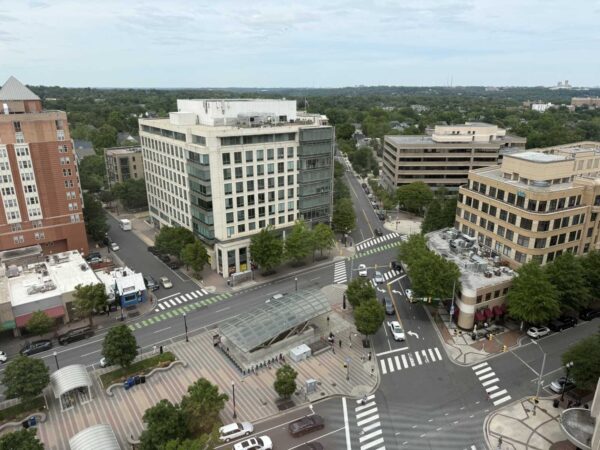
A variety of new pathways for redevelopment projects in Arlington and around Virginia are poised to open up following the passage of numerous housing-related bills.
On the way to Gov. Abigail Spanberger (D) are bills that would allow localities to make an administrative approval process for affordable housing and eliminate rezoning requirements for churches that develop affordable housing on their properties.
The General Assembly also passed legislation allowing homeowners to obtain administrative approval from localities for accessory dwelling units, permitting manufactured homes wherever site-built homes are allowed, and limiting parking requirements along transit lines and in certain districts to allow more room for housing units.
Faith in Housing
The Faith in Housing bills (HB 1279 and SB 388), if signed by Spanberger, would allow faith-based organizations and other tax-exempt nonprofits to bypass a key public input step by eliminating the need to rezone for redevelopment projects. Under the legislation, developments would have to contain at least 60% affordable housing for a minimum of 30 years.
The legislation would go into effect on Jan. 1, 2027 and would sunset after 2030 unless reenacted by a future General Assembly bill. Church-based developments would be subject to property tax unless the locality chooses to exempt them.
According to the pro-housing coalition HousingForward Virginia, faith-based organizations own more than 74,000 acres in the state, ranging from smaller urban properties to larger rural campuses. In the Lyon Village neighborhood, Clarendon Presbyterian Church, alongside True Ground Housing Partners, faced challenges advancing a proposal for a 90-unit senior affordable housing community.
Rev. Alice Tewell of Clarendon Presbyterian Church told ARLnow that her church decided to pursue the project in 2020 and expanded its footprint in 2021 for that purpose. But after five years, and with opposition holding up the rezoning process, rising construction costs priced out the project.
“We had no idea that the zoning would be so difficult,” Tewell told ARLnow. “We knew that we weren’t in the Clarendon sector plan in Arlington, but we knew that it was across the street, and we knew that less than 500 feet away, they were building 10-story buildings. So it just seemed reasonable to be able to build senior housing on our church land.”
Tewell has advocated for the bill since joining a broad group of housing advocates in early 2025. She noted the bill still specifies various review processes that developments must go through. Clarendon Presbyterian’s affordable housing project, for instance, would fall within a historic district, making it subject to stricter guidelines.
“I also live in Arlington, and I would want the proper studies to be done for any building that was being put up close to where I live or close to where I work,” Tewell said. “So it would still have environmental studies, which are quite extensive, archeological studies, historic studies, the sewer that people often mention, the tree canopy, the traffic studies — those would still all happen under this bill.”
Tewell says churches will need to review the final version of the bill if it becomes law, and it will take additional time to bring forward development proposals. Clarendon Presbyterian Church hasn’t decided if it will bring back its senior affordable housing proposal.
The pastor said the church will have internal talks, and would need to get approval from its governing authority, National Capital Presbytery. The church would also need to find a developer that believes the project is financially viable.
“For Faith in Housing, I’m not quite sure if on day one, you’ll get lots of applications,” Tewell said. “I would imagine that there would be a few, but congregations need usually a year or so to discern what they want to do next.”
Affordable housing administrative approvals
A bill allowing administrative approval of affordable housing (HB 594) gives localities authority to administratively approve affordable housing development proposals rather than require a full rezoning.
Arlington County would have to adopt an ordinance to allow this process to occur. Currently, Arlington has density bonuses for multifamily developments that provide a certain percentage of affordable housing.
Sheila Herlihy-Hennessee, director of faith organizing at the Virginia Interfaith Center for Public Policy, told ARLnow the legislation could incentivize developments with greater affordable housing percentages over ones with lower percentages, which would require more review. She compared it to doing a zoning code rewrite, where localities can choose the places where they would like more affordable housing and the densities for that development.
“It would be up to Arlington to actually write that ordinance and approve that ordinance and all that jazz, but it is a little bit similar to Missing Middle, because it does say that now this increased density would be allowed without having to go through [a special use permit] or conditional use permit process or rezoning,” Herlihy-Hennessee said. “But it’s a little bit more of a targeted focus, because it’s for explicitly affordable housing, as opposed to middle housing.”
Herlihy-Hennessee said the affordable housing administrative review process would go hand in hand with the county’s embattled Missing Middle policy, while focusing more on affordable units than middle-tier housing.
Other housing bills
Some other bills advanced in the General Assembly already apply in Arlington. The county already has an accessory dwelling unit program, which SB 531 would require all localities to have in their zoning ordinances for single-family residential zones.
“Arlington already has ADUs, and they seem like a great thing in our neighborhoods,” Tewell said. “They allow people to retire in place or allow adult children to live on the property, but maybe not in the same house. They allow for a rental unit to make your house more affordable, basically a house in someone’s backyard.”
Another bill (HB 4) gives localities the right of first refusal on publicly-supported housing to preserve affordable housing.
Tewell said that the parking requirements bill (HB 888) largely applies near Metro stations and other public transit.
“I think having to build less parking for every housing project would take down the cost of the project as a whole and make it more affordable,” Tewell said. “I’ve also heard that developers build as much parking as the people that live in the buildings need, so they can’t rent out the building if there is no parking, because people won’t live there, especially if it’s far from transit.”
A handful of other housing bills did not pass, including ones that sought to allow by-right multifamily development in commercial zones and put limits on private equity firms buying single-family homes.
Several tenant protection and eviction prevention measures passed the General Assembly, including HB 527 to create an eviction reduction program, HB 15 to increase the mandatory waiting period to suspend a rental agreement over unpaid rent, and HB 593 to provide more information to tenants with their eviction notices. However, HB 1177 — which would have allowed rent stabilization — did not pass.
Overall, Herlihy-Hennessee said she would give the General Assembly an “A-” grade on housing legislation due to the tenant protections and eviction reduction bills that advanced.
“However, on specifically the supply side part of housing, I feel like it’s more like a B,” Herlihy-Hennessee said. “I was very excited to see both Faith in Housing and expediting affordable housing go through. But there were some other bills that really would have helped get at the heart of the supply side crisis that ended up dying, either in committees or on the floor.”
Tewell added, “If parking reform and ADUs and Faith in Housing all get signed by the governor, I would say that it is a win for Virginia. It would be the most affordable housing legislation that I believe Virginia has ever passed, and it would set us up for the future to pass more.”
Spanberger has an April 13 deadline to act on bills passed during the 2026 General Assembly session.
