


This reporting was supported by the ARLnow Press Club. Join to support in-depth local journalism — and get an exclusive early morning email with a preview of that day’s planned news coverage.
By the time of his death in late 1995 at age 96, Edmund Campbell had been lionized as a civic leader and statesman whose legacy extended well beyond Arlington into state and national affairs.
The Washington Post ran a lengthy editorial on Dec. 17 of that year, describing Campbell as “a pioneer civic leader and force for good local government.”
The editorial praised his two terms on the County Board (1939-46) as a time when Arlington implemented its first master zoning plan, established an elected school board and grappled with issues not only of World War II but of postwar planning.
It noted his years as an attorney, often taking civil-rights cases that would, over time, help bring an end to state-mandated segregation policies. And it waxed rhapsodic about his marriage to Elizabeth Campbell, a potent force in her own right who served on the School Board and founded what became the public-television giant WETA.
Much less coverage had resulted five and a half years earlier, when Daniel Dugan had died at age 74 of congestive heart failure at Northern Virginia Doctors Hospital on Aug. 8, 1990.
A few modest obituaries memorialized the life of Dugan, who was living in Reston at the time of his death, but there were no grand retrospectives like those lionizing Campbell upon his death.
And yet, in 1946, Dugan had pulled off one of the greatest political upsets in County Board history. His victim? Edmund Campbell.
Running as an independent, Dugan trounced Campbell, who was serving as Board chair and had the full backing of not just the Arlington County Democratic Committee, but the powerful state political machine of Sen. Harry Byrd.
Campbell, a champion for liberal causes, backed by the Byrd Machine? It simply goes to show that Virginia politics in 1946 made for some strange bedfellows.
The 1946 County Board campaign has been largely lost to history, but was brought back to life during a recent presentation at the Arlington Historical Society by William Fogarty. Fogarty is a retired attorney who pens the “Our Man in Arlington” column in the Falls Church News-Press and researches and writes about county history.
His presentation focused primarily on the 1946 election, describing the Arlington County Board results as the first crack in the Byrd Machine across the commonwealth.
A look deeper into Dugan’s victory and his subsequent term and a half in elected office reveals a wild time in local governance, with many attempting to remove partisanship from local elected office and others fighting to retain it.
By the early 1950s, Dugan had cobbled together a 3-2 majority of independents on the County Board, and looked well on his way to becoming a power broker in a post-partisan political world in the county.
But the Byrd Machine struck back. Using a state law from 1788 and its control of Virginia’s judiciary, conservative Democratic forces managed to remove all three independents from office.
Campbell — who was representing the three independents in their legal battle to retain office — would decades later refer to it as a “judicial coup d’etat.”
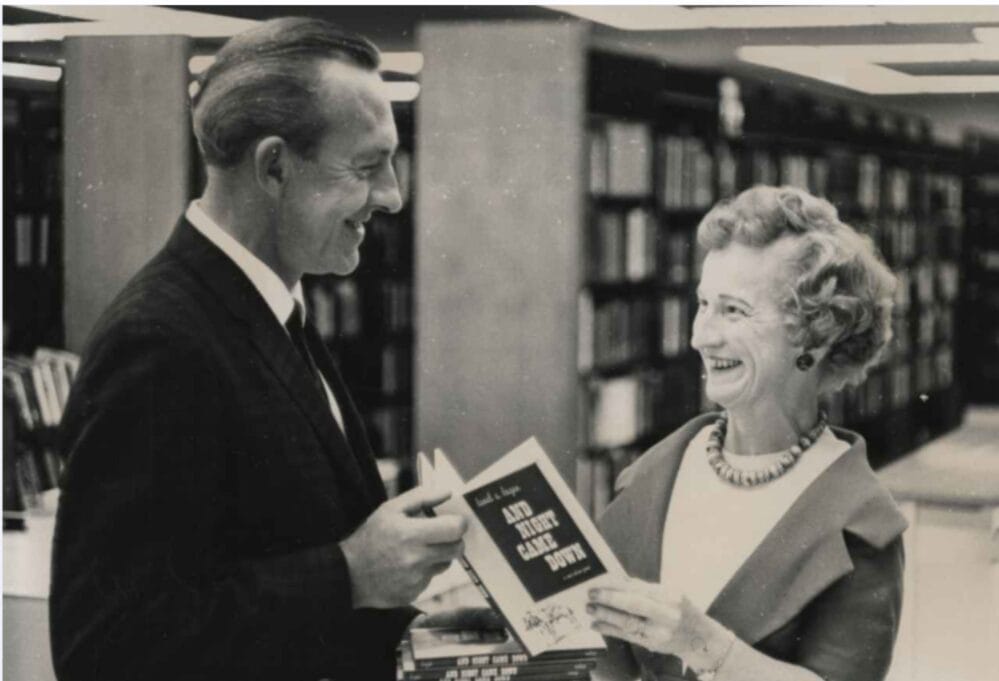
Despite promises to run for office again, Dugan largely faded from the public scene. The county government’s archives contain exactly one photograph of him, presenting a book he had written to the county’s library director in the early 1960s.
He participated in no known oral-history projects before his death, which might have served to flesh out the historical record.
Drawing from media coverage of the time, ARLnow has pieced together elements of the 1946 election and subsequent events in Dugan’s political life.
A campaign launched from out of nowhere
Having served two four-year terms without drawing much flak from the public, it seemed likely that Edmund Campbell would cruise to victory in his quest for reelection in 1946.
He had been chosen by his four colleagues to chair the body that year, giving him a prominent voice even before the campaign began. Backing by the local and state Democratic establishments only helped Campbell’s chances, or so it would have seemed at the time.
So, little was expected when Daniel Dugan, then 30 years old, announced plans to take on the 47-year-old Campbell as an independent. It was not deemed worthy of banner-headline coverage by any of Arlington’s newspapers — the Sun, Arlington Daily and Chronicle among them.
Coverage was also spotty among the major metro dailies, The Washington Post and Evening Star.
The same edition of the Sun that reported on Dugan’s campaign launch noted, in a separate article, that he had just been installed as president of the John Lyon Post of Veterans of Foreign Wars.
The connection to veterans would become an important theme of Dugan’s insurgent campaign in a race that included not just Campbell, but independent H.H. Howe, as well.
The issues of 1946
As 1946 dawned, Arlington — like the nation — was making a welcomed, but complex, transition back to peacetime.
The county, which had ballooned during wartime to 115,000 residents that year, would face issues over housing, zoning, education and the political power of the County Board.
There was also the question of whether Arlington should be incorporated as a city, something sought by the Byrd forces and first introduced into the General Assembly in 1942.
In February 1946, Campbell and Charles Fenwick (then a state delegate) announced their support for incorporation as a city. Leading the opposition was the county’s Republican treasurer, John Locke Green. His name will crop up later in the Dugan saga.
In March 1946, the General Assembly considered the legislation, but Fogarty said it went nowhere.
“I don’t even see where [supporters] tried to have a petition,” he said in the historical society presentation. “They needed to have 1,000 signatures to get the legislation on for a referendum, and nothing happened.”
Supporters of a proposal to eliminate staggered terms of County Board members did launch a petition drive on that issue, aided by support from the Arlington County Civic Federation.
But it was rejected by the court both for having missed the deadline and having only 167 signatures, not the required 200, Fogarty said.
There were also battles over appointments to the School Trustee Electoral Board, the body that then appointed the School Board.
To lobby for better educational services and more responsive government in general, the Citizens Committee for School Improvements was founded. That body demanded that the Rev. Paul Hunter of Rock Spring Congregational Church be appointed to the School Board.
When Hunter, the father of future County Board member James Hunter III, was rejected by Circuit Court Judge Walter McCarthy, the group staged a sit-down strike, but still did not get its way.
With that much going on in the community, it would have been wise for Campbell to have heeded the political dictum of a future county commonwealth’s attorney, who often said an incumbent needs to run “either unopposed, or scared.”

Playgrounds become campaign flashpoint
Looking toward the postwar period and anticipating the Baby Boom to come, Arlington voters in 1943 had approved a bond referendum to acquire land for playgrounds and build them throughout the county.
Three years later, the Dugan campaign used a lack of action as a campaign issue, appealing to parents of young children and those who expected to soon be in that demographic.
The Sept. 13 Northern Virginia Sun noted Dugan’s criticism of the incumbent County Board and County Manager Frank Hanrahan in failing to implement the will of voters.
“Only three of the eight sites have been acquired, and none of these are developed or equipped,” he said. “In the meantime, land prices have risen tremendously.”
Dugan said the county manager was largely responsible for dragging out the issue, and if he didn’t get moving on it, he should be fired.
The challenger pooh-poohed Campbell’s comments that playgrounds were on the way as nothing more than election pandering.
“It has been abundantly clear that if Mr. Campbell had been really interested in expediting the playground program, he would have been demanding action long prior to this election,” Dugan said.
Third candidate’s departure changes dynamics
With two challengers attempting to unseat him, Campbell had every reason to believe they would split the vote and guarantee his victory in days long before ranked-choice voting arrived in Arlington.
But in early September, everything changed: Howe dropped out of the race and endorsed Dugan.
Howe’s decision was based on realpolitik considerations: “It is obviously better for us to unite and win, rather than for both of us to lose in a three-cornered race,” he said.
In pulling out, Howe said he hoped an organization would be formed to support County Board candidates unaffiliated with political parties.
Howe would disappear from politics, but his dream achieved reality in the 1950s. Arlingtonians for a Better County, on the liberal side of the political spectrum, and the more conservative and less long-lasting Arlington Independent Movement, would serve as nonpartisan political organizations.
With the race now a one-on-one affair, the Campbell campaign attempted to tie Dugan to the Arlington County Republican Committee.
Arlington’s GOP had not fielded a candidate but, in shades of John Vihstadt’s 2014 campaign, opted to endorse Dugan’s independent candidacy.
Democratic leaders used that to denounce Dugan as “a Republican in sheep’s clothing.” The challenger attempted to laugh off the accusation.
“The ‘machine’ which controls the Democratic Party in Arlington is carrying on a program of misrepresentation,” he said in comments reported Oct. 4 by the Sun. “They know full well that I am an independent candidate and I am not the Republican Party candidate.”
Facing off at the Organized Women Voters
In late September, Campbell and Dugan faced off in a forum sponsored by the Organized Women Voters of Arlington.
Campbell was critical of what he saw as Dugan twisting facts while on the campaign trail.
While praising Dugan’s military service, Campbell — himself a World War I veteran — said “the fact that Mr. Dugan fought does not give him the right to campaign on reckless irresponsibilities and to make statements he knows to be untrue,” the Sun reported.
Dugan stuck to his key issues, notably the need for nonpartisan leadership on the local governing body.
“Partisan elections deprive a community of many honest and capable citizens who are not in politics, and who will not try to get elected to public office where party nominations are useful,” he said.
Election Day finally arrives
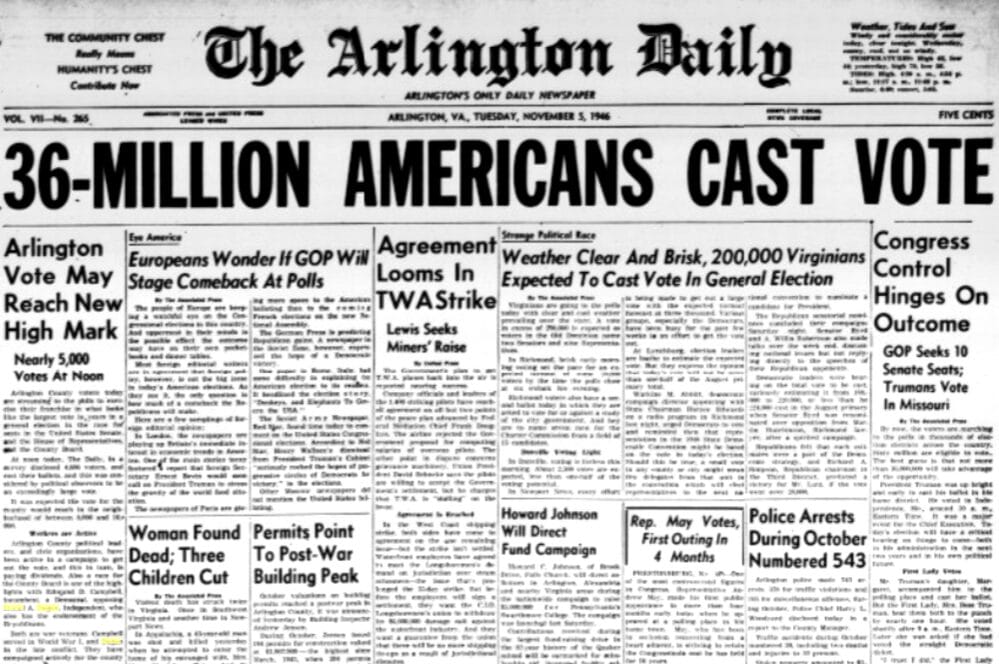
The Arlington Daily was an afternoon newspaper, and its Election Day (Nov. 5) edition noted the “exceedingly large” morning turnout among the Arlington electorate.
More than 4,600 had cast ballots by noon, coverage noted.
In the days leading up to the election, Campbell’s election manager, C. Harrison Mann, had tried to hammer home to voters that the challenger and his campaign manager, Harley Williams, were playing fast and loose with facts on issues ranging from zoning to playgrounds.
Dugan’s tactics “should be beneath the dignity of a candidate who is seeking as important a position as the County Board,” Mann was quoted as saying in the Nov. 1 Arlington Daily.
Dugan seemed to be ignoring the criticism. Four days before the election, his campaign held a countywide rally at Lyon Park Community Center, the Chronicle noted.
Just one of multiple races
The lone County Board race on the Nov. 5, 1946, ballot was just one of a number for Arlington’s electorate.
Not one but two U.S. Senate seats were up for grabs:
- Sen. Harry Byrd, the commonwealth’s undisputed political leader, was seeking a new term in a field that included Republican, Socialist, Communist and Prohibitionist candidates and an independent
- Democrats had fielded A. Willis Robertson — father of future televangelist Pat Robertson — as their candidate for the Senate seat left vacant by the death of incumbent Carter Glass, facing off against a Republican and independent
Also on the ballot was the 8th District U.S. House of Representatives’ seat held for more than a decade by Democrat Howard “Judge” Smith. He was being challenged by Republican Lawrence Michael.
Smith had unsuccessfully attempted to convince the Byrd machine to nominate him for Glass’s Senate seat. Robertson got the nod instead, so Smith opted to seek re-election to his House seat.
Voters across Virginia also were being asked to weigh in on a referendum that would permit the state government to tax federal-government lands in the commonwealth.
That referendum came with a catch: Congress would need to agree to such taxation.
Democrats rattled at national level
President Harry Truman wasn’t on the ballot in November 1946. But the growing unpopularity of the man who had succeeded Franklin Roosevelt in 1945 was certainly on voters’ minds.
In its Nov. 6 edition, the Arlington Daily’s banner headline blared “NEW DEAL DIES, GOP HOLDS CONGRESS.” Its front page was a mix of national, state and local election results — few of them good news for Democrats, be they of the liberal or conservative wing of the party.
Republicans had won control of both houses of Congress for the first time in 14 years, and picked up a large number of governorships.
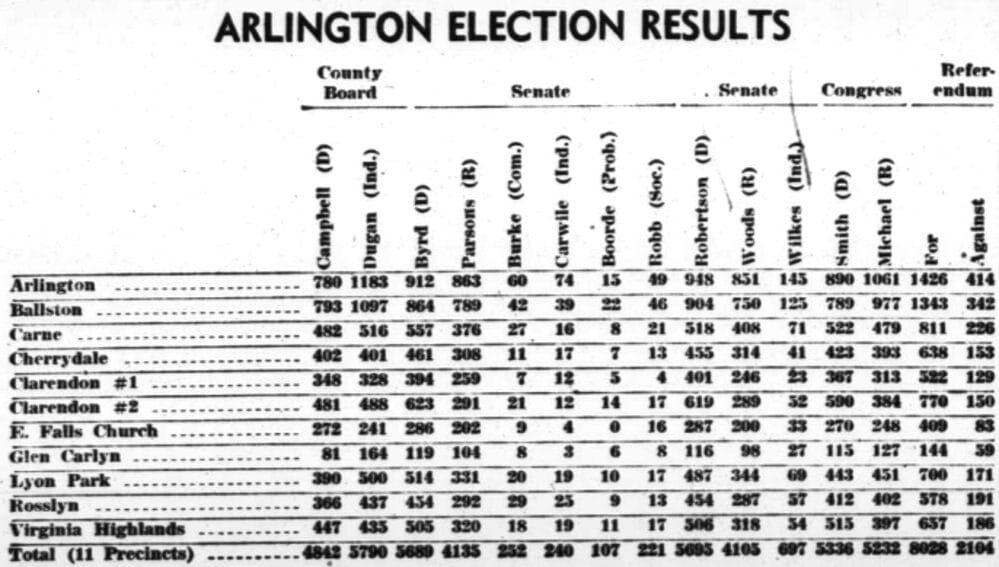
While Democrats were getting pummeled in some parts of the nation, both Byrd and Robertson won healthy majorities across Virginia, and each won all 11 Arlington precincts.
Smith’s reelection to the House of Representatives suggested that the 8th District was moving, slightly, toward greater competitiveness. Republican Lawrence Michael won just under 40% of the district vote and came oh-so-close (49.4%) to winning a majority of Arlington votes.
Like the rest of the commonwealth, Arlington voters overwhelmingly supported the referendum giving Virginia authority to tax federal lands. Predictably, Congress never granted the necessary authorization; federal lands remain nontaxable to this day.
Despite the heated nature of campaign season, no violence was reported at the polls in Arlington, the Arlington Daily noted.
Dugan wins, sets priorities
Day-after coverage of the local race showed Dugan winning 5,790 votes to 4,749 for Campbell. The challenger won seven county voting precincts to four for Campbell, in what the Arlington Daily called “the greatest political upset in recent county history.”
In its election post-mortem, the Chronicle said the ousted incumbent was a victim of circumstance.
“The upset is believed to be a protest against the Democratic Party in the county, rather than against Campbell,” its front-page coverage noted.
Nearly 80 years later, Fogarty came to essentially the same conclusion.
“There was emphatic opposition to the Byrd machine,” he said at his Historical Society presentation.
Fogarty also concurred with the Arlington Daily’s view that it had been the biggest upset in County Board history, adding that it hadn’t been topped in the eight decades since.
“I don’t know all the County Board elections, but I think I’m on pretty good ground here,” he said.
In their post-election comments, Campbell and Dugan put the vitriol of campaign season behind them.
The challenger called Campbell “a thorough gentleman” and “the best member on the County Board.”
Campbell said he wasn’t sure whether he’d run for office again, but said “I expect to continue to take an active interest in civic affairs where best needed.”
Asked by an Arlington Daily reporter to lay out his goals when in office, Dugan spotlighted three: support for veterans, addressing the housing shortage and setting up “an accredited Negro high school” as part of a broader prioritization of school improvements.
W-L students weigh in
While adults (21 and older) were voting at polling places, students in civics classes at what then was Washington-Lee High School were holding their own mock elections for local offices on Nov. 5, 1946.
Northern Virginia Sun coverage doesn’t quite make clear whether the students were selecting those they wanted to win, or those they thought were going to win, the vote in Arlington. But their selections came pretty close to the actual voting.
Students voted for Dugan over Campbell and for Byrd and Robertson for the U.S. Senate seats. All those tracked with final Arlington election results.
Civics students diverged in the 8th District U.S. House of Representatives’ race, voting for Republican Michael over incumbent Democratic Smith.
At least in Arlington, Michael came very close, as the Republican won 49.4% of the county’s vote. Across the 8th District in its entirety, however, he mustered only 37.9% of the vote, winning only Greene County among the 17 counties and cities that then comprised the 8th.
To fast forward: The conservative Rep. Smith would eventually become chair of the powerful House Rules Committee, serving until he was ousted by a left-leaning opponent, George Rawlings, in the 1966 Democratic primary.
Rawlings would be defeated in the 1966 general election by Republican William Scott.
Goodbye to becoming a city?
Crandal Mackey is known in Arlington history as the crusading commonwealth’s attorney who, in 1903, cleaned up Rosslyn of its varied elements of vice, from gambling dens to houses of prostitution to a racetrack.
More than four decades later, long gone from public office, Mackey wielded a pen rather than his famous shotgun as he wrote editorials for the Chronicle newspaper.
In the paper’s first editorial after the 1946 election results were in, Mackey and the Chronicle said Dugan’s victory should put a stake through the heart of plans to make Arlington a city.
Campbell’s “plan to incorporate the county should follow him in defeat,” the editorial noted.
Welcome to the County Board
If Edmund Campbell had any lingering hostility toward Dugan once the campaign was concluded, he did not show it publicly. In fact, he invited the incoming Board member to sit with him on the dais during the body’s two December meetings, so Dugan could get a feel for the rhythm of local governance.
At the last meeting of December, one of Campbell’s four colleagues was absent, but the other three paid tribute to their departing colleague.
“I shall miss him,” said Board member F. Freeland Chew in coverage reported by the Sun. “We have differed many times, but in most instances saw eye to eye.”
Board member Basil DeLashmutt said Campbell’s eight-year tenure would be remembered positively.
“I consider him one of the most capable among those who have ever been on the Board,” he said.
DeLashmutt said Dugan was joining the Board with the community’s “great expectations” behind him, and predicted he would “adequately fill” the seat.
Dugan officially assumed office, and began to draw his $1,200 annual salary, on Jan. 1.
Building an independent majority
It took time, but Dugan’s dream of a County Board with an independent majority began to take shape. In 1949, Robert Cox was elected to the Board, bringing the number of independents to two — still a minority of the five-member board.
Dugan’s 1950 bid for re-election faced few headwinds. Winning 9,931 votes, he easily defeated Democrat Fred Bach (5,497) and independent Jacob Bechtel (1,049).
In 1951, two of the five seats were on the ballot. In a field of nine candidates, Republican Robert Peck (of Bob Peck’s Chevrolet fame) finished first with 5,299 votes, followed by independent Alan Dean with 4,777.
Which meant that, when the 1952 County Board convened in January, independents held a majority and could start implementing some of their policies.
But not for long.
A bizarre interlude
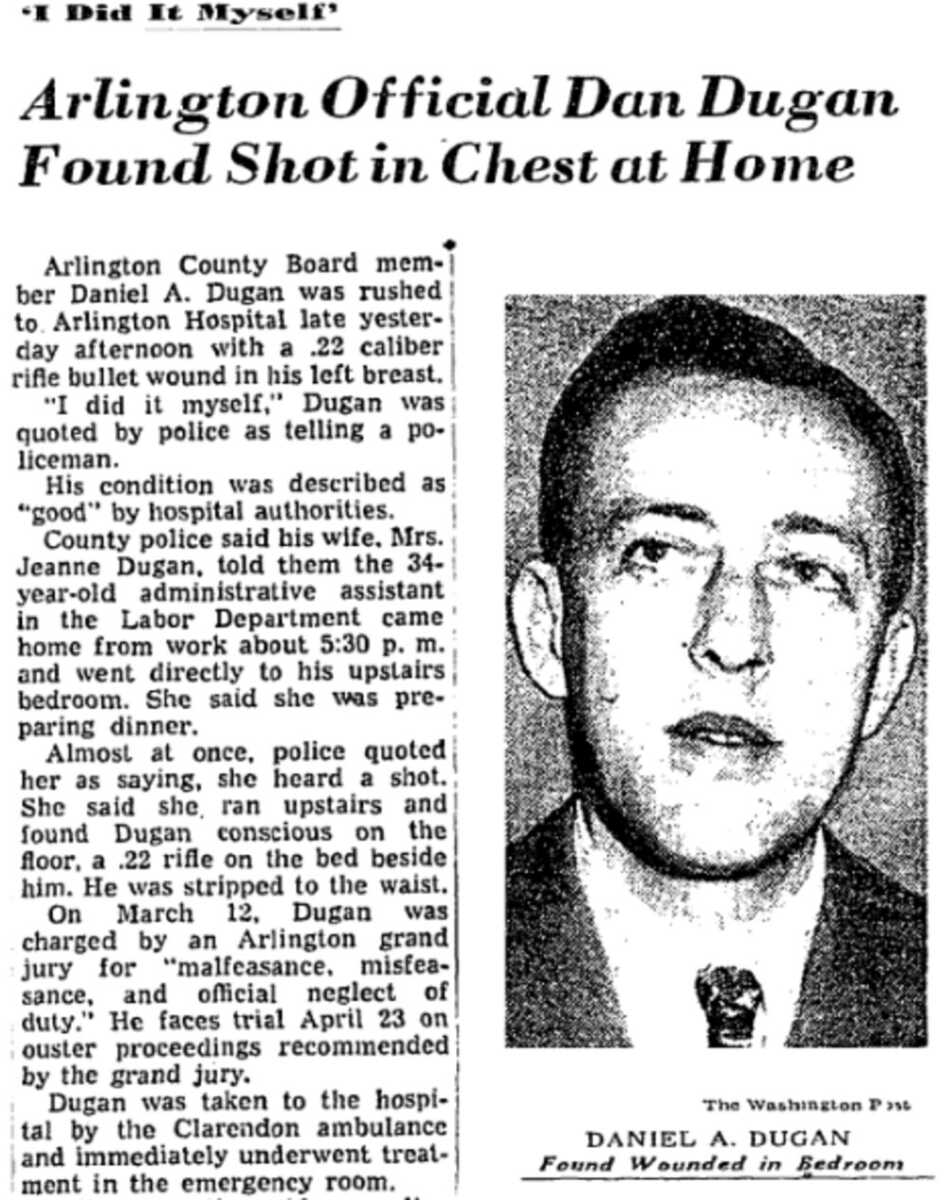
Before getting to the events of 1952 that saw the three County Board independents kicked out of office, it’s worth pausing at a somewhat bizarre occurrence the preceding year. In late March 1951, local newspapers reported that Dugan was in Arlington Hospital following a self-inflicted gunshot wound to the chest.
Just weeks before, Dugan had been charged by a grand jury with malfeasance, misfeasance and official neglect of duty, according to Washington Post coverage.
According to coverage at the time, Dugan was alleged to have appointed to a commission investigating criminal activity a man with “intimate associations” with slot-machine operators.
Dugan denied the charges, and was slated to have his day in court the following month. But the stress apparently got to him.
“A man can only stand so much,” The Post reported he told a police officer at the hospital.
He would later tell the Sun that “I guess I just went off my rocker.”
After a five-day trial in May that included testimony by nearly 40 witnesses, Judge John Ingram of Richmond ruled the commonwealth’s attorney had not proved the case. Dugan was found not guilty.
“The capacity crowd broke into sharp applause, which the judge did not rebuke,” Sun coverage reported.
“Thank God the truth has prevailed,” Dugan’s wife said in response to the verdict.
It was not, however, a complete vindication. Dugan’s attorney, progressive state legislator Armistead Boothe, acknowledged his client was guilty of “indiscretions” in some of his associations with persons of questionable repute.
The indiscretions did not, however, rise to the level of criminality, Boothe successfully argued.
Noting the suicide attempt of the previous month, the Sun reported Dugan looked “worn and thin” during proceedings, and needed a cane to get around.
Tossed out of office
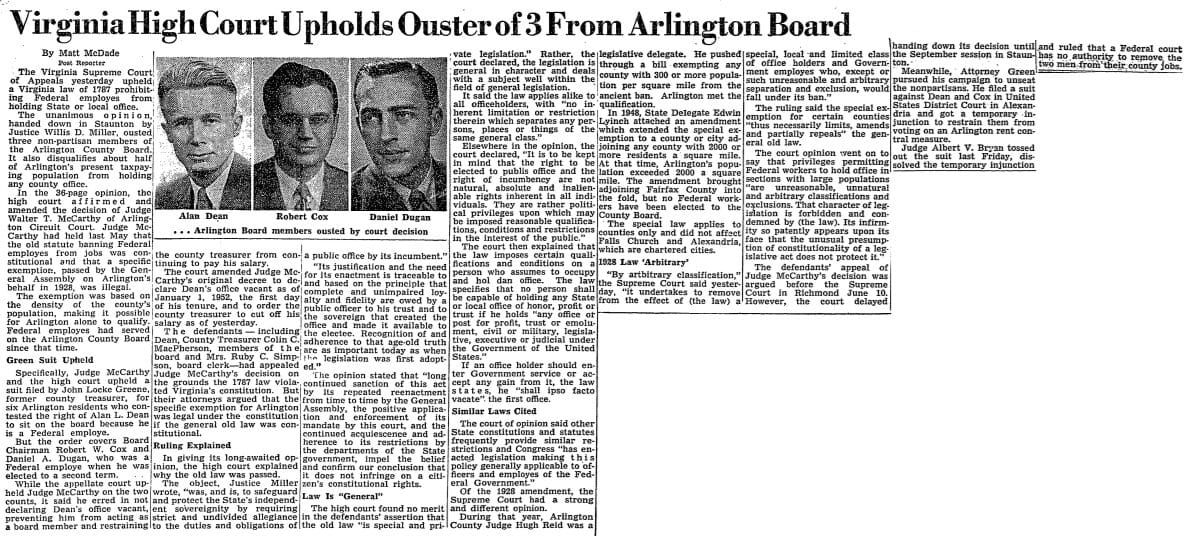
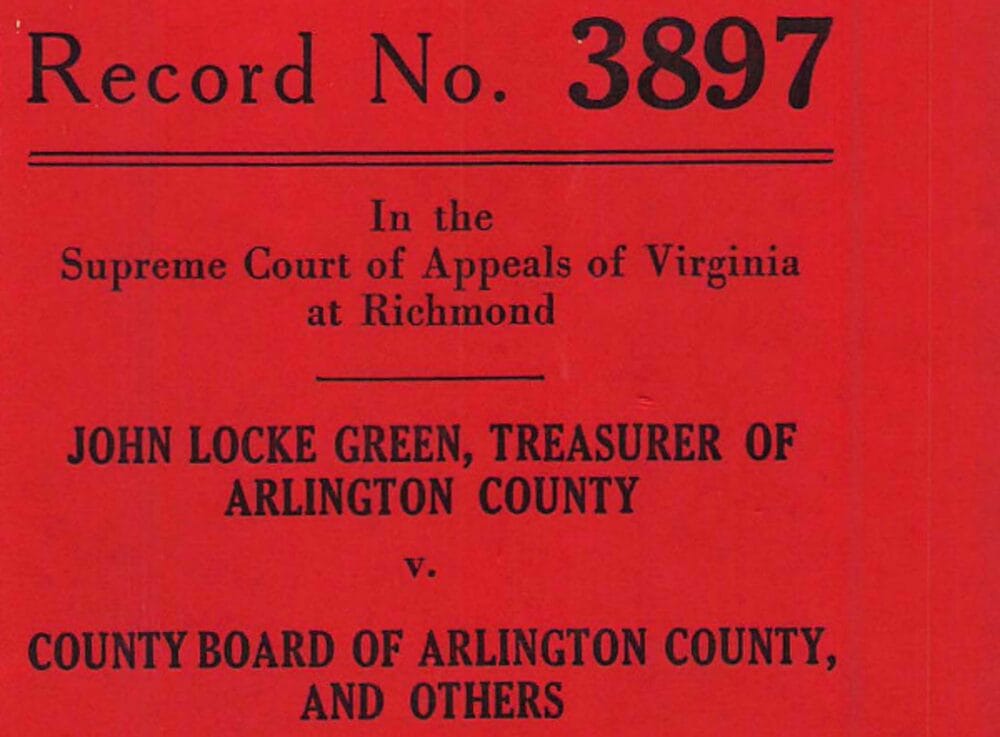
Unrelated to the events of 1951, Republican county treasurer John Locke Green filed suit in 1952, alleging that Dugan, Dean and Cox were holding office unlawfully.
The basis for his suit was a law enacted in 1788 by the General Assembly, declaring that no federal employee could serve in any local or state elected office in the commonwealth.
Dugan, Dean, Cox and their supporters were banking on a 1928 law, passed by the General Assembly specifically for Arlington, providing an exemption from the prohibition on federal workers in local elected office.
Their arguments did not sway McCarthy, who in May 1952 ruled that the three were not eligible to hold office based on the 164-year-old law.
Nor did they sway the Virginia Supreme Court of Appeals, which in a 36-page ruling issued in September 1952 said the 1788 law was valid, the 1928 one was not, and the three elected officials must give up their seats.
That included Dugan, even though he had lost his federal job with the U.S. Civil Service Commission as part of a series of reductions-in-force implemented by the Truman administration.
At the time of the ruling, Dugan was operating an upholstery-cleaning business in Arlington, according to coverage in The Washington Post.
The ruling said that any reasonable restriction on holding elected office “does not infringe on a citizen’s constitutional rights.”
“The right to be elected to public office and the right of incumbency are not natural, absolute and inalienable rights inherent in all individuals,” the court ruled. “They are rather political privileges, upon which may be imposed reasonable qualifications, conditions and restrictions in the interest of the public.”
The ruling, in language perhaps a little arcane for the layman, also affirmed the primacy of the General Assembly and the role of the courts to pay deference to it:
“The passage of an act by the legislature is a solemn declaration and affirmance by that branch of government of its constitutional power to enact the legislation and its unconstitutionality must plainly appear before a court can declare it void. Every reasonable presumption must be indulged and accorded it in favor of its legality.”
If the three displaced County Board members and their legal team considered attempting to make a federal court case out of the matter, such an effort never seemed to have transpired.
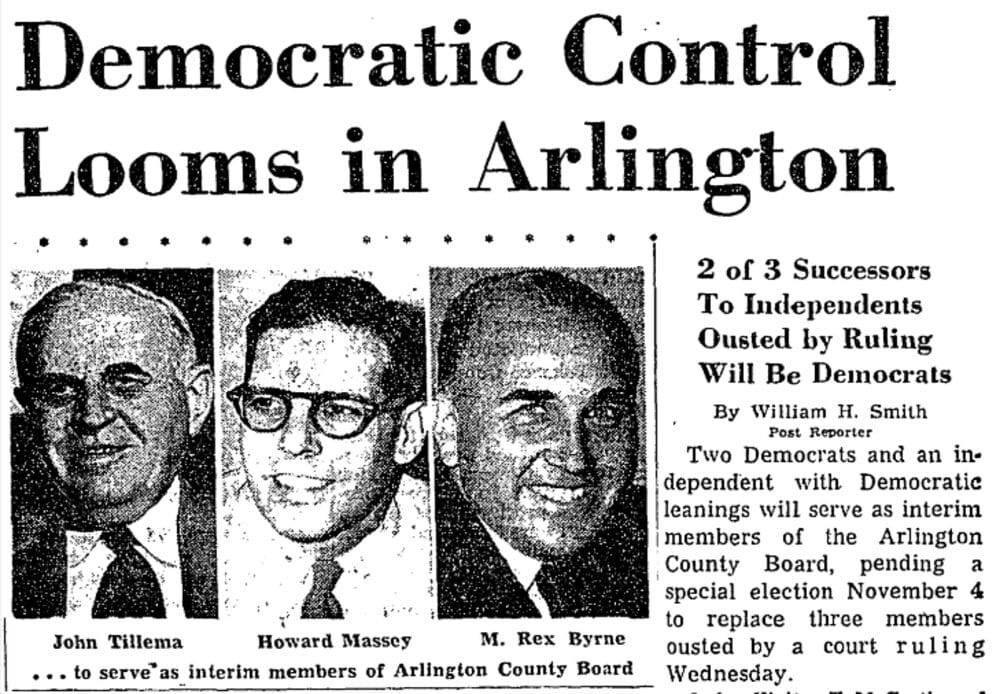
Under state law of the time, the power to fill the three vacancies belonged to Judge McCarthy. His selections, announced in mid-September, further infuriated backers of the independents, according to Washington Post coverage.
McCarthy tapped two Democrats, Howard Massey and M. Rex Byrne, and a Democratic-leaning independent, John Tillema, to fill the seats.
Their tenures, however, would be brief. Each would serve less than two months, until the winners of special elections to fill their seats had been certified by the court.
What became of the other two elected officials whose political careers were cut short in 1952?
Dean served as an economist with the Federal Reserve Board. He died in 2011 at age 92.
Cox, who died in 1983 at age 67, retired as director of administration with the National Foundation on the Arts & Humanities.
Three County Board races at once
After the final court ruling, Dugan, no longer a federal employee, said he planned to run for office in 1952. In the end, his name was not on the November 1952 ballot as Arlington voters cast ballots for all three positions:
- Alvin Kimel won Dean’s seat, which ran to the end of 1955
- Leone Buchholz won Dugan’s seat, running to the end of 1954
- Dr. Robert Detwiler won Cox’s seat, running to the end of 1953
That same November 1952 election also included a referendum on incorporation as a city. The final tally: 3,450 Arlington voters in favor, 27,523 against.
In a rerun of 1946, Sen. Byrd won re-election, as did Rep. Smith.
A last political attempt by Campbell
Edmund Campbell’s 1946 defeat was not the end of the political road for him.
In 1952, Democrats nominated Campbell as their candidate for the newly created 10th Congressional District, where he faced off against another Arlingtonian, Republican Joel Broyhill.
With the Truman administration still unpopular and Dwight Eisenhower running atop the Republican ticket for president, the conservative Broyhill was able to eke out a victory by just a few hundred votes.
He would serve in the post for two decades, only occasionally threatened (as in 1964) by a growing influx of a newer breed of liberal Democrats across the district.
Ultimately, Broyhill ended up a casualty of the Watergate scandal. Though he played no role in the malfeasance that forced Richard Nixon from office, the taint of Watergate on Republicans was enough to give Arlington County Board member Joseph Fisher victory in 1974.
Fisher would represent the 10th District until being ousted by Republican Frank Wolf in 1980. During Wolf’s three-decade tenure, Arlington was moved out of the 10th District and back into the 8th.
Picking up the pieces
With their political aspirations apparently in the rear-view mirror, one-time opponents Dugan and Campbell would collaborate in the mid-1950s to create Arlingtonians for a Better County, known as ABC, which for four decades was a potent force in local governance.
The organization endorsed candidates who did not wish to run under a partisan label. Among them was Ellen Bozman, who for the first five of her six County Board victories — 1973, 1977, 1981, 1985 and 1989 — was officially a candidate of ABC, albeit with tacit Democratic support.
In 1958, Campbell led a new task force on potentially making Arlington a city. As with previous efforts, “it didn’t go anywhere,” Fogarty said in his remarks.
After leaving the County Board, Dugan found work as a construction superintendent, including for the Metro system. He also wrote several books, as well as poetry. Campbell would continue the practice of law and segue into the role of Virginia elder statesman.
Flash forward to 2026
One can, if willing to do the research, compile a direct line of office-holders for each of the five County Board seats from the time of their creation nearly a century ago to the present day.
For the seat held by Campbell and then Dugan, after Buchholz came Leo Urbanske (elected in 1958), Ned Thomas (1966), Joseph Wholey (1970), Stephen Detwiler (1978), Mary Margaret Whipple (1982), Chris Zimmerman (1996), John Vihstadt (2014) and Matt de Ferranti (2018).
Like the other four seats on the five-member body, that list of occupants includes a mix of those who remain household names — at least to those who follow local politics — and those whose tenures in office have become more obscure as time marched on.
And if the name Stephen Detwiler sticks out, it is because he was the son of Dr. Robert Detwiler, mentioned earlier as one of those elected in 1952.
De Ferranti is currently seeking to hold onto the seat, having announced in early January plans to run for re-election. He is being challenged in the Democratic primary by James DeVita, who has previously run twice for County Board and once for State Senate.
The general-election field has yet to firm up, but the winner of the Nov. 3 election is likely to occupy the Campbell-Dugan seat into the 2030s.
Thanks to the Library of Virginia, Charlie Clark Center for Local History, Arlington Historical Society and the Arlington library system assisting with research.
