

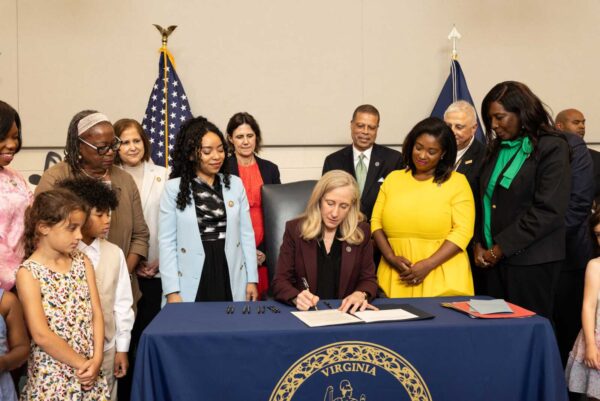
Legislation addressing the high cost of childcare in Virginia has received Gov. Abigail Spanberger’s signature — but it’s still unclear how much funding it will entail.
The governor held a ceremonial signing at a Richmond daycare yesterday (Wednesday) for Del. Adele McClure’s HB 18 and the Senate version (SB 3) by state Sen. Lashrecse Aird (D-13). The pair of bills will create an Employee Child Care Assistance Program with matching funds to incentivize employers to provide contributions for their employees’ childcare costs.
The Virginia Early Childhood Foundation will administer the program.
McClure (D-2), the mom of a toddler, shared personal experience with the burden of high childcare costs. Last year, she returned to the Virginia General Assembly eight weeks after giving birth — introducing bills, giving speeches and joining legislative discussions while caring for her infant daughter.
Once the session ended, she was not able to rejoin the workforce due to the difficulty of finding affordable childcare.
“We couldn’t afford full-time childcare. I live in an area with the highest childcare costs in the nation,” McClure said. “I had always advocated to expand access to affordable childcare, because it is an absolute necessity, one that so many needed yet so many had to go without — but once my daughter arrived, I understood the unique, painful and sometimes impossible position that working parents are in, and how economic realities too often shortchange the children who need our help most.”
The Employee Child Care Assistance Program’s state funding amount will be determined by the state budget, which has not yet been passed. Under the Senate budget proposal, the program would get $50 million over the two-year funding cycle, while the House version proposes $25 million.
The two-year state budget remains undecided as divisions remain between Democratic House and Senate leaders, as well as Spanberger, over whether to continue or end state sales and use tax exemptions for data centers. If state leaders do not pass a budget before the new fiscal year begins on July 1, Virginia could face a first-ever partial government shutdown.
“Right now the Employee Child Care Assistance Program and so many other very worthy, urgent priorities serve as great examples of why it is important that we ultimately pass a budget, because we have to fund these priorities,” Spanberger said.
McClure says the program will not only help families facing tight budgets due to the rising cost of living, but also employers seeking to retain employees.
“It will offer a leg up to so many in need of affordable child care, which also provides employers with an effective way to support and retain their workforce, including for childcare providers who are in need of childcare themselves as costs continue to rise on essentials like transportation, groceries, gas and medical care,” McClure said. “Monthly childcare payments can often rival mortgage and rent payments, and the unfortunate reality is that when childcare is no longer affordable, women are disproportionately impacted, which means that too many working mothers are forced to leave the workforce.”
Spanberger said rural communities may face shortages of childcare options, while suburban communities often have plentiful options but long wait lists.
Northern Virginia has the highest costs in the state, sometimes running upwards of $20,000 per year.
“We are competing against 49 other states for the best talent in the United States, and for the businesses that follow that talent, if childcare costs are driving parents out of the workforce, we are losing that competition before it even starts, and the costs are staggering,” Spanberger said. “The idea that you are paying more than college tuition, or more than a car payment, or more than a mortgage to have your children in quality childcare is larger issue that should impact and does impact all of us.”
The legislation specifies that state matching funds would be awarded on a first come, first served basis but that small business contributions would be prioritized.
The legislation seeks an interim report from the Virginia Early Childhood Foundation to the General Assembly by Sept. 1, 2028 and full report on the program’s effectiveness and impact by Sept. 1, 2030.
