

The treatment of those enslaved by Bazil and Elizabeth Hall on their 330-acre Arlington farm in the 1850s was known to be excessively cruel even by the brutal standards of the era.
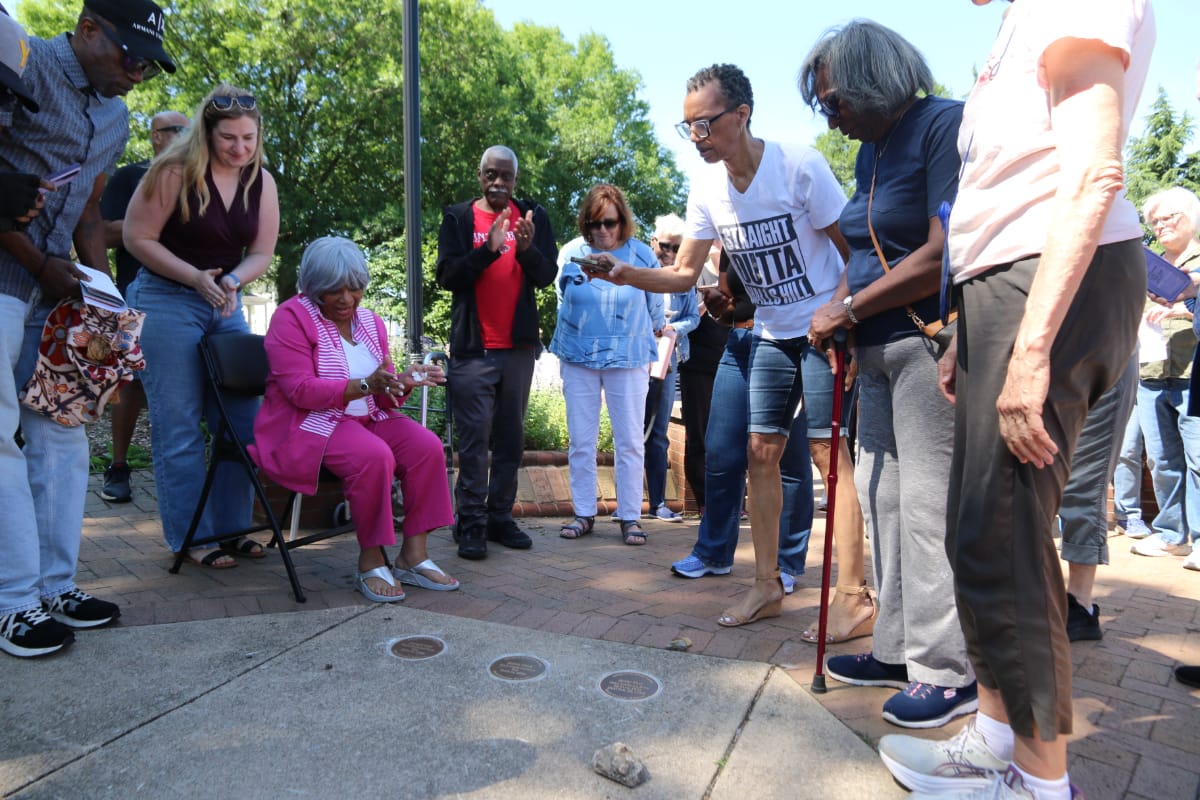
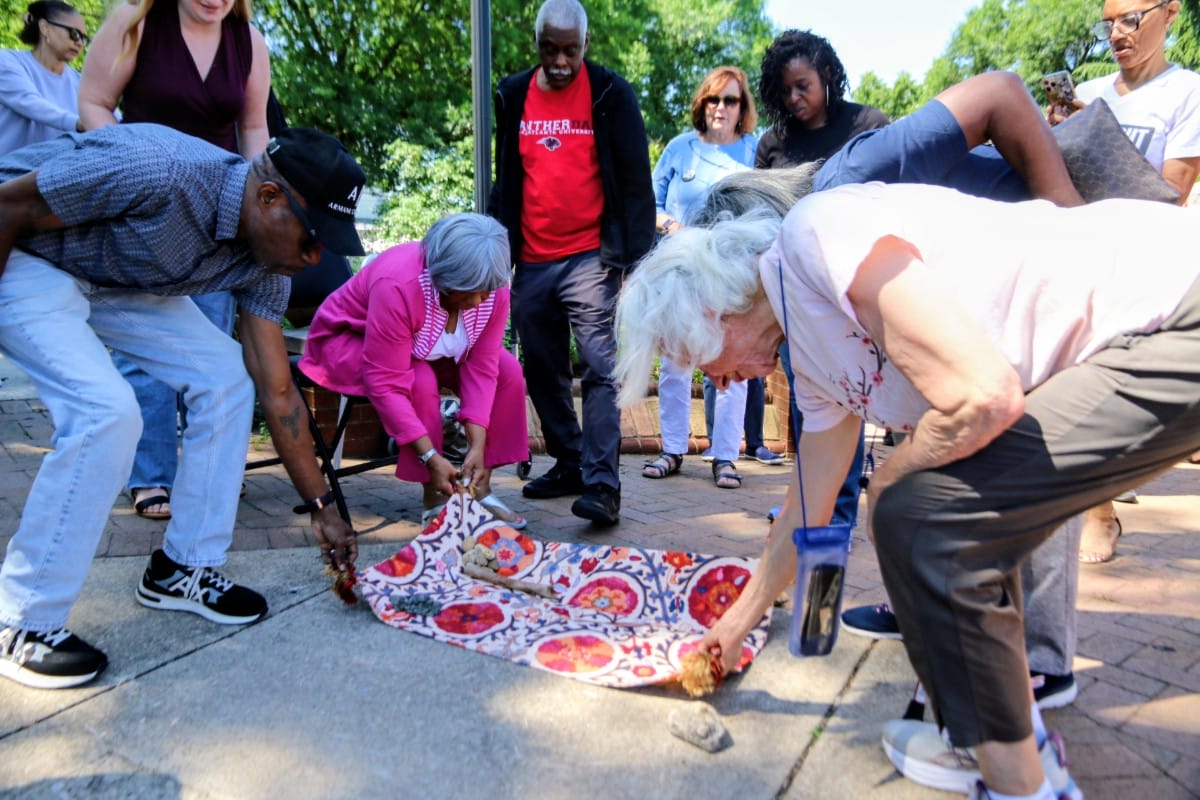
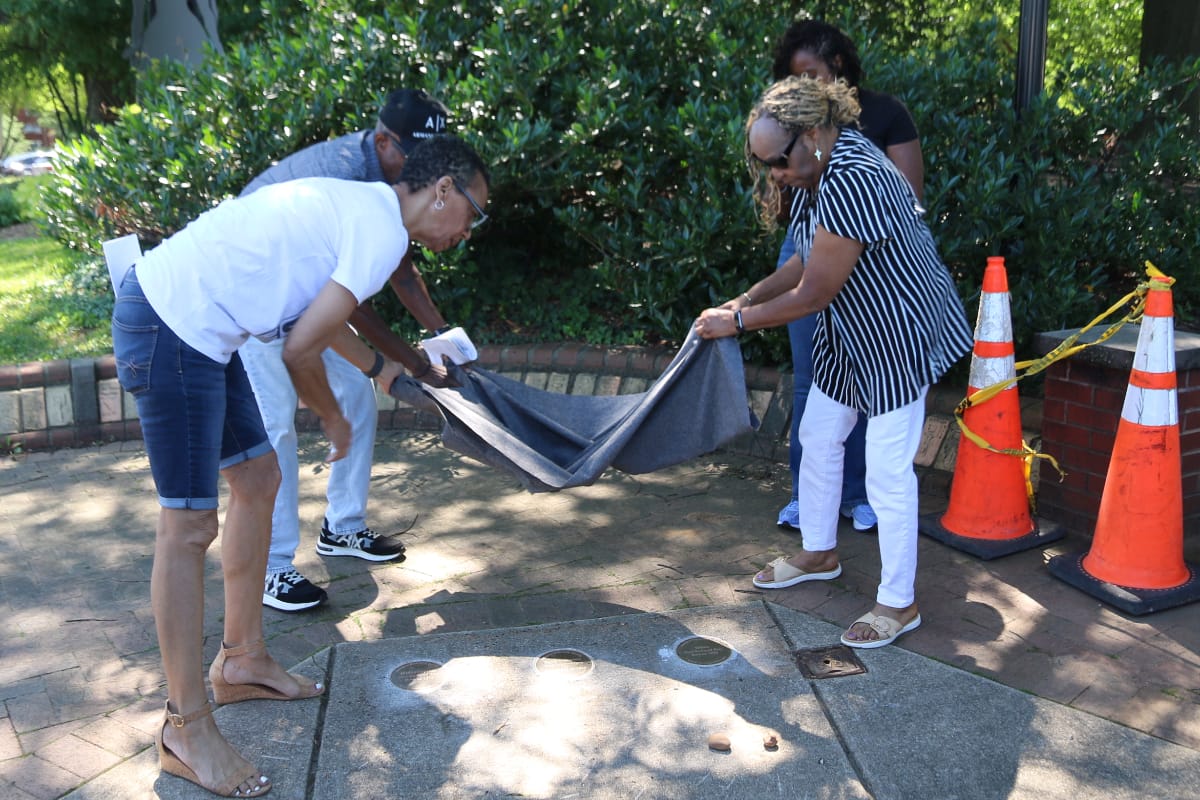
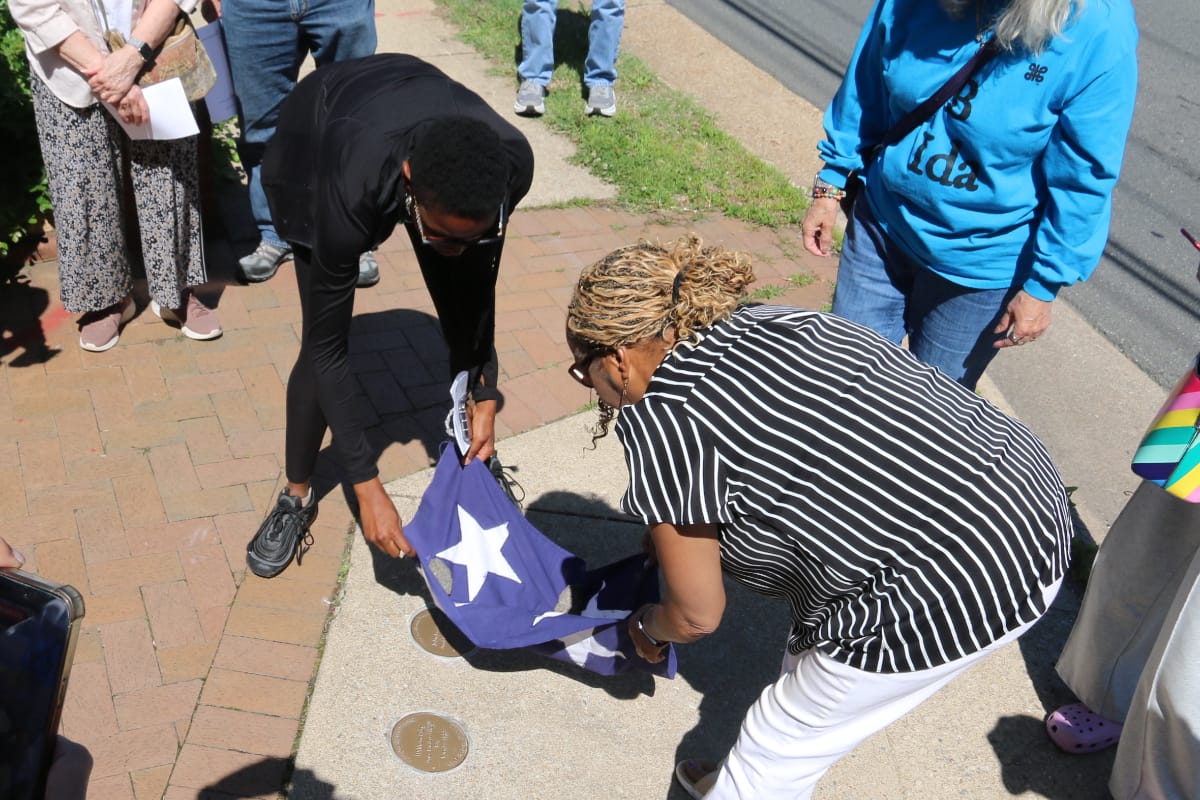
Last Saturday (May 30), eight of those who lived in bondage on the farm were honored with the latest “stumbling stones” placed through the Memorializing the Enslaved of Arlington initiative.
Honored were Jenny Farr and her four sons — James Clark, William Farr, John Lewis Farr and Joseph Farr — along with William Sprigg, his wife Selina and their infant daughter.
“Their names deserve to be said out loud,” said Wilma Jones, president of the John M. Langston Citizens Association, during a dedication ceremony that attracted about 75 people to a small park fronting Langston Blvd at N. Cameron Street in the Halls Hill/High View Park community.
With the brass markers now embedded in the sidewalk, “you cannot pass through the neighborhood … without being reminded” of those “who lived and labored and suffered and survived” in bondage, Jones said.
In 1850, Bazil Hall purchased Jenny and her son, James Clark. While enslaved in Arlington, Jenny married Alfred Farr, a free Black man employed by Hall. They proceeded to have three sons.
Under the law at the time, the status of children born in such marriages was determined by the mother’s status. As Jenny Farr was enslaved, all her children legally were born into slavery, as well.
It is known that William and Selina Sprigg also were enslaved on the property, although whether the Halls owned them outright or leased their services from another slaveowner is not known. Nor is the name of their daughter.
All of those enslaved by the Halls endured acts of repeated violence, said Heidi Fritschel, who has studied the historical record and spoke at the May 30 event.
“Conflict and physical abuse were commonplace in this household,” she said. “Elizabeth’s own father described her as brutal.”
Jenny Farr and Elizabeth Hall featured in one of the most notorious criminal cases in Virginia’s pre-Civil War history.
In late 1857, a physical confrontation between the two turned deadly when Jenny Farr allegedly pushed Elizabeth Hall into a large, lit cooking fireplace and held her there as she burned.
Elizabeth Hall, 31, survived for a day, enough time to provide testimony about the incident to a justice of the peace before succumbing to her injuries.
Though revolts of those enslaved were among the most feared possibilities in the antebellum South, contemporaneous news coverage of the incident suggests that those who knew the Halls were not necessarily surprised at Elizabeth Hall’s fiery end.
Drawing from Washington Star coverage, a newspaper called The South that compiled news items from across the region had this to say of Bazil Hall:
“He and his family were considered by respectable persons in the neighborhood as being hard on servants, and not very long since he had a portion of his farm buildings burned by some of his servants.”
Based largely on Elizabeth Hall’s deathbed testimony, and without providing Jenny Farr the opportunity to speak in her own defense, a jury in January 1858 convicted her of murder. She was hanged in Alexandria a month later, “thronged by an eager crowd” estimated at 300, The South noted in its coverage.
Its report, drawn from the Alexandria Sentinel newspaper, said that Farr “maintained a most composed deportment … calm and collected” as she was led to the gallows. A man speaking on her behalf relayed that Farr would die a Christian and “resigned herself to the will of God.”
Representatives of the Arlington Historical Society and Black Heritage Museum of Arlington, which coordinate the Memorializing the Enslaved initiative, said placing a marker to denote Farr’s life did not represent passing judgment on either the incident between the two women or the eventual court ruling.
Jones said Farr’s life needed to be seen in its totality.
“Jenny Farr was a human being,” Jones said. “History tried to erase her. These stones say ‘we remember.'”
Farr’s sons, all pre-teens, remained enslaved by Bazil Hall. Despite emancipation being declared in occupied portions of Virginia in January 1863, Hall refused to acknowledge it.
“He continued to treat them as slaves,” Fritschel said, both for the duration of the war and beyond. Beatings, and worse, continued.
Based on his actions, a military court in 1866 found Hall guilty of abuse. But in part because of his staunch support for the Union cause during the war, he received no jail time and his fine was set at $50, a nominal amount for a man of his means.
Hall nonetheless refused to pay, and his attorney convinced President Andrew Johnson to overturn the military verdict and transfer jurisdiction to civilian authorities. They did not pursue the matter.
Of the individuals honored with the stumbling stones along Langston Blvd, the life of only one — Joseph Farr — currently can be traced past the immediate post-Civil War period.
According to research, he “moved to Alexandria to live near his father, worked as a laborer and raised a family” before disappearing from the historical record around 1910.
As for the others, “we don’t know where they ended up,” said Jessica Kaplan of the Arlington Historical Society.
After Elizabeth’s death, Hall remarried. He spent much of the war in the District of Columbia, and at its conclusion sold some of his Arlington landholdings to newly freed Black residents. There is some question whether he did so for financial reasons, to irk white neighbors he disliked or, perhaps least likely, because he had some sympathy for those who had been emancipated.
Regardless of the motives, those landowners become some of the founding families of the Halls Hill/High View Park community.
Hall died in 1888. He is buried adjacent to both of his wives at Oakwood Cemetery in Falls Church.
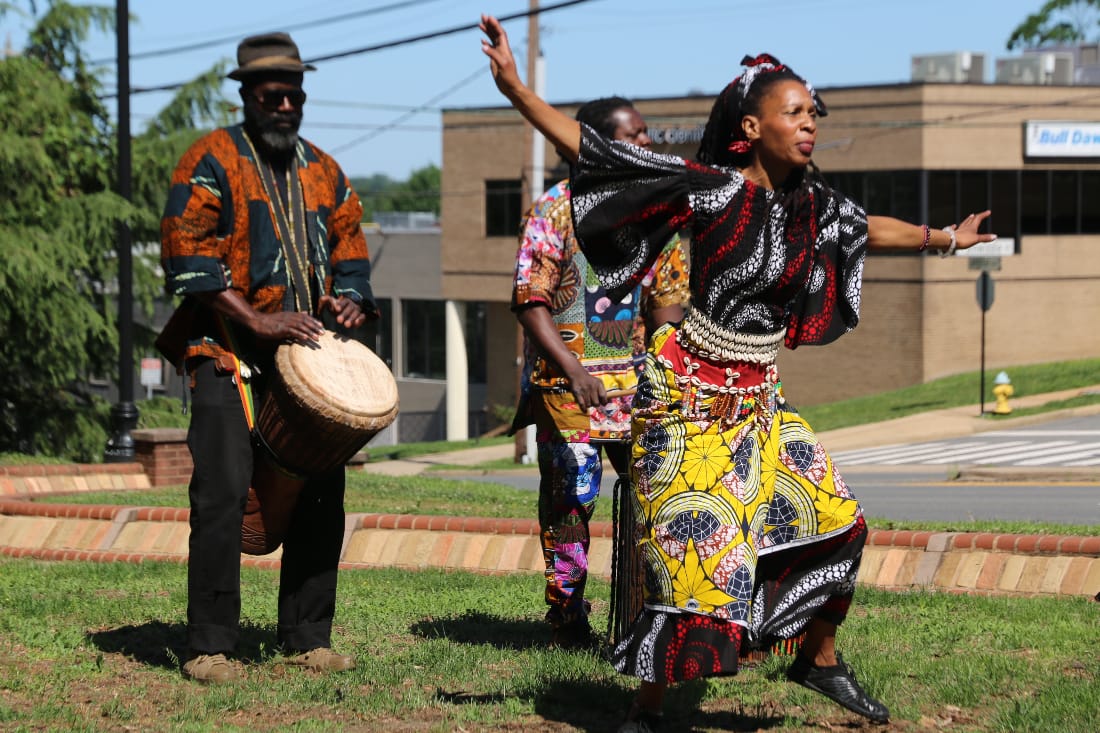
The May 30 ceremony included an African drumming ceremony by Hands On Drums. To conclude, Black Heritage Museum of Arlington president Dr. Scott Taylor led the assembled group in “Battle Hymn of the Republic.”
Based on a German effort to memorialize Holocaust victims, stumbling stones are designed to “interrupt you, to stop you, to make you wonder and think — bring to life the human beings that suffered,” County Board Chair Matt de Ferranti said at the dedication ceremony.
De Ferranti was joined by his colleague Maureen Coffey and School Board member Monique “Moe” Bryant at the dedication.
Last year, a total of 31 markers were placed across the county. This year, more than 100 are planned, said Nancy Pilchen, who helps coordinate the effort.
They will serve to “remember the struggle of humanity and celebrate the victory of humanity,” said Pastor Donovan Archie of Calloway United Methodist Church, who participated in the ceremony.
Markers are designed to remember some of the more than 2,700 individuals identified as enslaved in what today is Arlington, from the arrival of European settlement in the 1600s until the end of the Civil War.
Of the 2,700, researchers have determined at least a first or last name for about 1,100 people.
Individuals and community groups can sponsor placement of a memorial stone for $300. The eight dedicated on May 30 were funded by individuals and a number of civic associations.
The May 30 unveiling was part of Halls Hill-High View Park’s 2026 Neighborhood Day celebration. Other events included a walking tour, community celebration and dedication of a marker honoring pioneering local Black physicians Dr. Harold Johnson and Dr. Edward Morton.
