

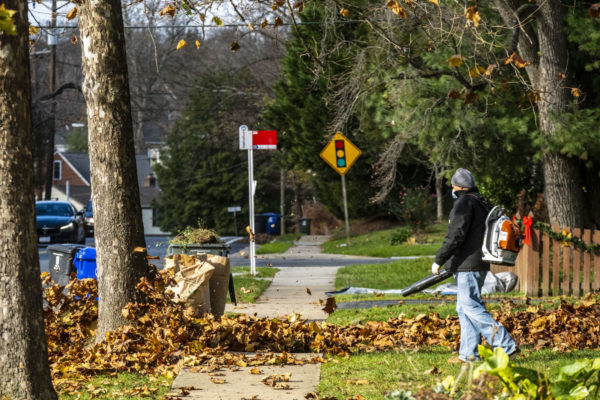
County Board members have voted to consider a transition period of between 18 and 36 months to potentially phase out gas-powered leaf blowers.
On a 5-0 vote, Board members advertised a July public hearing for final action. The proposal features a potential implementation timetable that is longer than some environmental activists want but shorter than some industry leaders say is feasible.
The action taken on June 13 only sets the potential minimum phase-in time frame. In adopting a final ordinance in mid-July, Board members could set a longer transition, but could not go lower.
An 18-month period would be half the amount of time recommended by county staff, which has proposed a three-year implementation deadline. A number of local environmental advocacy groups pushed for limiting the transition to as little as 12 months.
“That would cover this fall’s cleanup and it would cover next spring’s as well,” said Margaret McKelvey, a member of Quiet, Clean Northern Virginia who testified in favor of a 12-month transition period.
McKelvey said lawn-service workers were among those most impacted by the noise and environmental impacts of gas-powered blowers. She also zeroed in on potential impacts to youth.
“We will look back some day and say, ‘How did we ever allow Arlington children to breathe this foul air for so long?'” McKelvey told Board members.
Peter Harnik, an environmental advocate and Maywood resident, suggested 18 months as a reasonable period of time for businesses to gear up.
“Eighteen months would be much more beneficial to everybody … [to] get this scourge out of our neighborhoods,” he said.
The hearing also brought out representatives from lawn-care firms, who said a shorter transition period could bring unintended consequences.
“I do not believe the financial and operational realities facing small businesses have been fully considered,” said Andy Shelton, who grew up in Arlington and operates a landscaping business.
Shelton advocated for a minimum three-year implementation period, along with financial incentives or assistance to offset higher costs. He estimated the cost of new electric blowers, batteries and support equipment at 12 times the cost of a new gas-powered blower, and asserted that a switch to electric would make jobs take longer.
Mandating a switch to electric might not solve all environmental concerns, he added.
“Companies may be forced to use gasoline-powered generators in their trucks to simply keep equipment charged and operational,” Shelton said.
James Lo Monaco, another local landscaper, said a switch would not be painless for customers.
“Those costs don’t disappear,” he said. “They’re ultimately passed down to Arlington residents.”
Lo Monaco suggested county officials were being myopic, or disingenuous, in focusing solely on gas-powered blowers:
“This mandate unfairly targets one industry rather than addressing the broader issue. … If this is truly about environmental impact, then why are gas-powered leaf blowers being singled out while mowers, trimmers, chainsaws, generators and other gas-powered equipment remains unaffected?”
Several County Board members acknowledged concerns about expected costs for landscapers.
“We don’t want to lose jobs. We don’t want blowback, for lack of a better word,” Board member Takis Karantonis said.
Jennifer Fioretti, the county government’s assistant county manager for climate policy, said staff followed D.C.’s lead in recommending a three-year implementation phase. The District used that time frame when enacting its ban in 2022.
Fioretti said setting a three-year limit would likely cause many lawn-care firms to transition within 18 to 24 months.
“Businesses didn’t wait until the effective date,” she said.
She also noted that it took the Arlington government itself more than three years to fully phase out its own gas-powered leaf blowers, and relied in part on federal funding to cover the cost.
Unlike D.C., the Alexandria City Council set an 18-month phase-in period when, in May 2025, its members enacted the first prohibition on gas leaf-blowers in the commonwealth.
In enacting the change, the City Council relied on a 2024 legal opinion by Virginia’s then-Attorney General, Jason Miyares. But that opinion relied on powers inherent in Alexandria’s charter — powers that are not quite as explicit in Arlington’s governing documents.
Miyares’ opinion expressed the general view that other localities could use noise-control ordinances to enact a limitation on leaf-blowers, “so long as it is reasonable.” The word “reasonable” could lay the groundwork for future litigation on the topic.
In a report prior to the June 13 meeting, county staff noted concerns about the impacts of a phase-in period shorter than the three years recommended:
“While many residents favor an immediate or 18-month prohibition, commercial landscaping businesses raised valid concerns about the upfront cost, availability of financing and performance of some electric alternatives. Staff propose a 36-month phase-out specifically to mitigate these economic impacts and allow businesses time to adapt.”
The General Assembly thus far has refused to clarify the powers of cities, counties and towns to regulate gas-powered blowers. Measures giving localities like Arlington the ability to do so were introduced in both the Virginia Senate and House of Delegates this session, but were either pushed back to 2027 or killed outright.
County leaders have been considering the intricacies of a ban on gas-powered blowers since last year. When Board members discussed the matter this February, a slightly shaky consensus for the three-year implementation period seemed to have emerged.
But since then, three major advisory boards all expressed support for an 18-month period: the Climate Change, Energy and Environment Commission; Forestry and Natural Resources Commission; and Park and Recreation Commission.
None of the five Board members has indicated any qualms about enacting a ban. Open questions mostly concern the phase-in period and what support, if any, might be given to businesses impacted by it.
