

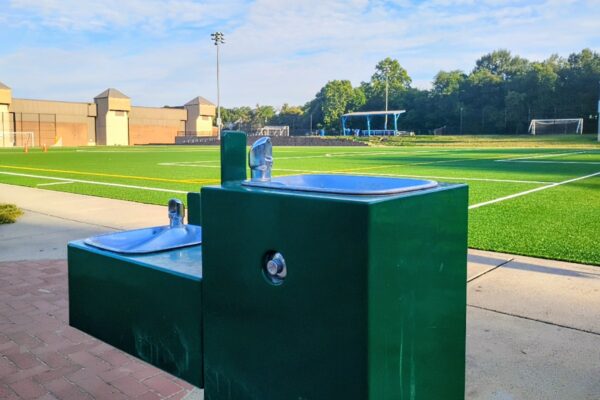
Arlington officials are working to modernize outdoor drinking fountains in county parks, but acknowledge the effort will take time.
It could be into the 2030s before all fountains are converted to year-round use, the Park and Recreation Commission was told on June 16.
“This is very expensive — a lot more expensive than one might think,” said Michael Simmons, a division chief at the Department of Parks and Recreation (DPR).
The parks department currently maintains 86 drinking fountains at its facilities. Of them, 70 are frost-free and operate year-round, but the remaining 16 are turned off from Nov. 15 to March 15.
Typically, two or three non-frost-free fountains are upgraded to frost-free operation per year, although the schedule can vary.
“There’s no real standard that we’re going to get to them two per year, but we try to get to them as much as possible,” said Simmons, who heads the Park and Natural Resources Division at DPR.
Making the switch requires purchasing new equipment and digging trenches below the frost line to ensure pipes don’t freeze in winter months.
Conversions can cost $30,000 to $40,000 apiece, although frost-free fountains typically have fewer maintenance problems because they operate constantly throughout the year.
“We would like to get, eventually, to all-frost-free fountains,” Simmons said.
The replacement of seasonal fountains also occurs when parks are renovated, said Marco Rivera, staff liaison to the Park and Recreation Commission.
There is “constant coordination” during the planning process, he said.
Though neither the most eye-catching nor the most controversial issue in county governance, the subject drew extensive conversation at the commission meeting.
The costs associated with upgrading the fountains drew some raised eyebrows. Commission members asked county staff to look at practices in neighboring jurisdictions to keep costs down.
Commission member Andrew Damitio sought information on the cost of adding new drinking fountains to park facilities, while commission member Richard Viola sought county collaboration with NOVA Parks to install drinking fountains at its facilities.
“I’d live to see some water fountains on the W&OD Trail south of Columbia Pike,” Viola said.
Commission vice chair Gary Shinners asked if signage could be put up, requesting that people not wash sand and dirt in the fountains. Especially in non-year-round fountains, accumulated debris can clog drains and cause problems when water flow is turned back on during the spring.
Simmons, however, said that signage probably wouldn’t help.
“I would love for that to solve the issue,” he said, but “who’s really going to pay attention?”
The Department of Parks and Recreation has two plumbers on staff to deal with issues at fountains, spraygrounds and bathrooms at its facilities.
