

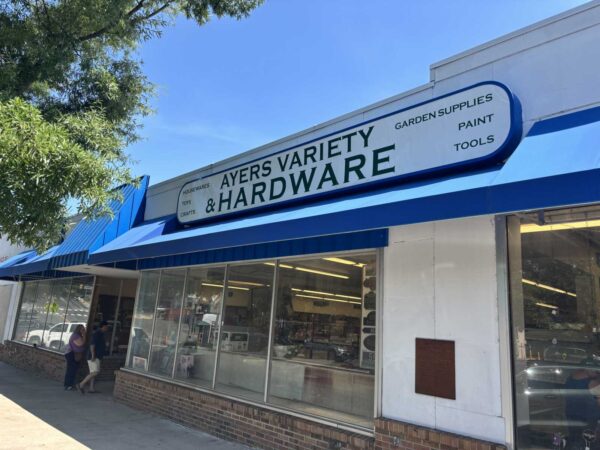
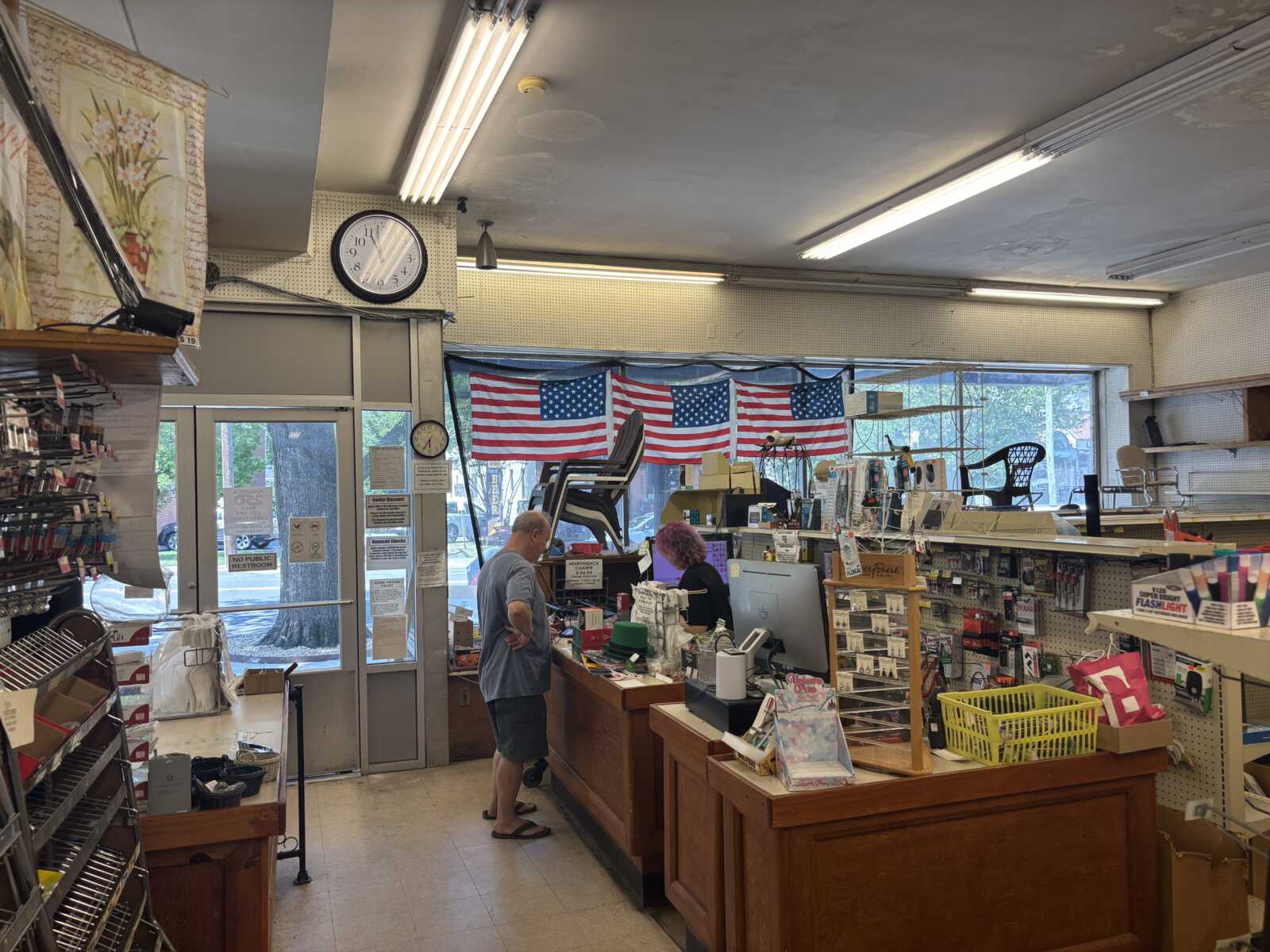
The recent closure of Ayers Variety & Hardware was a stark reminder that nothing is forever, even businesses that have built generational relationships with customers.
The shuttering of the store that served Westover for nearly 80 years is also an indication of how challenging current times are for many of Arlington’s other small businesses, community leaders say.
“As Ayers’ demise demonstrates, it is hard for any of Arlington’s legacy small businesses to survive in an economic environment of rising costs, higher rents and competition from online and big-box stores,” Andrew Schneider, executive director of the Columbia Pike Partnership, told ARLnow.
The owners of Ayers previously said they decided some time ago to sell the business before their lease runs out at the end of July. But no offers materialized, said Kristy Peterkin, who operated the 5853 Washington Blvd business with her brother, Keith Kaplan.
Though the retail venue wasn’t located on the Pike, Schneider has fond memories dating to his childhood:
“I grew up in Westover — I remember buying penny candy at Ayers, visiting with Santa as a child, stopping there almost every afternoon after school at Swanson and, as an adult, knowing that Ayers would always have that one thing I needed for that one project.”
Its closure represents “a loss for the entire community,” Schneider said.
Arlington has more than 10,000 small businesses, said Anna Nissinen, who recently was tapped to serve as the county’s chief economic development officer and director of Arlington Economic Development.
“Every time a long-standing local business closes, our community feels that loss,” she said. “It is also a reminder that economic resilience is not something we can take for granted. It is something we build together.”
“While we’re proud that Arlington was recently recognized as one of America’s top communities for small businesses, we also recognize that many business owners are navigating a period of significant change,” Nissinen said.
“Our responsibility is to stand alongside our entrepreneurs through those challenges,” she said.
Kate Bates, president/CEO of the Arlington Chamber of Commerce, said the community has seen a number of retail businesses and restaurants shut their doors in recent months.
It’s more than the typical cyclical nature of small-business operations, she said.
“Many small businesses are facing meaningful headwinds,” Bates said, adding:
“We hear from members about the challenges of rising costs alongside softening consumer spending, which are especially difficult for businesses such as restaurants and retailers that often operate on thin profit margins. Unfortunately, even longstanding businesses are not immune.”
Nissinen said the county government and others offer numerous ways for aspiring and existing business owners to find support:
“Arlington’s entrepreneurial support network, including Arlington Economic Development’s BizLaunch team, the Arlington Chamber of Commerce, SCORE, George Mason University and many other partners, is committed to helping.
“Our goal is not simply to help businesses navigate uncertainty, but to ensure Arlington remains a place where entrepreneurs have the confidence to start, grow, adapt and build the next generation of great local businesses.”
“That entrepreneurial spirit has long been one of Arlington’s greatest strengths, and it will continue to be an essential part of our community’s resilience and prosperity,” Nissinen said.
County Board member Julius “JD” Spain, Sr., who serves as the Board’s liaison to the Economic Development Commission, called the closing of Ayers Hardware “difficult.”
“Every small business is part of the fabric of our community,” Spain said.
But he stopped short of seeing an alarming trend in the closure.
“While every business has its own story, one closure does not define Arlington’s economy,” Spain said. “I am confident that — working alongside Arlington Economic Development, our business districts and community partners — we will continue to invest in the entrepreneurs who make our neighborhoods vibrant and our economy resilient.”
Bates said the county government needed to expand efforts to “remove unnecessary costs and regulatory burdens so businesses of all sizes can grow and thrive.”
Getting government out of the way was a key facet of the Chamber’s recent County Board candidate forum, and has been a topic of discussion at other candidate debates this year.
Julie Farnam, a Democratic candidate seeking to unseat County Board Chair Matt de Ferranti in the Aug. 4 primary, said the county government has an uneven track record of making sure storefront properties and other mom-and-pop businesses are supported.
“We do good with big businesses, but they’re not going into those spaces,” Farnam said at a recent forum sponsored by the Douglas Park Civic Association.
Different areas of the county have been impacted unevenly by the economic challenges accompanying the Trump administration’s cuts to the federal workforce. As a result, economic development efforts targeting small businesses may need to simultaneously focus on hyperlocal areas and the county as a whole.
Said Schneider:
“We must heed the cautionary tale of Ayers, and the dozens of small businesses that have closed on the Pike over the past five years, and acknowledge that without targeted investment and policies that support our small businesses, we risk continuing to lose what we value most: the diversity, character and small businesses that significantly contribute to what makes Arlington such a special and unique community.”
“Ultimately, as a community — residents, consumers, elected officials, county staff and policymakers, and businesses — we must determine how to align our values with our investments,” Schneider added.
