

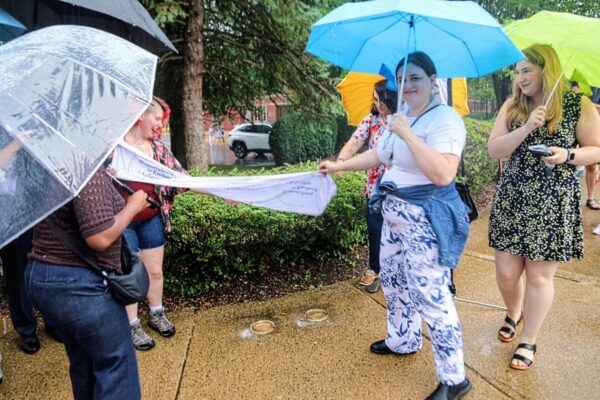
Two individuals who were once enslaved in the Bluemont neighborhood were honored during an Aug. 2 ceremony at St. Ann Catholic Church.
The ceremony honored Henry Speaks and Lidia, whose last name is unknown. They are among about 100 individuals being honored this year with commemorative brass markers, or “stumbling stones,” as part of the Memorializing the Enslaved in Arlington initiative.
“Without the truth, there can be no healing,” said Tim Aiken, a coordinator of the Memorializing the Enslaved program. This is a joint effort from the Arlington Historical Society and Black Heritage Museum of Arlington.
The ceremony honored “two human beings, held against their will, whose labor helped shape the land,” Aiken said.
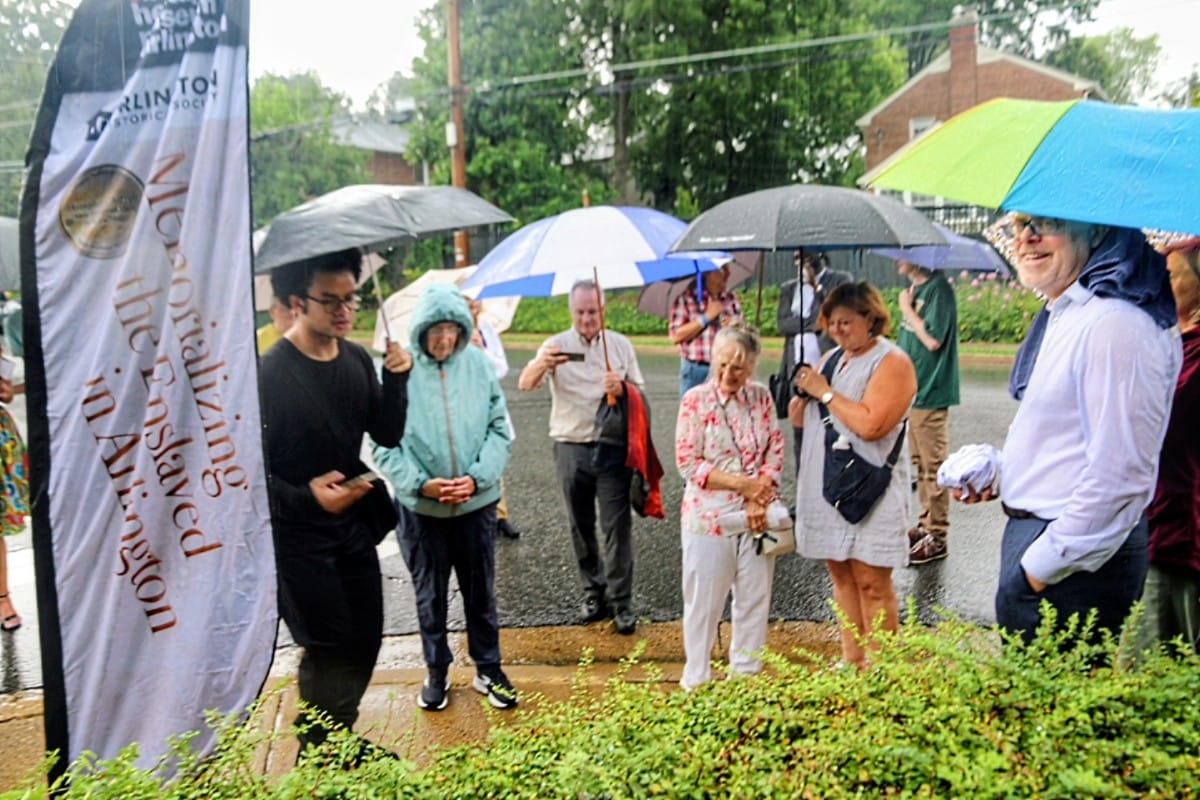
The noon event had been slated to be held outside at the corner of 10th Street N. and N. Frederick Street, where the markers are located. But as the rain intensified, church leaders offered to move inside the building.
“I appreciate the history — history we all have to learn,” said Rev. Johanes Raharjo, pastor at St. Ann Catholic Church.
About 100 people attended the ceremony, many of them parishioners at the church. For most, it was their first time at a stumbling-stone unveiling.
“We are honored to be here. This is just fitting,” said Kate Mattos, president of the Bluemont Civic Association.
Speaks was born into slavery in 1827 and passed through the hands of several enslavers. They included William Nutt, a clerk at the U.S. Department of the Treasury who, in the 1840s, owned farmland near today’s East Falls Church Metro station.
In 1856, Richard Southern leased Speaks from Nutt for a total of $466 paid in installments, with the proviso that Speaks would be freed when he turned 35.
Speaks worked on Southern’s 100-acre farm, where the church and part of the Bluemont community are located today.
At the outbreak of the Civil War, the Southern family and the people they enslaved moved to D.C. In 1862, Speaks was freed via D.C.’s Compensated Emancipation Act, authorized by Congress. The federal government compensated D.C. enslavers up to $300 for each individual freed.
After emancipation, Speaks continued to live in D.C., working as a driver and laborer. He may have been drafted into the Union Army at the tail end of the war.
Speaks disappeared from the historical record in the mid-1870s.
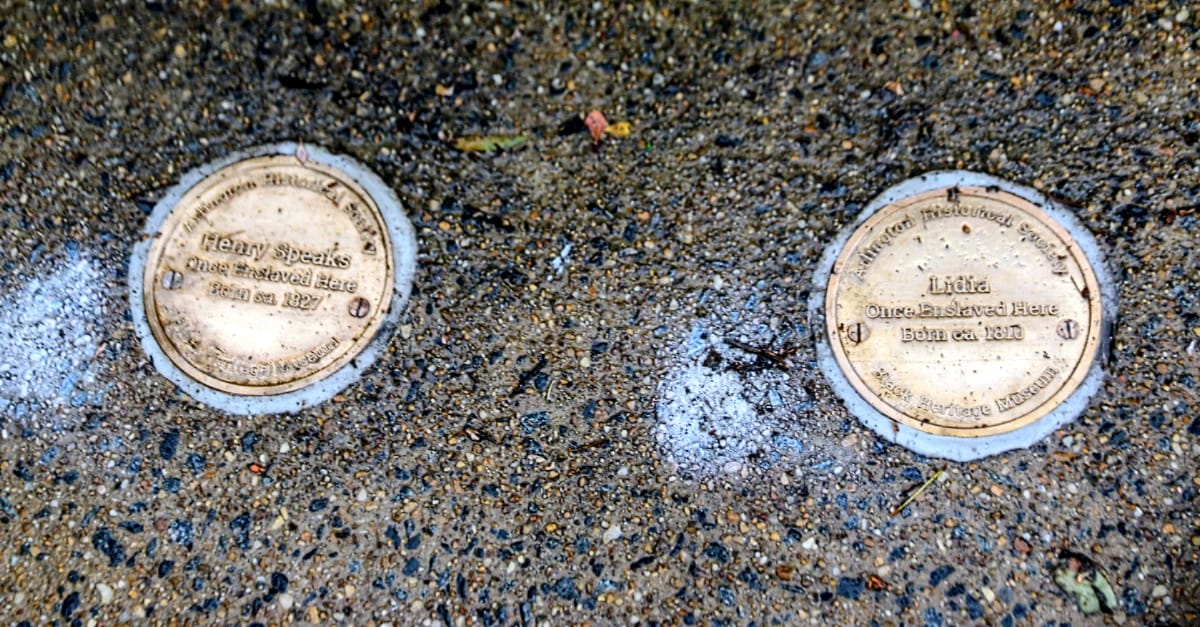
Less is known about Lidia, who was freed by the Southern family at age 21 in November 1831. Beyond an emancipation deed recorded in the Alexandria courthouse, the rest of her story is currently lost to history.
“We pray she lived a long and fulfilling life,” Aiken said.
County Board member Maureen Coffey, who attended the event, said it served as an opportunity to learn from the past and provide “a respect for Henry and Lidia they were not afforded in their living days.”
“Virginia in particular has one of the most complicated [racial] histories there is,” Coffey said. “We cannot separate the Arlington of today from the Arlington that used to be. We can’t undo [the past], but we can move forward.”
Last year, the Memorializing the Enslaved in Arlington effort assisted in placing 31 stumbling stones across the county. This year, more than 100 will be placed, but the number represents just a fraction of the 2,700 individuals identified as enslaved in the community between 1669 and 1865.
Nancy Pilchen, who helps coordinate the effort, said it will continue as long as there is community interest.
“We think Arlingtonians are up for this challenge,” she said.
The initiative is based on Stolpersteine, stumbling stones that, starting in the 1990s, were placed at locations in Germany where victims of the Holocaust and other Nazi aggressions lost their freedom. The concept has expanded worldwide to honor those victimized in different ways.
“This is something that is very serious,” said Scott Taylor, president of the Black Heritage Museum of Arlington. “We have to honor these people — we stand on their shoulders.”
