

The Arlington Historical Society has modernized its operations and outreach, but challenges remain for the nearly 70-year-old organization, leaders said.
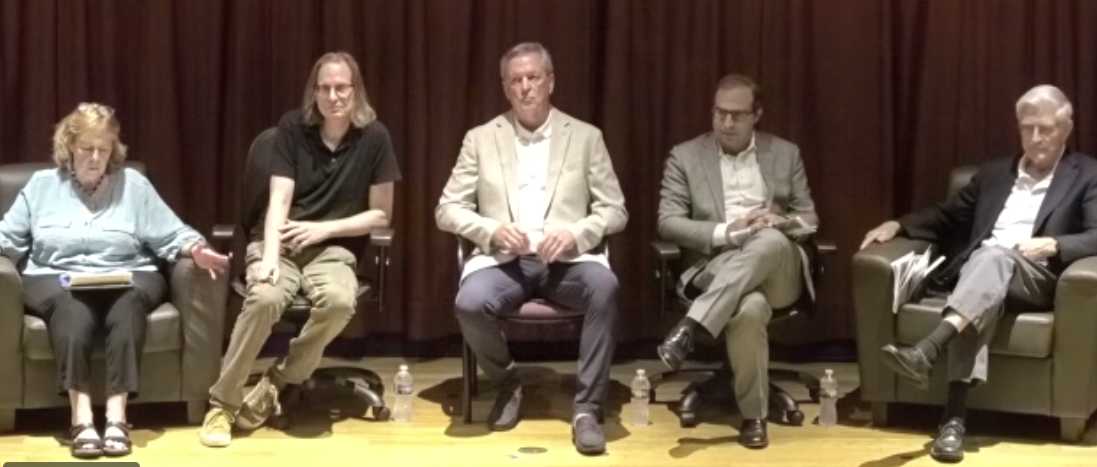
Five former Historical Society presidents gathered Sept. 10 to assess the state of the organization. Their verdict was mixed.
Among the positives: Leaders said that, over the past two decades, the society has done a better job of telling the entirety of Arlington’s story, incorporating groups that had previously been left out of the conversation.
“You’ve got to sometimes go looking for history,” said Cathy Bonneville Hix, who was the society’s president from 2018-23.
During her tenure, “we started looking at who are the underrepresented” in the county’s story, Hix said.
Efforts to broaden the organization’s scope led it to join with the Black Heritage Museum of Arlington in sponsoring the Memorializing the Enslaved in Arlington project. The initiative has created a database of people enslaved in the county over the course of two centuries, and is sponsoring the installation of “stumbling stones” to honor their legacy.
“That was a game-changer for the society — that kind of put us on the map,” Hix said.
Dealing with race, both internally and in the broader community, had been an issue for the society since its founding. In Arlington of the 1950s, “Black people and white people lived in two separate worlds,” said Karl VanNewkirk, who led the society from 1991-92, 1994-95 and 2015-17.
The society’s collections and programs evolved to acknowledge the importance of Black history to the community, and the organization has since worked to fully incorporate it into the broader narrative.
“In reality, there’s only one history — Arlington’s history,” VanNewkirk said.
Other modernization efforts, such as accepting credit-card payments for dues, also moved the organization away from the “this is how it always has been done” mentality, said Ali Ganjian, president in 2012-13.
“I view it as making [the society] more accessible,” he said.
Fundraising and expanding the organization’s online presence were priorities of Johnathan Thomas, who served as president in 2017-18.
“We had very little money — about $3,000 in the checking account,” he said.
Thomas oversaw the evolution of the organization’s annual banquet into a more upscale event, held at Washington Golf & Country Club. The result was a new era of sponsorships that helped bring in additional revenue.
By the mid-2010s, “we were able to finally get a really nice website,” Thomas said.

The five presidents also waded into the complicated relationship between local-government leadership and preserving the county’s past.
Unlike neighboring Alexandria, where the city government has a robust effort chronicling local history, the Arlington County Board has been disinclined to invest similar resources in recent decades.
The county government contributed $25,000 in 2024 to support the refurbishment of the Arlington Historical Museum. It also served as a pass-through for a $50,000 state grant for the same purpose, secured by Del. Patrick Hope (D-1).
Otherwise, however, its financial support has been slim to nonexistent.
Thomas pulled no punches, declaring the lack of investment a “travesty.” Too many local elected officials have been “transplants that don’t care about our history,” he said.
“Everything falls on deaf ears with this County Board, and it’s sad,” he said, channeling the view of the late county Treasurer Frank O’Leary, who often decried the county leadership’s lack of interest in local history.
Others on the panel said there were advantages to not relying on government support.
“All money comes with strings attached,” Ganjian said.
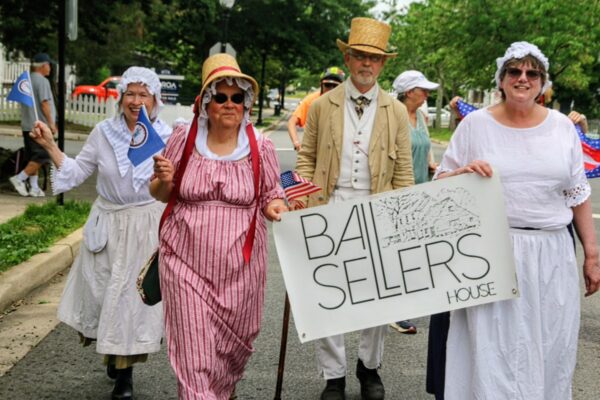
That said, “it would be nice if the county paid for the maintenance of the buildings,” said Ganjian, referring to the museum on Arlington Ridge Road and the Ball-Sellers House in Glencarlyn.
VanNewkirk said that while Alexandria city leaders pay more attention to history, the government’s involvement can overshadow grassroots efforts.
“It’s better funded and it’s more professional [in Alexandria], but it’s not enthusiastic,” he said. “In Arlington, the government clearly isn’t participating in it, but the people are.”
The best outcome would lie somewhere in the middle, VanNewkirk suggested.
The Arlington Historical Society was founded in the fall of 1956 by 88 charter members. Del. Harrison Mann served as the first president, and the first major gathering came that December with a candlelight tour of Arlington House.
Then as now, impacts of growth were top of mind, said the society’s current president, Peter Vaselopulos.
“Arlington has changed drastically, but one thing has not changed: the need to understand where we came from … to collect, preserve and share Arlington’s story,” he said.
Historic preservation should not just look at the past but also ensure that current history is chronicled for future generations, Vaselopulos said.
“History is still being made,” he said.
Hix, who served as a history teacher and school administrator for nearly four decades, said the goal of any historical organization should be to provide the community with a set of figurative windows and mirrors.
“We have windows so you can see through to others, and mirrors to reflect on yourself,” she said.
