


A proposal to prioritize buses on portions of two major Falls Church roadways prompted plenty of questions from City Council members at a recent meeting.
The concept delivered to city leaders was “Business Access and Transit Lanes,” or BAT. It allows drivers to use bus-priority lanes only for making right turns or accessing businesses along the route.
The BAT concept marks a midway point between the current arrangement, where buses share traffic lanes with other vehicles, and reserving travel lanes exclusively for transit use.
Portions of N. Washington Street and W. Broad Street were proposed by the Northern Virginia Transportation Commission (NVTC) for consideration. Each currently includes two all-purpose travel lanes in each direction, while the proposal would result in one full-use travel lane and one BAT lane each way.
Officials seemed generally open to trying out the proposal on Washington Street, though perhaps only for certain times of day, at first. Beyond that, little agreement has emerged.
“I do worry about having dedicated bus lanes on Broad,” Council member Laura Downs said at an Oct. 5 work session focused largely on transportation and transit issues.
There was extensive discussion about the possibility of restricted travel lanes on major roadways causing drivers to divert onto neighborhood streets.
“Riled-up drivers” are unsafe drivers, Council member Arthur Agin said.
“The cut-through traffic is the unsafe drivers more so than the local traffic,” he said.
Vikram Sinha, an NVTC planner, acknowledged the lack of a simple solution to move more traffic in an increasingly congested region.
“Transit benefits do come with traffic tradeoffs,” he said.
City staff echoed that view in a report to Council members:
“BAT lanes would improve transit travel times but would also increase traffic delays along an already constrained corridor. Full BAT approach provides the greatest transit benefit but also the greatest impact to general traffic operations.”
Mayor Letty Hardi appeared supportive of a more aggressive approach to prioritizing buses.
“We’ve had these long statements about how we want to prioritize multimodal, prioritize pedestrians, and here’s our chance,” she said.
Her Council colleague Dave Snyder had some reservations but said city leaders needed to come up with a plan soon.
“Whatever we do, I think we should move expeditiously — find the right balance and move forward,” he said.
Also discussed at the Oct. 5 meeting was planned bus prioritization at five intersections on W. Broad Street and two on N. Washington Street.
Once set up, bus drivers would be able to extend green signals or truncate red signals in their travel lanes to speed up the trip.
That step “sounds perfect to me on Broad,” Downs said.
Design is set to take place in the fiscal year beginning next July.
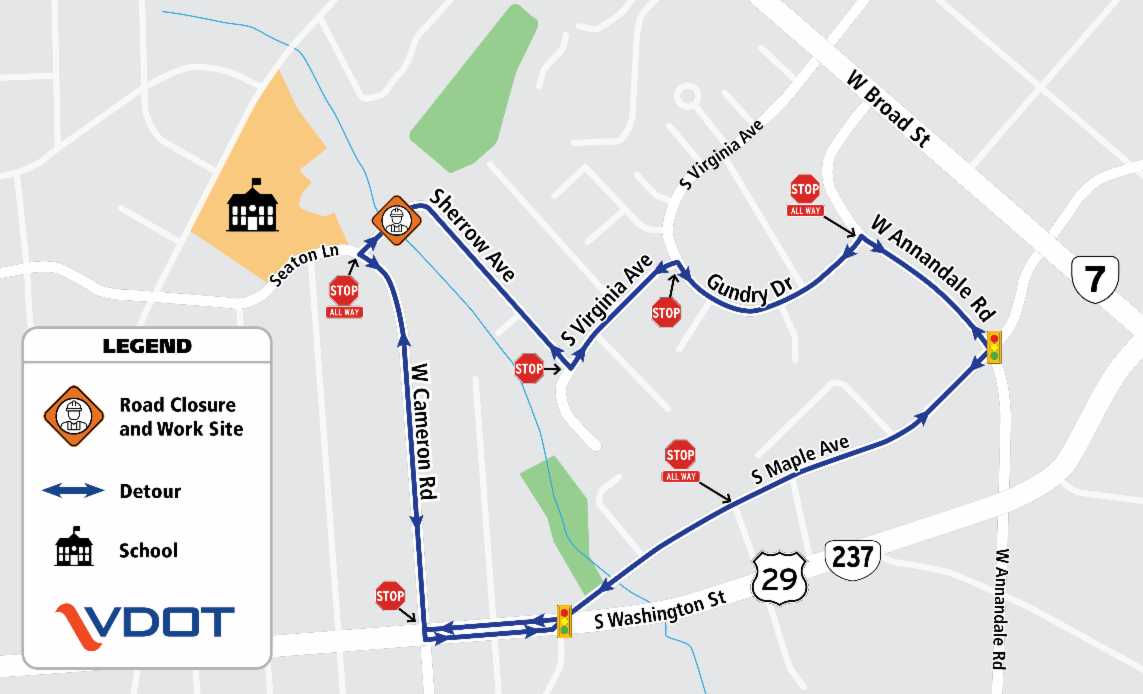
Road closure in effect until spring
Replacement of a culvert over Tripps Run in Falls Church will cause a months-long closure of Sherrow Avenue.
The Virginia Department of Transportation closed the roadway between Seaton Lane/West Cameron Road and S. Virginia Avenue for the duration of the project.
[Update: VDOT officials have delayed the closure to Oct. 19, Falls Church officials told ARLnow on Oct. 9.]
Drivers needing to reach properties along Sherrow Avenue will still have access during the closure. However, they will not be able to go beyond the culvert (located between 421 Sherrow Avenue and 423 Sherrow Avenue) in either direction.
One of the two Sherrow Avenue sidewalks along the culvert will remain open for pedestrians.
Through traffic will be detoured via W. Cameron Road, S. Washington Street, S. Maple Avenue, W. Annandale Road, Gundry Drive, and S. Virginia Avenue back to Sherrow Avenue.
When complete, traffic will no longer be weight-restricted over Tripps Run.
The $3.8 million project is financed with federal funding. It also includes a new bench facing the stream, as requested by the community.
