


Arlington’s jobless rate was stable in September, but the number of residents seeking jobs remains elevated from levels before Donald Trump returned to the White House.
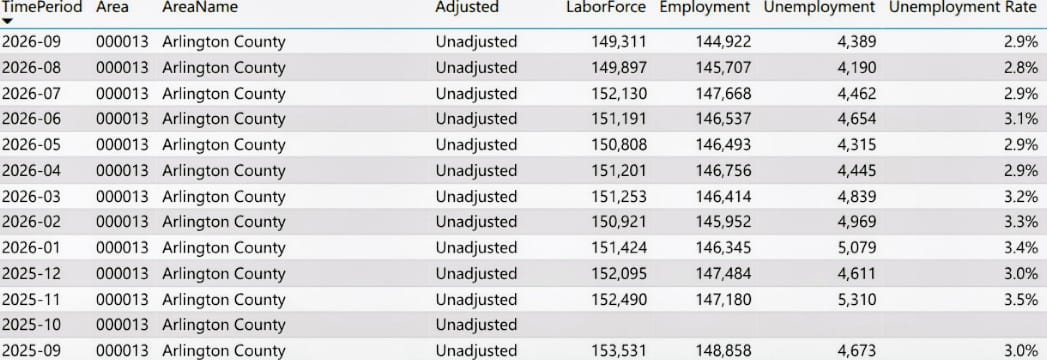
With 144,922 county residents employed in the civilian workforce and 4,389 looking for jobs, the county’s unemployment rate of 2.9% was down from 3% a year before, according to figures reported Oct. 28 by the Virginia Department of Workforce Development and Advancement.
While jobless rates have largely stabilized since the Trump administration’s cuts to the federal workforce began in 2025, the number of county residents reported as seeking jobs in September was up 23% from the 3,563 reported in September 2024, before Trump’s return.
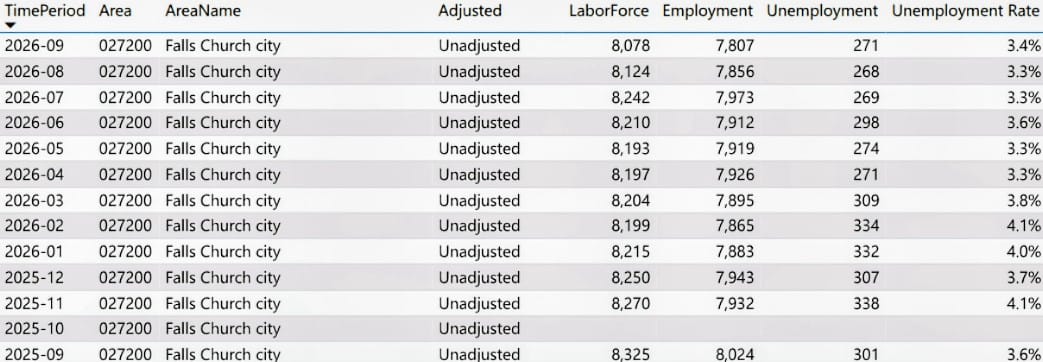
A similar situation has played out in Falls Church, where the number of jobless in September 2026 (271) was up 28% from the 212 unemployed in September 2024, according to state data.
Falls Church’s unemployment rate was 3.4% in September 2026, compared to 3.6% in September 2025 and 2.5% in September 2024.
Across Northern Virginia as a whole, September’s jobless rate of 3.4% was up from 3% a year ago, representing just under 1.65 million in the civilian workforce and about 57,800 seeking jobs.
Statewide, September’s jobless rate of 3.6% was up from 3.4% a year ago, with about 4.28 million with jobs and just over 162,000 seeking them.
The D.C. region was one of 226 metro areas across the nation to see lower year-over-year jobless rates in September, according to data reported on Oct. 28 by the U.S. Bureau of Labor Statistics.
Rates were higher in 138 metro areas and unchanged in 23.
The national unemployment rate in September was 4%, little changed from a year before, federal officials said.
Across the D.C. metro area, about 3.44 million were employed in September, with about 126,000 seeking jobs. The resulting unemployment rate of 3.7% was down from 4.1% a year before.
While the region’s number of unemployed was down from a year before, so was the number of those employed. Some residents have left the workforce, moved to irregular jobs or left the region entirely.
In terms of total nonfarm employment, the D.C. region saw the sharpest decline in raw numbers year-over-year, losing 61,000 jobs or 1.8% of its total.
That’s more than 15 times the next largest drop, a total of 3,800 recorded in Bloomington, Ind. But because Bloomington is significantly smaller, its percentage drop of 4.7% was significantly larger than the D.C. region’s.
Figures are not seasonally adjusted. All September 2026 figures are preliminary and are subject to revision.
