

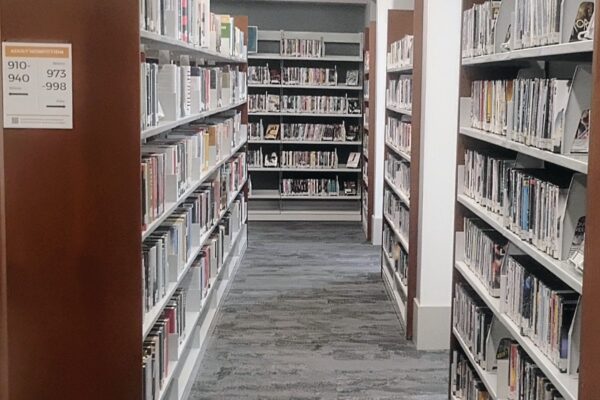
The closure of a nearly 200-year-old book wholesaler will impact how soon new materials turn up on the shelves at Falls Church’s Mary Riley Styles Public Library.
Like many library systems nationally, the Falls Church library dealt with Baker & Taylor for many of its materials purchases. But the North Carolina-based company, founded in 1828, is wrapping up operations after announcing earlier in the year that its planned acquisition by another firm would not materialize.
“Every library knows of or has used Baker & Taylor in some capacity, and so now every library is going to march to another vendor,” said Megan Dotzler, library director of the Falls Church city government.
She was speaking at the Dec. 17 meeting of the Falls Church Library Board of Trustees.
Falls Church has found alternate suppliers, including Ingram Content Group. But “you can tell they might be a little stressed” by the influx of new orders, Dotzler said of companies working to pick up the slack in the marketplace.
As a result, delays are to be expected, she forecast.
Wholesalers don’t just supply books to libraries. They also provide cataloguing and labeling services, important steps before materials can be placed on the shelves.
For the fiscal year that began July 1, the library system has a budget of $115,000 for new books. Through the Dec. 18 meeting, it had spent about $53,000 of that amount, according to figures presented by Dotzler.
While physical books still account for a significant portion of the library’s circulation, Falls Church is now spending more on e-materials. Its fiscal 2026 budget totals $161,000, of which about $76,000 has been spent.
The pipeline of electronic materials was unaffected by the troubles of Baker & Taylor, but the increasing switch toward e-materials is impacting those in the traditional book-publishing business.
“The profit margins on sales [of print materials] tend to be small, while costs for distribution centers and business infrastructure tend to be high,” American Libraries magazine noted in its coverage of the looming Baker & Taylor closure.
The company had launched an ebook service in 2023, but it “had not gained a substantial market share,” the coverage noted.
The city’s library system also spends about $11,200 annually on periodicals. Almost all the funding for the current fiscal year has been spent, with most periodicals being renewed each August.
As of the Dec. 17 meeting, Dotzler had not received guidance from the city manager’s office on what to expect, funding-wise, for the fiscal year beginning next July. Once she receives the figures, she will be able to construct a budget that will be reviewed by the library board, city manager’s staff and, ultimately, the City Council.
The library system’s fiscal 2026 budget totals about $2.7 million, with some of the funding coming from state reimbursement but most from local taxpayers.
