


School leaders are projecting a gradual decline in student enrollment over the next decade — but they don’t believe it will translate to lower costs.
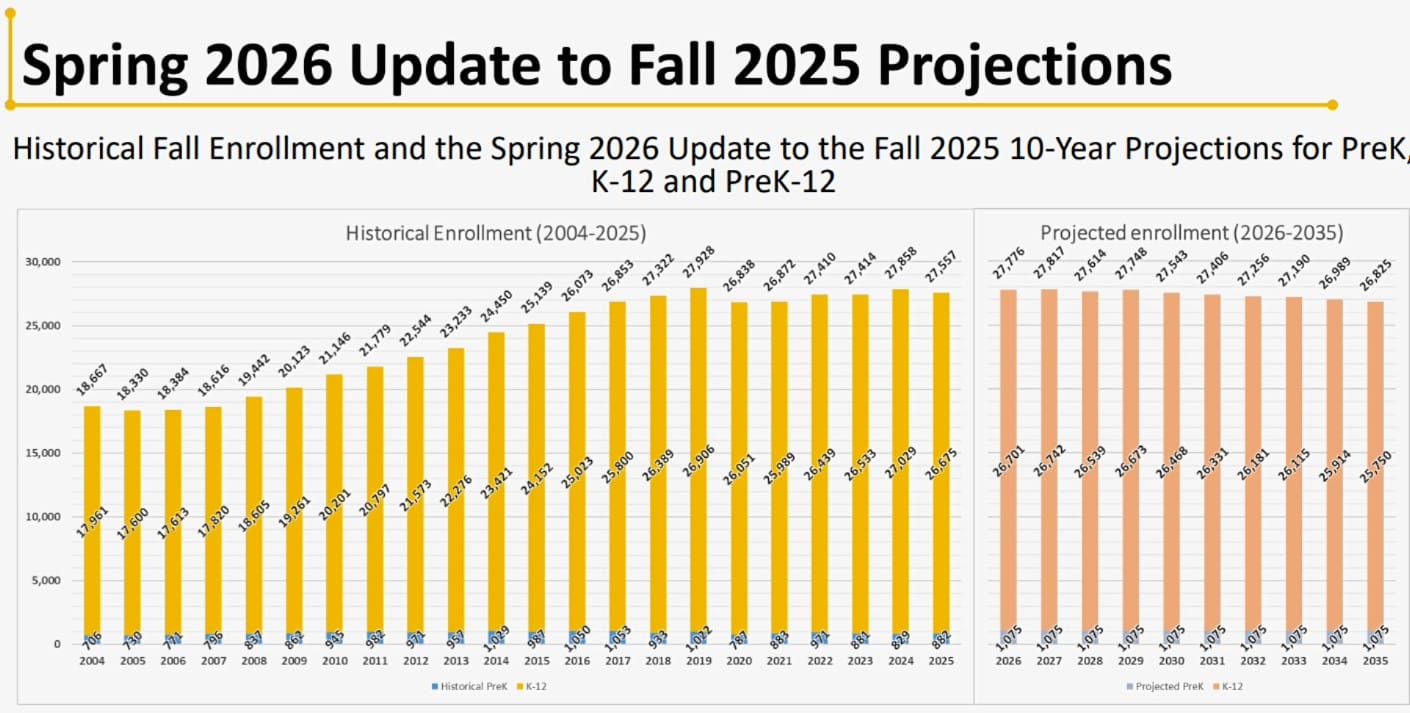
In total, Arlington Public Schools now projects a 3.7% decrease in enrollment by 2035, even as the number of students in high-risk categories is showing signs of increasing.
An increase in the number of students with limited English proficiency and students with a variety of disabilities will tax existing resources despite the overall student decline, Superintendent Francisco Durán said at an April 14 work session.
Those changes represent “a huge driver … in the type of instructional delivery that is necessary,” he said.
Students learning English and facing disabilities “require more intense support,” Durán said.
Raw enrollment projections don’t tell the full story, said School Board member Zuraya Tapia-Hadley.
“As a system, our needs have changed, and the student profile, student needs, have changed,” she said.
Even short-term projections of student enrollment are notoriously tricky, APS planning staff acknowledged during the work session with School Board members.
Arlington Public Schools’ official 2025-26 enrollment stands at 27,557, based on the number of students in class last Sept. 30. That was down from 27,858 a year before, and was nearly 300 students below the number anticipated for the current school year.
Planners “overprojected significantly” in anticipating 27,840 students in class at the start of the 2025-26 school year, said Catherine Lin, the school system’s director of facilities and operations.
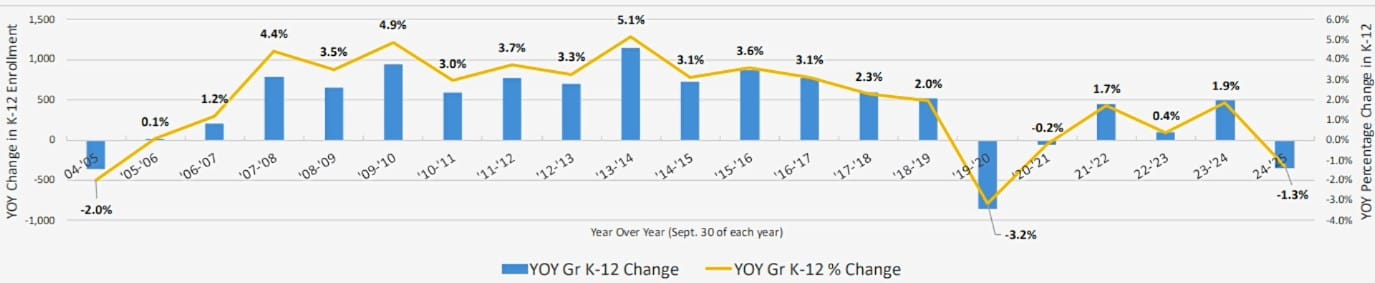
The decline “was a little unexpected, especially in our kindergarten grade level,” Lin said.
The 2025-26 enrollment total represented the first year-over-year drop for the school system in two decades, excepting the Covid years of 2020 and 2021.
Moving into the future, new estimates anticipate 27,776 students in class at the start of the 2026-27 school year. From there, “we’re projecting pretty much a leveling off,” Lin said.
If reality tracks with the projections, student enrollment will wobble between 27,000 and 28,000 until the 2034-35 school year, when it will drop below 27,000 for the first time since 2017 (excepting 2020 and 2021).
The student-enrollment estimate for 2035-36, the last year of current projections, is 26,825. While below current figures, those figures remain well above the 18,330 students in county classrooms in 2005.
The figures include students in pre-kindergarten through 12th grade. At the April 14 forum, School Board member Miranda Turner was critical of school officials for using a placeholder figure of 1,075 pre-K students for each year in the future, rather than attempting to estimate an actual figure.
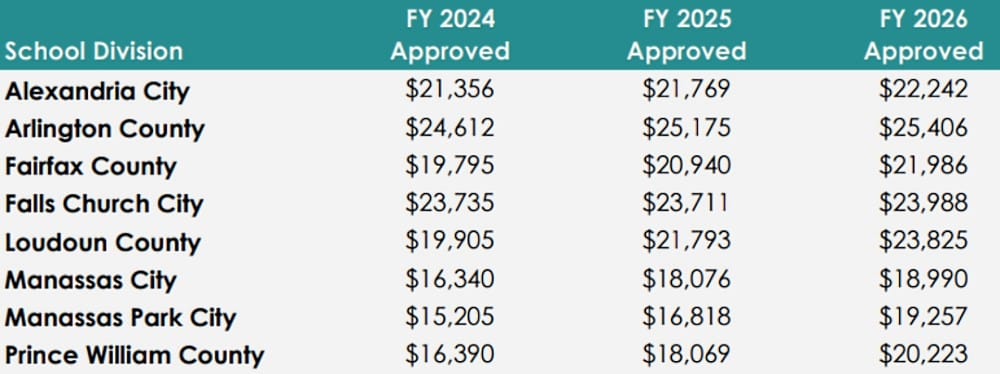
Swings up and down in enrollment can have significant budget implications. Arlington’s per-student cost of $25,406 leads Northern Virginia school districts, according to data reported by the Washington Area Boards of Education.
School Board Chair Bethany Zecher Sutton commiserated with those who try to estimate future student enrollment — noting the difficulties of forecasting in such a transient community.
“The idea that a student starts at kindergarten and graduates from 12th grade [all in Arlington] is perhaps overall a lower figure than some other districts would experience,” she said.
Zecher Sutton asked planning staff to provide School Board members with an enrollment breakdown, looking back five years, of English-language learners and students with disabilities.
“That would be very helpful, to look at what the trend has been and what we might anticipate going forward,” she said.
Her colleague Kathleen Clark asked for more specificity — having the data broken down by degree of disability — since that determines the level of support services required.
