


The Arlington real estate market is expected to see a modest rise in sales and prices in 2026, despite economic challenges that may hamper growth.
In the single-family sector, Arlington’s projected 3.8% rate of price growth is on the higher end for jurisdictions in a new 2026 market forecast, released Dec. 29 by the Northern Virginia Association of Realtors (NVAR) and Center for Regional Analysis at George Mason University.
Among the six localities in the forecast, only Alexandria (+4.2%) is expected to see higher growth. Loudoun County is projected to see a growth in median sales price of 3.3%, with Fairfax County posting an increase of 1.9%
Declines are expected in Prince William County (-0.2%) and Stafford County (-4.6%).
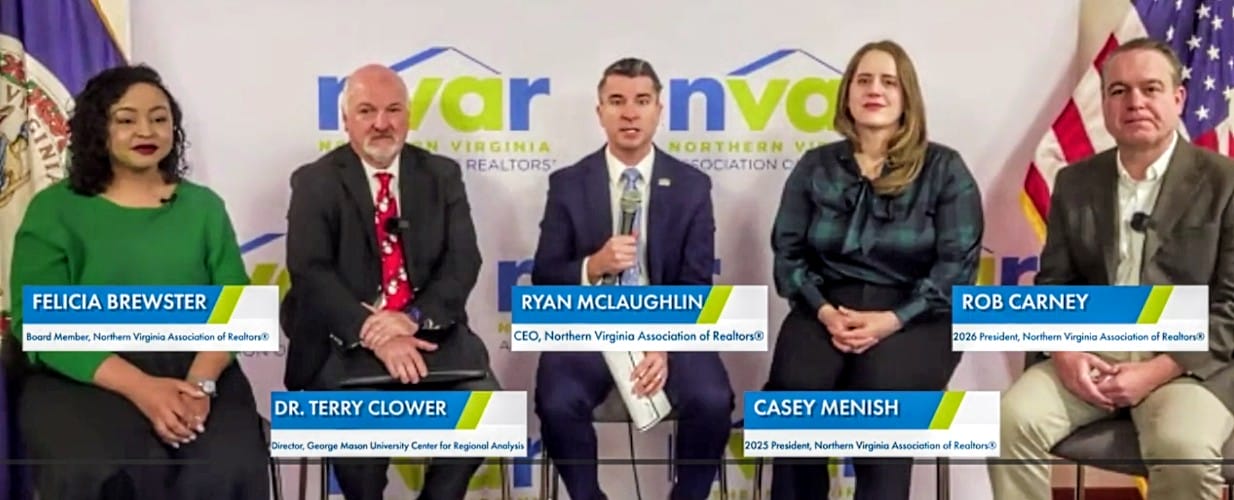
“There are a lot of things going on in the regional economy — this means we’re at a bit of a pivot point, which is always challenging for forecasters,” said Terry Clower at the Center for Regional Analysis.
The consensus opinion is that “we’re moving into a market that’s more balanced” between buyers and sellers, NVAR CEO Ryan McLaughlin said in a 45-minute presentation accompanying the forecast.
It follows the Covid era, when a tight inventory of homes on the market pushed prices higher across the region and led to buyer frustration.
The coming year should provide “arguably a healthier dynamic in the marketplace,” McLaughlin said.
His comments were echoed by 2025 NVAR president Casey Menish of Pearson Smith Realty. With a more balanced market, “you can really take the time to buy the right house, and not just jump on the first one,” she said.
That may be more true in other jurisdictions than in Arlington, particularly in the single-family segment, where inventory remains constrained.
“In Arlington, there are so few homes coming on market that we think that market is going to stay relatively strong,” Clower said.
Expectations for the 2026 Arlington market include:
- Single-family homes: The median sales price is expected to rise 3.8% year-over-year, with sales up 1.1% and inventory rising 27.8%
- Townhouses: Median prices are expected to rise 1.9%, with sales up 1.4% and inventory up 20.8%
- Condominiums: Prices are expected to rise 2.1%, sales 1.3% and inventory 30.9%
Part of what is holding back condominium costs — in Arlington and regionally — is the higher fees being charged by condo associations, Clower said. Those increased costs reflect general inflation over the past three years.
While the inventory increases seem large, they are off relatively low amounts in 2025, Clower said.
Despite continued economic concerns and uncertainty in the federal workforce, 2026 may be a year where growth in personal income begins to approach increases in housing costs.
That would provide “a chance for our area to catch up a little bit” after years of housing costs outpacing income growth, 2026 NVAR president Rob Carney said. Carney is affiliated with TTR Sotheby’s International Realty.
Post-Covid return-to-work edicts may be negatively impacting markets in areas outside the immediate metro area, and strengthening more close-in locations.
“There are folks that might have been thinking about farther-out suburbs that have decided, nope, we’re going to keep our focus inside the Beltway,” Clower said. “That’s going to help keep those price rises going up.”
Interest rates are expected to hover in the 6% range for the coming year. That’s slightly lower than the long-term average but significantly higher than during the early part of the pandemic.
“We’re never going to get back to the rates we had a few years ago, but there has been improvement there to help with affordability,” Carney said.
NVAR is a trade association with approximately 13,000 members across the region, dealing with both residential and commercial real estate. Year-end Northern Virginia and D.C. region sales and price figures for 2025 are expected to be released Jan. 11.
Nationally, home sales are expected to rise by about 14% in 2026 and home prices by about 4%, according to a National Association of Realtors forecast published in November.
Lawrence Yun, the organization’s chief economist, said the expected rebound reflects easing mortgage rates, continued job gains and improving market stability after several challenging years.
“Next year is really the year that we will see a measurable increase in sales,” Yun said. “Home prices nationwide are in no danger of declining.”
