

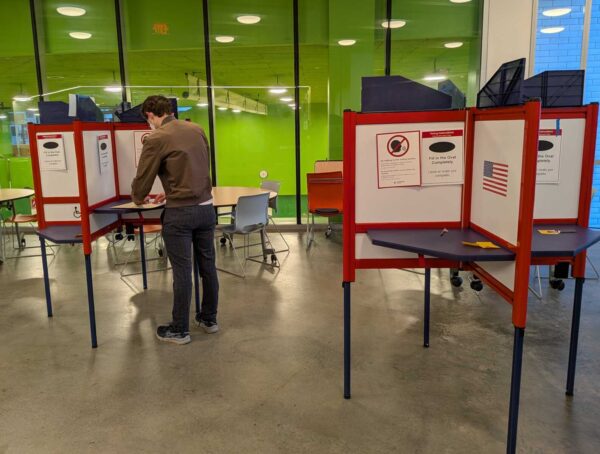
Arlington stands to be divided into two congressional districts following last night’s statewide referendum, which narrowly passed with overwhelming support from local voters.
The “yes” vote rolled up about 80% of the vote in Arlington, based on preliminary vote totals released last night by the Virginia Department of Elections. This helped the measure squeak by statewide with about 51.5% of the vote — a majority of about 90,000 votes out of more than 3 million cast, according to preliminary figures.
Unless overturned by the Virginia Supreme Court, the new maps provide Democrats the opportunity to win as many as 10 of the commonwealth’s 11 House of Representatives districts in the Nov. 3 general election.
Democrats currently hold six of the 11 seats, including all three — the 8th, 10th and 11th — representing inner areas of Northern Virginia. Under the Democratic maps, not only is Arlington split in two, but neighboring Fairfax becomes part of five separate congressional districts, up from the current three.
Despite the closeness across the commonwealth, a win is a win, supporters of the measure said.
“Arlington voters made clear that attempts to sideline the will of voters will not stand,” Arlington County Democratic Committee deputy chair Sarah Flourance said after the results were in.
In preliminary results, Arlington’s “yes” vote was 65,570, or 79.9%, with the “no” voting picking up 16,494 votes, or 20.1%. All 54 Arlington precincts voted “yes” with percentages ranging from 56.7% to 86.2%.
Turnout countywide was around 45%, state elections officials reported, with a few ballots, notably provisionals and late-arriving mail ballots, still to be added to the total.
In the city of Falls Church, with all three precincts reporting, “yes” received 5,234 votes, or 80.7%, to 1,250 votes, or 19.3, for “no.” Turnout was about 53%.
The county’s Democratic leadership held a watch party at Highline RxR in Crystal City, while Republicans gathered at Crystal City Sports Pub.
In the run-up to the election, the Arlington County Democratic Committee said the proposed amendment represented “a temporary, emergency response to that national environment.”
The local party mobilized a get-out-the-vote effort.
“Our volunteers knocked doors, made calls and engaged voters in every corner of the county,” said School Board member Zuraya Tapia-Hadley, who chaired the party’s redistricting committee. “The result — overwhelming support for the amendment — reflects a community that believes deeply in fair elections and equal representation.”
In an Election Day message to party members, Arlington GOP Chair Matthew Hurtt characterized redistricting as “the far left’s naked quest for power.”
“I am so impressed by what you’ve accomplished in the weeks since Abigail Spanberger, Louise Lucas, and Don Scott forced this on voters,” he said in the morning message to Republicans.
Former Arlington County Board member John Vihstadt argued on Facebook for a “no” vote, finding himself in a spirited but civil back-and-forth with those supporting the amendment.
Among those weighing in on the Vihstadt post was political analyst and consultant Ben Tribbett. He said the state GOP potentially could do well under the new districts, if the party found a way to unite its various wings:
“This is a good thing for Virginia Republicans. Under the new lines if they won [Donald] Trump’s vote in rural areas, and [Mitt] Romney’s vote in suburbs they would win six seats. A couple points beyond that and they win eight. All they have to do is reach out beyond their MAGA base — but if they refuse to do so, they will get one seat. Their choice.”
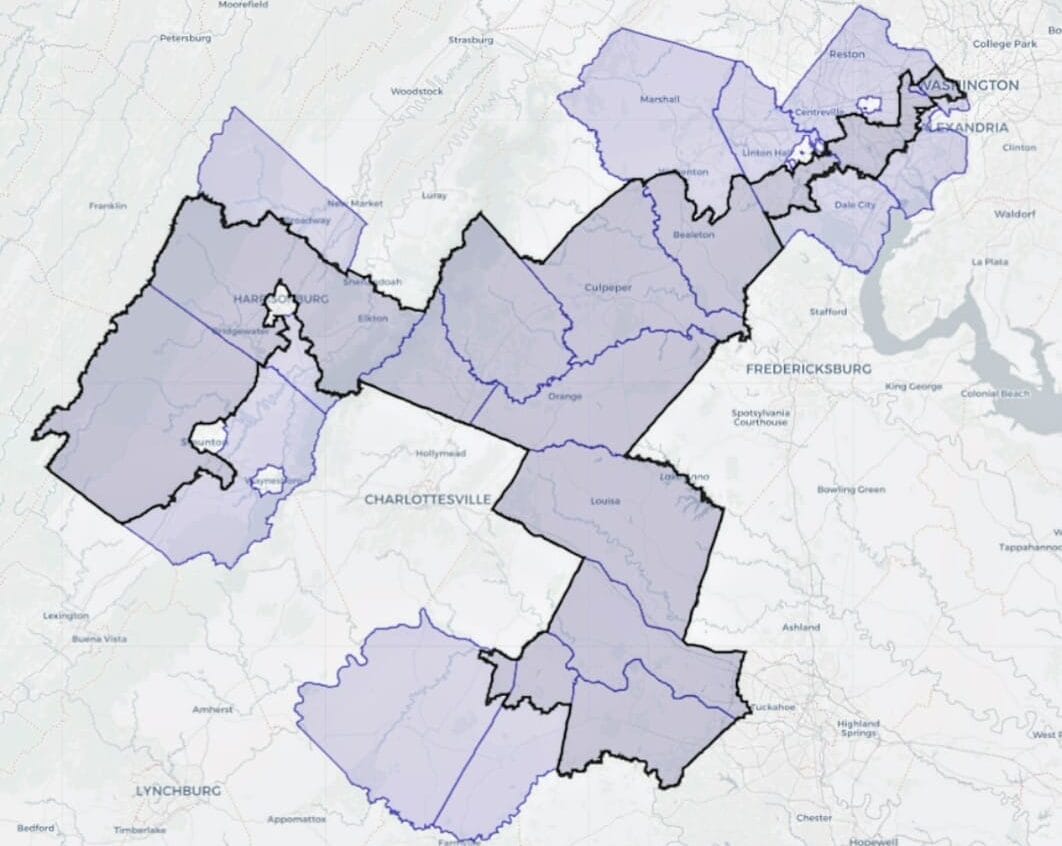
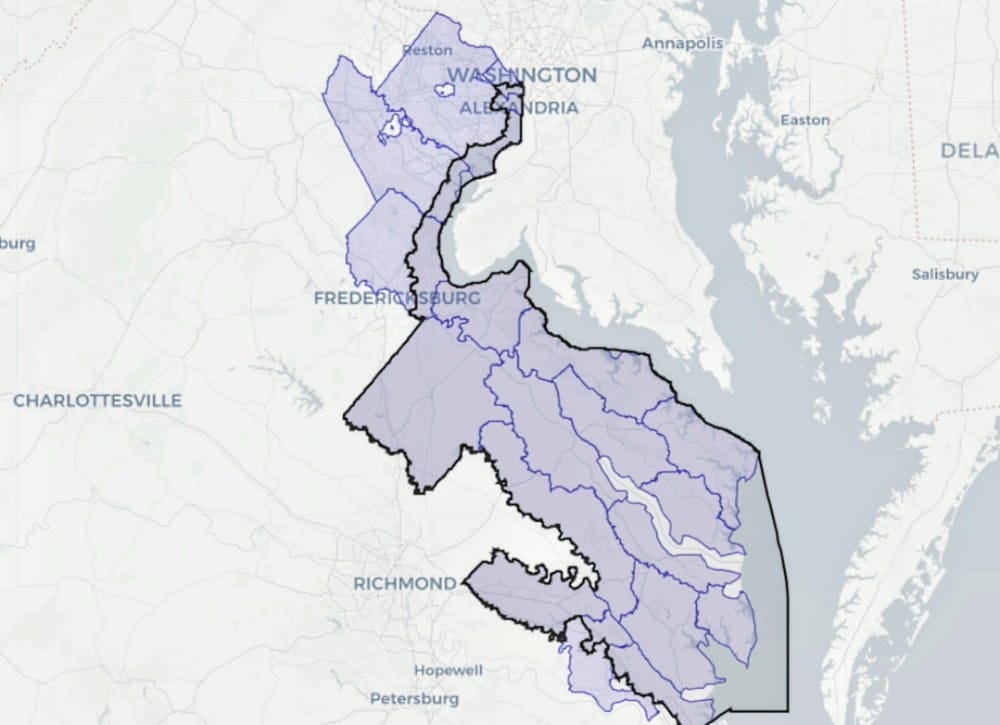
Under the redrawn maps, the northern 60% of Arlington shifts into the new 7th Congressional District, while the remaining part of the county remains in the redrawn 8th District. The city of Falls Church moves from the 8th to the 7th.
Both the redrawn 7th and 8th lean toward Democrats, but favor the party less than does the existing 8th District, represented by Rep. Don Beyer (D). Both districts begin in Arlington and then meander through suburban and rural areas — the 7th runs west and southwest, the 8th south as far as the Williamsburg area.
Beyer, an Alexandria resident who first was elected to Congress in 2014, is seeking re-election in the 8th District. He is being challenged by a number of Democrats in the Aug. 4 party primary.
“I look forward to working to earn the trust and support of communities in the new district, from Arlington to Yorktown, while reconnecting with those I have had the honor of serving, including communities I previously represented as lieutenant governor,” Beyer said in a statement released by his campaign.
In the 7th District, which has no Democratic incumbent, a number of candidates have emerged to compete in the August nominating process.
In recent months, J.P. Cooney, Dave Kennedy, Del. Adele McClure, Sen. Saddam Azlan Salim and Sen. Dan Helmer appeared before the Arlington County Democratic Committee to launch their campaigns.
Former Virginia First Lady Dorothy McAuliffe and Joe Schiarizzi also have announced plans to run, but have yet to appear before county Democrats. Others are considering entering the contest.
Republican fields for each district are likely to firm up over the coming weeks. The general election for Arlington’s congressional representatives is likely to be unusually competitive, given the large numbers of Republicans elsewhere in the redrawn districts.
The GOP and other redistricting critics will continue their push to have the Virginia Supreme Court invalidate the referendum results. Justices have taken up the case but allowed the referendum to be held before further considering the merits of challenges to it.
“The legal fight is just beginning,” former Virginia Attorney General Ken Cuccinelli said in a social-media post reposted by the Arlington GOP.
Polls in recent weeks showed support for the referendum modestly outpacing opposition. On the morning of the vote, the 2025 Republican candidate for lieutenant governor, John Reid, told WMAL radio it likely would require “a miracle” for opponents to pull off an upset win.
The night before voting, President Donald Trump participated in a tele-rally in opposition to the referendum. Democrats, well aware of the president’s low approval ratings among Virginia voters, worked to tie him to opposition forces.
Trump did not address the election result in overnight postings on his Truth Social platform, instead issuing a jumble of verbal broadsides on political consultant James Carville, the Wall Street Journal, the Iranian government and Sen. Mark Kelly (D-Ariz.) over various matters.
Democrats enlisted the aid of former President Barack Obama in commercials supporting the new congressional districts, contending they are a temporary measure designed to counteract mid-decade congressional redistricting in other states.
Hillary Clinton and Nancy Pelosi were among other prominent Democrats who worked to try and sway Virginia voters.
As Election Day dawned, the Arlington NAACP encouraged its members to get out to the polls.
“Our ancestors prayed for this right, marched for this right, suffered for this right, and in many cases died for this right,” local NAACP president Rev. DeLishia Davis said in an email. “We honor them not only with remembrance, but with action.”
The local branch did not take a formal position on the referendum, but the NAACP Virginia State Conference supported a “yes” vote.
The relative closeness of the statewide result left opponents of the measure asking “what-if” questions.
“There are a lot of Republicans in Washington tonight wondering why national GOP political organizations didn’t spend more aggressively in Virginia,” said Jake Sherman, founder of Punchbowl News, in a social media post.
For the first half of the 20th century, Arlington had been part of the 8th District. In 1952, after Virginia gained an additional congressional district, it moved into the 10th District, but reverted to the 8th in 1992.
