

The County Board has taken a step toward considering potential historic status for the Melwood site, despite vigorous opposition from the development team’s attorney.
Board members voted 5-0 to start consideration of the Historical Affairs and Landmark Review Board’s (HALRB) recommendation to designate a portion of the former Nelly Custis Elementary School at 750 23rd Street S. as historic. This is a procedural step and doesn’t indicate whether they support the recommendation or not.
A historic-district designation would make it more difficult to tear down the building and replace it with affordable housing as proposed by Melwood and Wesley Housing.
At the April 23 meeting, Andrew Painter — a prominent local land-use attorney representing Melwood — reiterated the development team’s opposition to historic status.
“It would restrict its rights as a private-property owner to modernize and utilize the facility in furtherance of its mission,” Painter said.
Historic status “really should not be imposed without having the underlying property owner’s consent,” he added.
Board Chair Matt de Ferranti responded that this was an argument to be made at a later date, as the April 22 action was merely “a requirement … for what we must do process-wise” before considering the application’s merits.

Until recently, County Board members had a two-step process in land-use cases: first advertising the matter for a public hearing and then, typically a month later, holding the hearing and making a decision.
But a Circuit Court ruling in 2024 found that a further step is needed — approving an “initiating resolution,” followed later by advertisement of the public hearing and then the hearing/decision itself.
The April 22 vote on the initiating resolution was merely pro-forma, County Board member Julius “JD” Spain, Sr., said.
“This gets us started,” he said. “I want to stay within the framing of the law.”
Under the timeline, the measure will be advertised in May, with final County Board consideration of historic designation taking place in mid-June.
On a 7-4 vote, HALRB members in March determined that original portions of the school building met two of the 11 criteria — the bare minimum — outlined in the county’s zoning ordinance to be considered for historic status. County historic-preservation staff sided with Melwood in opposing the designation.
The HALRB vote recommended retaining the earliest parts of the building, from 1924 and 1931. The panel voted that additions constructed in 1962 and in the mid-1990s did not qualify as historic.
County Board members last year approved redevelopment of the 1.7-acre site, but barred Melwood and Wesley Housing from moving forward until the question of historic status is resolved.
Painter’s case did not carry the day at the March HALRB meeting, but likely will be more persuasive when the matter goes to the County Board in June. In recent years, Board members have been reluctant to impose historic-district status on properties when the designation is opposed by the property owner.
Also aiding Melwood’s case is the fact that the county’s historic-resources inventory of 2011 did not include the building among those that merit preservation.
De Ferranti said Painter had brought up “fair arguments,” and that they would be considered at the appropriate time.
Upcoming public hearings at both the Planning Commission and County Board are likely to pit housing advocates on one side, preservationists on the other. Aurora Highlands residents appear split on historic designation, although the local civic association has come out in support of it.
‘Nelly’? ‘Nellie’? What’s in a name?
At the April 22 public hearing, one public speaker said the county government was misspelling the name of the former elementary school now being slated for Melwood’s redevelopment project.
Bernie Berne, who often speaks at public hearings on issues related to history and the environment, contends that the school’s namesake is not “Nelly Custis” as spelled in the historic-district application, but rather “Nellie” Custis. He cited several historical documents.
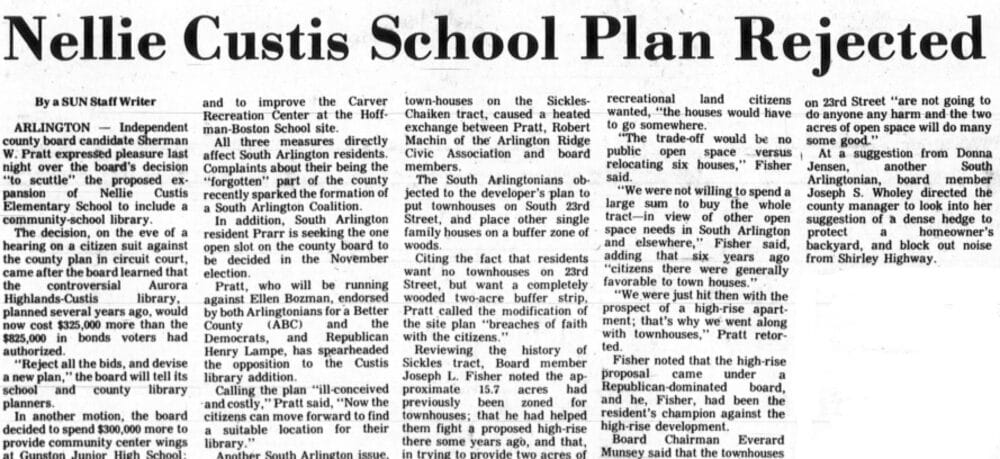
The preponderance of the historical evidence is that Eleanor Parke Custis Lewis (1779-1854) went by “Nelly” rather than “Nellie.” That is how she is referenced by George Washington’s Mount Vernon — she was the granddaughter of George and Martha Washington — as well as the Encyclopedia Virginia. The Daughters of the American Revolution chapter in Mount Vernon that honors her also uses “Nelly” rather than “Nellie.”
Melwood and its development partner, Wesley Housing, also use a “y” at the end of her first name, as does Wikipedia.
Working in favor of Berne’s argument is news coverage in the Northern Virginia Sun from the 1950s-70s. Articles and headlines more often than not went with “Nellie” over “Nelly” in its coverage of the elementary school, which was closed in the late 1970s due to declining countywide student enrollment.
After that brief detour down a historical rabbit hole, County Board member Takis Karantonis said the spelling of the name “is probably not relevant” to consideration of the historic-district application. He was backed up by County Attorney Ryan Samuel.
