


A key county advisory panel has recommended giving historic protections to portions of the former Nelly Custis School in Aurora Highlands.
The 7-4 vote by the Historical Affairs and Landmark Review Board on March 18 sends the matter to the Planning Commission and County Board. And it complicates efforts by Melwood and Wesley Housing to redevelop the 1.7-acre site at 750 23rd Street S. for affordable housing.
The vote was a rejection of the conclusion by county historic-preservation staff that the property did not meet the minimum of at least two of 11 criteria to be considered as a local historic district.
In the end, the HALRB majority decided it met the bare minimum — two of the 11 — required under the zoning ordinance for consideration as a historic district.
“This property is very ‘on the line.’ It definitely is challenging to say whether it qualifies,” said HALRB member Andrew Fackler.
Fackler ultimately voted against the recommendation for historic designation. He was joined by board members Nathan Burlingame, Alexandra Foster and Gerald Laporte.
Omari Davis, Nan Dreher, Robert Dudka, Joan Lawrence, Mark Turnbull, Richard Woodruff and Chair Kaydee Myers voted to support the recommendation for historic designation.
HALRB member Gray Handley abstained, and several members did not participate in the meeting.
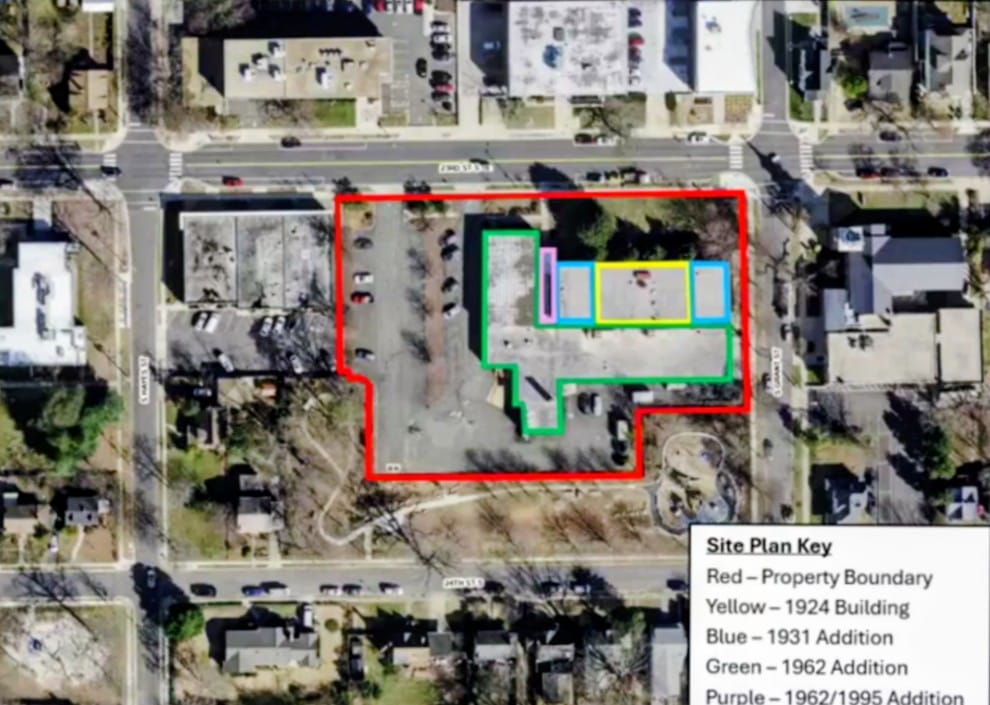
The recommendation to County Board members calls for retention of the earliest parts of the former school building, which date to 1924 and 1931. Later additions, constructed in the 1960s and 1990s, would not be covered by the designation.
It remains possible, even likely, that County Board members end up rejecting historic status, particularly given opposition by the property owner. But the March 18 HALRB action requires that Board members at least hold a hearing and take a vote.
Woodruff, who pushed passionately for historic status, said the interests of a property owner shouldn’t play into HALRB’s decisions.
“I’ve been through a number of these battles where we have not protected properties that need to be protected,” he said. “I don’t really put much thought into what the property owner wants.”
A local resident in April 2024 filed the application to designate the property as historic. Two months later, HALRB members directed staff to review the property’s provenance.
In February 2025, County Board members approved Melwood’s site-plan request to raze the property and in its place build 105 affordable apartments plus approximately 17,000 square feet to be used for Melwood’s clientele.
Under the redevelopment plan, about one-third of the apartments would be set aside for residents with disabilities.
Despite the County Board’s rezoning action, the plan remains on hold until a final decision on historic status is made.
At the March 18 meeting, attorney Lauren Riley, representing the property owner, said multiple additions to the building since its 1924 construction render it no longer truly historic.
“The building is not worthy of designation,” said Riley, asking HALRB members to support the staff recommendation.
Jeffrey Williams, the first of many speakers on both sides of the issue at the March 18 hearing, said the greater good would be served by allowing redevelopment to move forward.
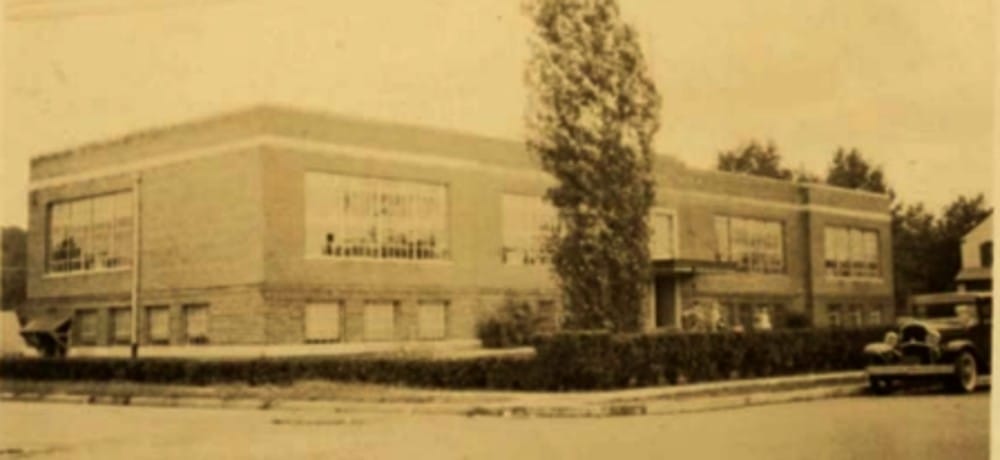
The proposed architectural features of the proposed apartment building would be enough to acknowledge the “spirit and sense of place” of the original school, said Williams, a 63-year resident of Arlington.
“We should not let sentimental attachment to the past prevent our community from evolving to meet present and future needs,” he said.
But Nicholas Giacobbe, another speaker and longtime resident, said that underneath the later additions, the original Georgian Revival building remains and could be preserved.
“The integrity is there,” he said.
Giacobbe, who lives in Aurora Highlands, said the HALRB’s decision-making needed to stay strictly within historic-preservation portions of the county code. Plans for future use of the site have no place in coming to a conclusion about the property’s eligibility for historic status, he said.
“We don’t need to discuss the merits of the housing — that’s not the decision before you,” Giacobbe said.
Another advocate for preservation, Tom Dickinson, said Arlington needed to retain what little of its physical history that remained.
“We have such a tiny, minuscule inventory of historic properties left,” he said.
Larysa Kautz, president/CEO of Melwood, and Kamilah McAfee, president/CEO of Wesley Housing, issued a joint statement expressing disappointment in the HALRB vote.
“This decision differs from the findings of county staff and professional experts who determined that the building does not meet the county’s criteria for designation,” they said, “especially given that alterations significantly compromised the building’s architectural integrity and historic fabric, as noted in the staff report.”
The statement suggested motivations of those behind the effort to bestow historic designation were not truly about history:
“It appears that this process was initiated not based on the merits of historic preservation, but as a tool to hinder development. If the HALRB’s position stands, it opens the door to any neighbor stopping or slowing another private property owner’s decision the neighbor dislikes. We are concerned about the precedent this position may set for other private property owners in Arlington County and the impact this decision may have on our ability to deliver much-needed affordable housing and supportive services for individuals with disabilities in Arlington County on our private property.”
Nelly Custis School served the surrounding community from 1924 to 1978, when it was closed due to age and declining countywide student enrollment.

The school system in 1979 conveyed the building to the county government, which then deeded it to Sheltered Occupational Center of Northern Virginia — better known as SOC Enterprises — in exchange for a Ballston property owned by SOC.
SOC converted the Aurora Highlands property into a training facility for clients with intellectual disabilities. The organization later changed its name to Linden Resources and eventually merged to become part of Melwood.
The former school is part of the Aurora Highlands Historic District, which in 2008 was included on both the Virginia Landmarks Register and the National Register of Historic Places.
Those designations are merely honorary, and convey no protections from future redevelopment.
At the March 18 meeting, HALRB member Trumbull said he was hopeful that public attention coming out of the current controversy would lead more Arlington communities to consider the historic properties in their midst.
“I really hope that other neighborhoods that are concerned about the historic integrity of their neighborhoods start thinking about what they can do, as neighborhoods, to save more of the buildings,” he said.
One option would be to follow the lead of the Maywood community, whose residents in 1990 convinced county leaders to designate the 46-acre entire neighborhood of approximately 300 buildings as a single historic district.
As a result, exterior architectural changes sought by Maywood residents must go through a review and win approval either by historic-preservation staff or HALRB members.
To date, Maywood — whose homes date back to the early 20th century — is the only neighborhood-wide local historic district in the county.
