

Metropolitan Washington Airports Authority (MWAA) officials are expressing cautious optimism that Reagan National Airport will see more passenger growth in 2027.
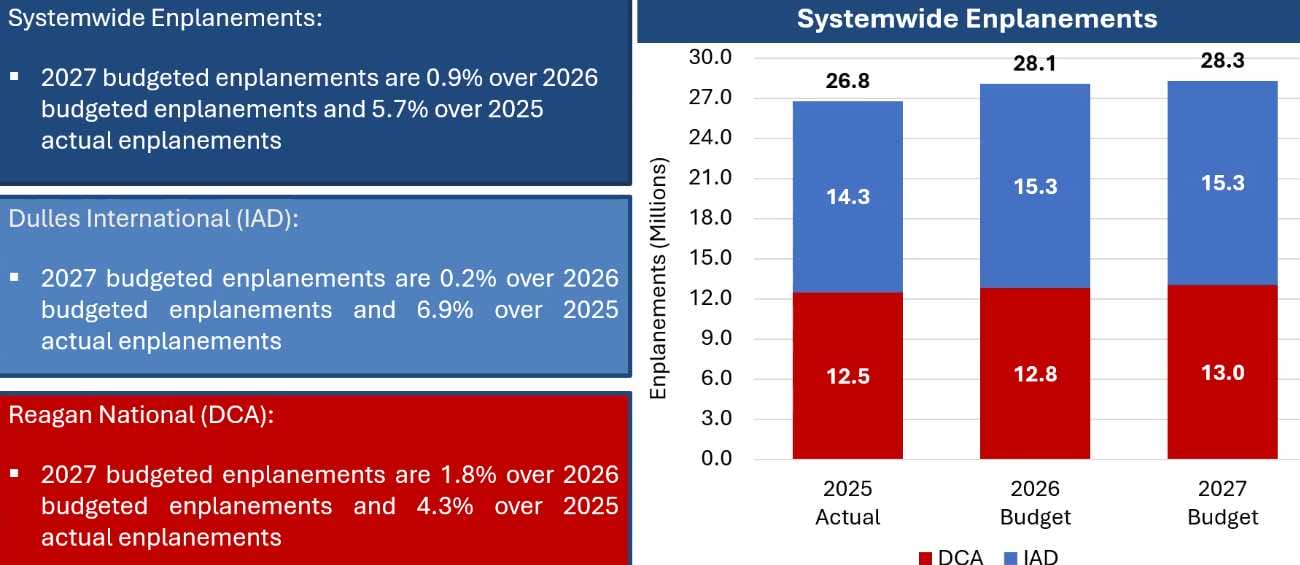
The authority’s calendar year 2027 budget, adopted Nov. 18, anticipates total enplanements of 13 million in 2027, up from the 12.8 million estimated for 2026 and the 12.5 million recorded in 2025.
That 2025 total was down about 5% from the year before, owing to factors ranging from the Trump administration’s cuts to the federal workforce to the January 2025 midair crash and challenging winter weather conditions.
For 2027, MWAA is estimating 15.3 million enplanements at Dulles International Airport, unchanged from 2026 estimates but up from the actual total in 2025.
The 2027 budget anticipates a cost-per-enplanement of $15.80 at Dulles and $10.96 at National in 2027, up from this year’s $10.41 at National and $12.77 at Dulles.
Cost-per-enplanement takes the total fees charged to airlines by MWAA and divides them by the total passenger count. The result is used to compare operating costs in airports nationally.
“When you bring on a capital program, you’re going to see cost-per-enplanement rise,” said Andrew Rountree, the authority’s senior vice president for finance. “These are still pretty reasonable … in relation to other airports.”
During a Nov. 18 discussion of the authority’s fiscal 2027 budget, economic and geopolitical conditions that could impact traveler counts and airport revenue were front and center.
“We’re in a very dynamic time — there’s a lot going on,” MWAA CEO Jack Potter said during a meeting of the authority’s finance committee.
In developing the calendar-year 2027 budget, “we’ve had to work very closely with the airlines,” he said.
Several hours after those comments, the MWAA board of directors voted unanimously to adopt the proposed budget, which anticipates aviation-related revenues totaling $1.05 billion for the coming year, up 11.4% from 2026.
“This is the first time we’ve passed the billion-dollar mark,” Rountree said.
Aviation-related expenses are budgeted at $976.8 million, up 9.8% from the current budget, including a 10.9% increase to $31.5 million in debt service costs.
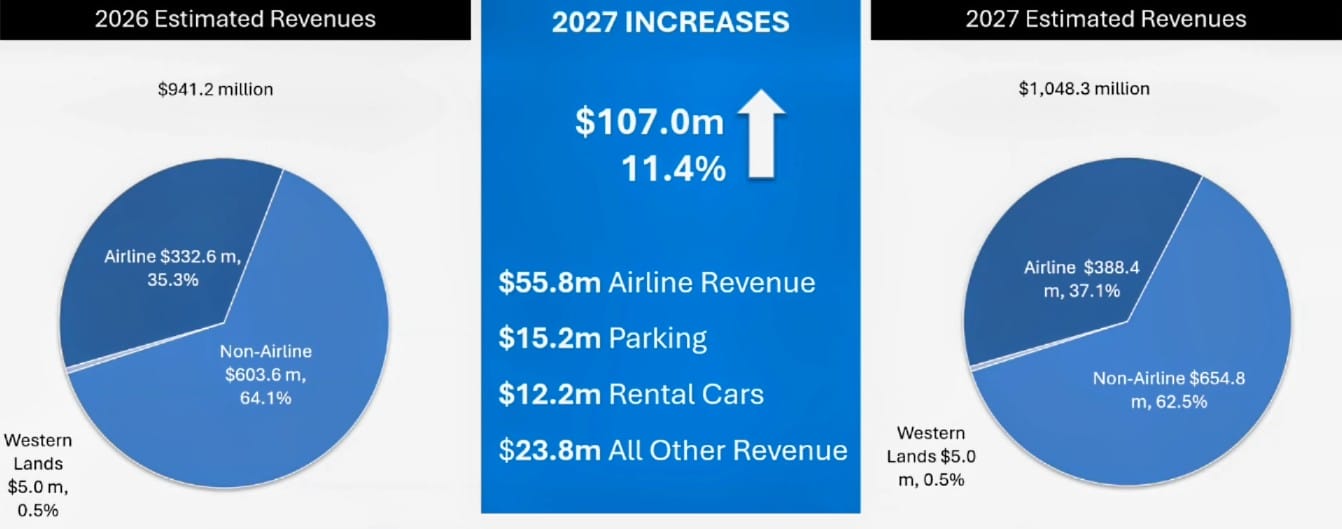
Direct revenue from airlines is expected to rise $56 million to $388 million, with non-airline revenue from parking, rental-car concessions and retail leases also expected to rise.
Factors including inflation, the labor market, retiree costs and the need to invest in cybersecurity protections could impact both revenue and expenses, Potter told board members.
Also rising is the lease payment from the authority to the federal government. Congress recently increased it from $7 million to $15 million annually.
“We should send them a thank-you note,” deadpanned Kate Hanley, a longtime Fairfax County leader who was attending her final meeting as an MWAA board member representing Virginia.
Capital spending has risen because of the recently opened Concourse E at Dulles, and it will continue to grow as the authority works on a redevelopment plan for Dulles announced earlier this year.
All told, long-term capital spending is now estimated at $26.6 billion — $23.59 billion of it at Dulles and $3.01 billion at Reagan National. The coming year’s capital spending is budgeted at $790 million at Dulles and $247 million at National.
Like any budget, figures for operating revenues and expenditures are informed estimates, but are not guaranteed to play out as expected. If revenues run below projections, the authority has the ability to go back to the airlines and impose higher costs.
“We hope it doesn’t come to that,” said Potter, who has announced plans to retire early next year from the post he has held since 2011. “We haven’t had to do that for a long time, [but] we have that ability.”
At the finance committee meeting, Potter noted several operational variables, including the weather and the wars in Ukraine and Iran.
“There’s a potential for a lot of snow this coming season,” he said. “Hopefully there’s progress on two wars. We’ll see how it goes.”
Board members also expressed concern about a traveling public that might choose methods other than aviation, given the recent nationwide ground stop due to Federal Aviation Administration technology issues.
One board member said she hoped the budget included “a little bit of wiggle room for the unknown.”
The authority is moving toward 2027 in relatively stable financial shape. Year-to-date through October, aviation-related revenue is running above the budgeted amount, led by a 4.9% increase in non-airline revenue.
Reagan National opened in 1941, with Dulles following in 1962. MWAA was created by Congress in 1987 to manage the two airports, which remain under federal ownership. Its operating lease runs through 2058.
In addition to the two airports, the authority operates the Dulles Toll Road under contract to the Virginia Department of Transportation. Revenues and expenses for those operations are separate from the aviation budget.
