

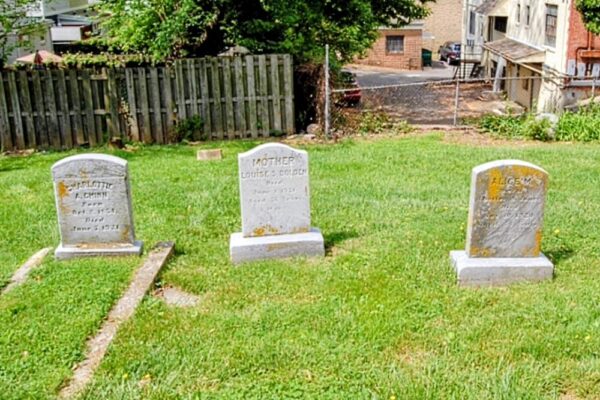
A new partnership between the county government and a local church aims to preserve, improve and maintain public access to a historic cemetery.
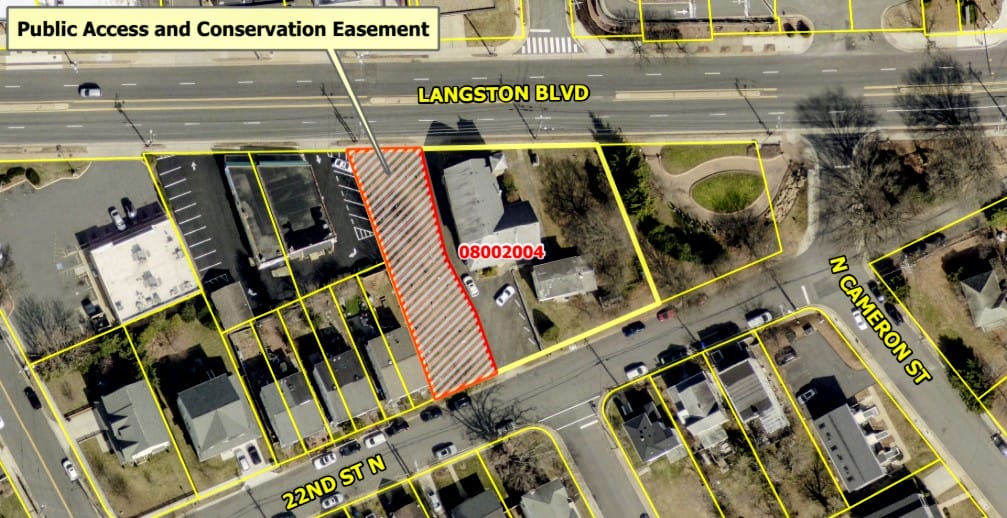
The county government plans to install perimeter fencing, access gates and a bench at Calloway United Methodist Church’s cemetery at 5000 Langston Blvd, one of the oldest church-affiliated African American graveyards in all of Arlington.
Per an agreement that the County Board unanimously approved at a Saturday meeting, the improvements will occur on the western side of the parcel, where the cemetery is located. They will not impact the church building on the eastern portion of the site.
Once the improvements are made, the congregation will be responsible for maintaining them, according to the agreement. In addition, a permanent easement from the church to the county government will ensure public access to the cemetery site in perpetuity.
The remains of an estimated 100 people are buried in the 7,000-square-foot cemetery parcel. Interments took place from 1891 to approximately 1959, but there are no existing records pertaining to the cemetery or burials there.
Among those interred in the cemetery grounds are:
- Winsted Calloway (1843-91), a Methodist minister who served congregations throughout Virginia and is the namesake of the church
- Margaret Hyson (1825-1891), who had been enslaved at Hall’s Hill Plantation before being emancipated, and was one of the early leaders of the church
More than half of those believed buried do not have grave markers. In 1960, when the Virginia Department of Transportation widened Langston Blvd (then Lee Highway), the remains of 10 people were exhumed and moved to Coleman Cemetery in the Alexandria area of Fairfax County.
According to a staff report, the cemetery is reflective of the time in which it was in use for burials:
“Historic African-American cemeteries often had little or no formal landscaping, and at times, ornamental plants or vegetation were used to mark grave locations. The graves tended to be randomly placed and scattered instead of placed in a symmetrical arrangement. Wooden coffins were typical, often marked by simple wood or stone monuments that were made by hand, as were unmarked graves or those marked only by fieldstones placed on end.”
The cemetery was included on the roster of Arlington historic districts in 2012. Being designated a local historic district provides protections against redevelopment, and allows the Historical Affairs and Landmark Review Board a degree of oversight responsibility.
In its description of the site, the county government’s list of local historic districts notes that “the most significant feature of the Calloway Cemetery is its assortment of grave markers of varying type, material, age and ornamentation.”
“The majority of visible graves have either concrete or marble markers,” the county site noted. “The cemetery has a high degree of historic integrity with the overall physical condition of the individual grave markers being very much intact.”
Under terms of the agreement, the church will not pay for installation of the fencing or bench. The county government will pay the congregation $1, which is required to validate the agreement, for a temporary construction easement on the parcel.
According to the church website and other sources, Calloway can trace its roots back to an 1866 prayer service held at the home of member Samuel Smith. He lived on the Saegmuller farm, where the Knights of Columbus is located today.
In 1904, the congregation built the first sanctuary on the current site. Renovation and expansion efforts occurred in the early 1940s and late 1970s.
