

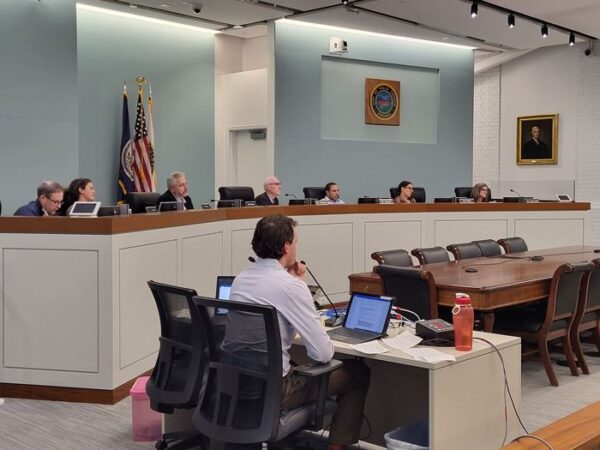
Falls Church officials are awaiting developments in Richmond to determine whether the city’s Planning Commission will get back powers that the General Assembly stripped last year.
However, legislation to restore the old arrangement could face an uphill battle.
Until last year, the city’s planning commission had the final say on development site plans proposed by developers. However, legislation passed during the 2025 General Assembly session required that all localities of more than 5,000 people vest that power in government staff.
With about 15,000 residents, Falls Church was required to make the changes, although some members of the Planning Commission and City Council members were not happy about doing so. At a Jan. 30 meeting of the Council’s legislative committee, officials discussed measures to increase the population threshold to 20,000.
If it happens, the Council would have the option of returning regulatory powers to the Planning Commission. Council member Arthur Agin viewed this as a positive development.
Agin said that, so far, the Planning Commission and planning staff had worked harmoniously in the new arrangement. But that is not always guaranteed, he said.
“Taking away the authority of the Planning Commission … is problematic. The way it’s set up, [the commission] could be ignored,” Agin said. “I know they’re frustrated by this change.”
Legislation patroned by Del. Karen Hamilton (R-62) is likely dead for the session, although a similar measure patroned by Sen. Bryce Reeves (R-28) is still awaiting a hearing.
A subcommittee of the House Committee on Counties, Cities and Towns on Jan. 23 recommended on a 6-1 vote to the full committee that Hamilton’s measure not move forward.
Reeves’s measure currently sits in the Senate Committee on Local Government. It will need to be acted on by the upper house of the legislature by Feb. 18, or it also will be dead for 2026.
At the Jan. 30 meeting, Mayor Letty Hardi said that despite what had been typical practice in the city, where the Planning Commission worked with developers to improve projects and incorporate public feedback, that’s not technically the way the process is supposed to occur.
“Legally, the Planning Commission is supposed to really just check to see whether [the proposal] matches the code, and if it meets all the requirements, discretion isn’t really supposed to be there anyway,” she said.
“I feel like we have missed that point in this discussion,” Hardi said.
The Hamilton/Reeves legislation had not been submitted when Council members adopted their 2026 legislative-priorities package late last year, so the city’s leadership is not formally on record for or against it.
Should the legislation fail, the Council would have the option to seek legislative approval to amend the city’s charter to give the Planning Commission oversight responsibilities. Under Virginia law, provisions in a locality’s charter trump state law in most cases.
If the city wanted to go this route, it would need to wait until 2027, as the filing deadline for the 2026 session has ended.
The legislation approved in 2025 also tightened deadlines for local governments across the state to act on development submissions. At the Jan. 30 meeting, there seemed general consensus that those shorter deadlines ultimately could have a beneficial effect on the overall development process.
“I don’t really have a problem with the speed,” Agin said.
