

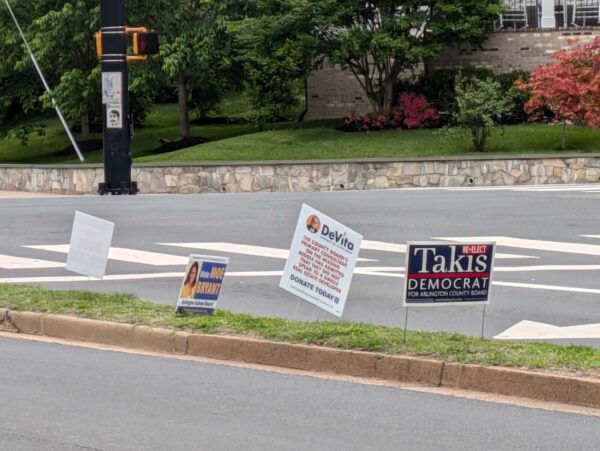
The Arlington County Board has voted to restrict, but not eliminate, the placement of campaign signs and other signage on county medians.
In a 4-1 vote, a majority of Board members said the compromise is a reasonable middle ground that will reduce clutter without severely impacting candidates’ ability to get their messages out.
For political candidates and parties, the major changes to existing policy are:
- Signage will now be limited to one per candidate/party/issue per median strip, down from the current two
- Signage will be allowed up to 45 days before an election, down from the current 76 days
Signage “plays a critical part of our democracy,” said Board member Julius “JD” Spain, Sr., who crafted the compromise that won support from all of his colleagues except Maureen Coffey.
The new rules go into effect May 1, after the April 21 congressional redistricting referendum. Allowing campaign signs in medians starting 45 days before an election would coincide with the start of early voting in both general and primary elections.
County Board Chair Matt de Ferranti said the adopted changes represent “a fair way forward.”
“Democracy is inconvenient,” he said to those concerned about the visual clutter of signage.
Coffey was the only Board member to embrace a staff proposal calling for a full ban on all signage, including political signs, in medians. She argued that median signage distracts drivers and creates visual clutter.
“Some people like them, a lot of people don’t,” she said of median signs. “They feel it is infringing upon their daily life.”
In a social-media world, campaign signage increasingly is an anachronism, Coffey said.
“Signs don’t convey anything other than ‘I’m a candidate,'” she said. “Everyone has access to alternative methods of getting their names out. There are so many.”
Coffey’s statement that neighboring jurisdictions had enacted signage bans didn’t sway any other Board members.
“We’re not Alexandria, we’re not Falls Church,” Spain retorted.
Enacting a ban would represent “a step backward, in my opinion, for democracy,” he said.
That was the view of most who spoke at the public hearing preceding the vote.
Banning campaign signs on medians would “stifle free speech, shield incumbents, limit electoral competition and diminish alternative voices and viewpoints,” said former Board member John Vihstadt.
He believes signage represents “an essential way for candidates and advocates to reach voters and for voters to become familiar with the electoral landscape from year to year.”

James DeVita, currently making his fourth bid for elected office, said his creative use of signs in past races got him noticed — for the right reasons.
“I used my campaign signs to communicate my positions on the issues, and voters loved it,” said DeVita, who currently is challenging de Ferranti in the County Board Democratic primary.
DeVita countered Coffey’s argument that signage had an increasingly limited role in elections.
“Politics is about ideas. Signs have staying power and they produce results,” he said.
Audrey Clement, a perennial protest candidate in local elections, acknowledged that a proliferation of signs on medians could be seen as a “public spectacle.” But, she said, banning the practice would represent a “draconian solution” rather than a nuanced response.
Clement asked Board members to limit signage to 31 days before an election and to major roadways.
One who supported the proposed ban was civic activist Bernie Berne. He cited the visual distractions for drivers, bicyclists and pedestrians, and said that because signs were omnipresent, “people ignore their messages.”
In the end, Coffey voted against the compromise. “The middle ground is not so appealing to me,” she said.
But she and other Board members said the issue likely would be revisited in coming years.
No representatives from the county’s Democratic or Republican committees testified at the hearing. However, in a letter to Board members, Arlington County Democratic Committee chair Paul Ruiz sought continuation of median signs in some form.
“Visible reminders in the public realm help ensure voters are aware that an election is occurring and understand what is at stake,” he wrote.
Before the final 4-1 vote on Spain’s compromise, there was a 3-2 split on when to implement the changes.
Spain, Coffey and Susan Cunningham supported an implementation on May 1, while de Ferranti and Takis Karantonis backed Jan. 1, 2027.
As a result, the first election where the new rules will be in place will be the Aug. 4 Democratic primary for County Board and U.S. House of Representatives.
The rules changes will not impact campaign signs on private property, which under state law cannot be restricted by local governments.
Changes to commercial-signage rules win approval: Action on median signs was part of a larger effort at the March 14 meeting to update the county’s zoning rules related to signage.
The other measures, focused largely on signage in commercial areas, had broad support and did not generate opposition from the public or Board members.
“This is an incredible body of work that is no small lift — another huge step forward,” Cunningham said of the noncontroversial portions of the zoning changes.
Changes proposed for advertising signage had the backing of the Arlington Chamber of Commerce. The organization’s president and CEO, Kate Bates, called the package a pragmatic step.
“At a time of economic uncertainty and high commercial vacancy, it is crucial for the county to take a proactive approach to encourage businesses to locate, operate and grow in Arlington,” Bates wrote in a letter to Board members.
