

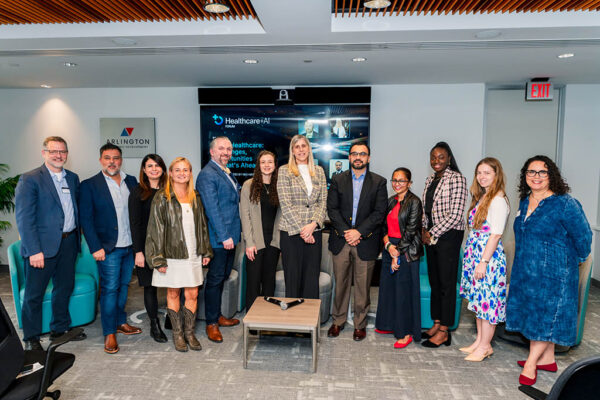
Leaders in healthcare, technology and research gathered in Arlington last month to explore how artificial intelligence is shaping the future of patient care.
The Healthcare + AI Forum, held March 26 at Arlington Economic Development (AED), brought together healthcare professionals, researchers, entrepreneurs and industry leaders to discuss real-world applications of AI in healthcare, from clinical decision support to the responsible and ethical adoption of emerging technologies. The event was sponsored by AED, the Ballston Business Improvement District and Darwoft.
Panelists included Usman Akhtar of VHC Health, David Patric Werner Rastall of Johns Hopkins Medicine, Skye Donovan of Marymount University and the American Physical Therapy Association (APTA) and Shavini Fernando, CEO of Arlington-based startup OxiWear. The discussion was facilitated by Ned Hayes of Darwoft.
Throughout the conversation, speakers highlighted how technology can support faster, smarter clinical decisions while keeping the focus on improving patient outcomes and making a meaningful impact on people’s lives.
“Given our proximity to federal health agencies, leading research institutions and a highly skilled talent pool, Arlington is uniquely positioned to convene these conversations and help translate them into tangible partnerships and impact,” said Adriana Bonilla, Assistant Director of Business Development at AED. “We wanted to bring together the community working at the intersection of healthcare and technology to explore real-world applications, responsible adoption and new opportunities for collaboration.”
The event began with a series of startup pitches, where founders shared how they are using technology to tackle challenges in healthcare. Featured companies included Arlington-based startups Seamless Transition and WISE Connect, along with OxiWear and Floreo, a Maryland-based startup with employees in Arlington.
One example highlighted during the event was OxiWear, which is developing wearable technology that continuously monitors oxygen levels in real time. The device can help detect early signs of respiratory issues and enable more proactive care. Data from tools like these can also support broader AI-driven insights that help clinicians identify patterns and improve treatment decisions.
The startups in attendance reflected the strength of the local innovation ecosystem, a highly connected environment where startups can access talent, customers, capital and strategic partners, often within just a few miles.
Organizers say the forum was designed not just to spark conversation, but to strengthen connections across Arlington’s growing innovation community. By bringing together healthcare leaders, researchers and entrepreneurs, the event aimed to accelerate collaboration and highlight the role Arlington can play in advancing healthcare innovation.
To stay up to date on similar events and opportunities, subscribe to Arlington Economic Development’s Innovation Ecosystem newsletter, which highlights programs and resources for those driving Arlington’s innovation economy.
