

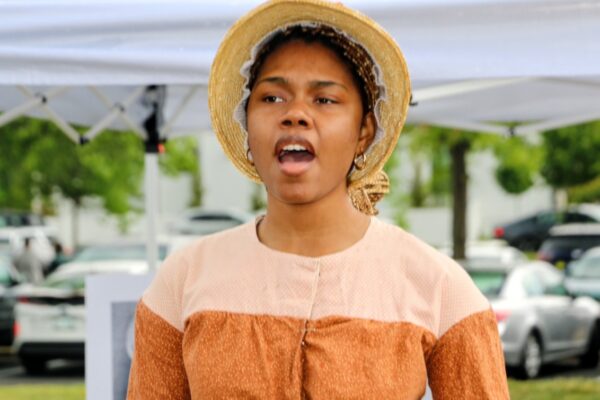
The true story of a local enslaved woman’s legal fight to earn her freedom was brought to life in a series of performances this spring.
The name “Julia Roberts” is connected in most people’s minds with the successful Hollywood actress. But an earlier Julia Roberts played a seminal, but until now largely overlooked, role in local, state and national history.
That has begun to change through the efforts of the Arlington Historical Society.
A condensed version of “Julia Sues for Freedom,” originally conceived as an hour-long production, was performed on May 9 at Arlington’s HistoryFest following other productions elsewhere in the county.
At the festival, Tia Thomas performed a one-woman version of the original four-character play under the direction of Catherine Aselford.
The tale revolves around Roberts, who was born enslaved but, in 1842, brought suit in Alexandria County (today’s Arlington) to guarantee her freedom.
That freedom had been promised by Revolutionary War veteran Simon Summers, who purchased Julia’s mother, Sarah, in 1785 and held her in bondage.
According to a history of the episode written for the historical society by Zachary Newkirk, Summers decided that slavery was “contrary to the spirit of Christianity or humanity” in 1801. However, that moment of “Methodist magnanimity,” as Newkirk put it, did not extend to freeing Sarah immediately.
Instead, it provided she was to be emancipated in 1814, and any children born to her before then would be freed when they reached 25 years of age.
Julia, one of an estimated 14 siblings born to Sarah, is believed to have been born on April 23, 1812. Because her mother was still enslaved at the time, she was, as well.
At age 5, a local farmer leased Julia Roberts’s servitude for 20 years. She grew up performing domestic and farm duties in what today is Arlington.
The date of her promised emancipation in 1837 came and went with Roberts remaining in bondage. Ultimately, she took the almost unheard of step of filing a lawsuit to enforce the decree of Summers, her former enslaver, granting her freedom.
Equally unheard of, the two attorneys directed to assist Roberts in her case convinced the all-male, all-white jury to order the wishes of Summers carried out.
The matter did not end there, though. Roberts’ enslavers appealed to the U.S. Supreme Court, which had jurisdiction as Alexandria city and county at the time were incorporated into the District of Columbia.
The key question considered by justices was not connected to the broader implications of slavery. Instead, it revolved around the technical issue of whether witnesses had accompanied Summers when, in 1802, he recorded the paperwork at the Fairfax County Courthouse — which still stands — and whether an absence of witnesses would invalidate his written instructions.
Justice James Wayne of Georgia, writing for a unanimous Supreme Court in the 1844 decision Adams v. Roberts, upheld the jury’s verdict. It ordered Roberts to be released from enslavement.
Thomas, who portrayed Roberts in the May 9 excerpt, is a graduate of Baltimore School for the Arts and earned a bachelor’s degree in theater performance at Towson University. She has performed in productions as diverse as “A Midsummer Night’s Dream” at Chesapeake Shakespeare Company and “Ma Rainey’s Black Bottom” at ArtsCentric.
At her presentation during HistoryFest250, Thomas had to convince some of those observing that this was no work of fiction.
“It’s based on a real person,” she told them in a question-and-answer session. “She lived in middle Arlington, where Lubber Run is now.”
What became of Roberts? The last documentary evidence researchers have found comes in the 1860 federal census, said Jessica Kaplan of the Memorializing the Enslaved in Arlington initiative.
In that census, Roberts was listed in domestic service as a laundress and cook in D.C., Kaplan told ARLnow. To date, no further documentation has been uncovered, and it is unknown how long Roberts lived and whether she has descendants that may be alive today.
“It’s hard to prove a negative,” Aselford said when asked about potential descendants. “We don’t know that she had children, but she had siblings.”
The full hour-long production of “Julia Sues for Freedom” was first presented on April 18 at Central Library, in a partnership between the Black Heritage Museum of Arlington and Guillotine Theatre, with support from the Arlington Historical Society.
The script was based on documentation of the era, augmented by more current research into the case.
The April 18 production featured Lisa Hill Corley as Julia, Ken Jackson and Ricardo Frederick Evans as attorneys, and Black Heritage Museum of Arlington president Scott Taylor as the judge. Several attendees were recruited to portray jurors.
Additional performances later were presented at the Ball-Sellers House and Westover Farmers Market.
