

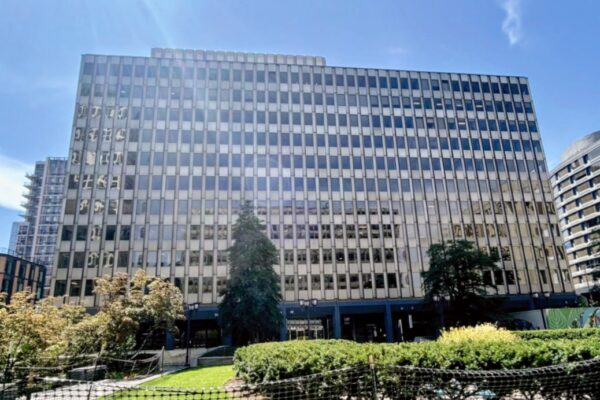
The County Board has approved two more projects seeking to convert aging office buildings in Crystal City into residential buildings.
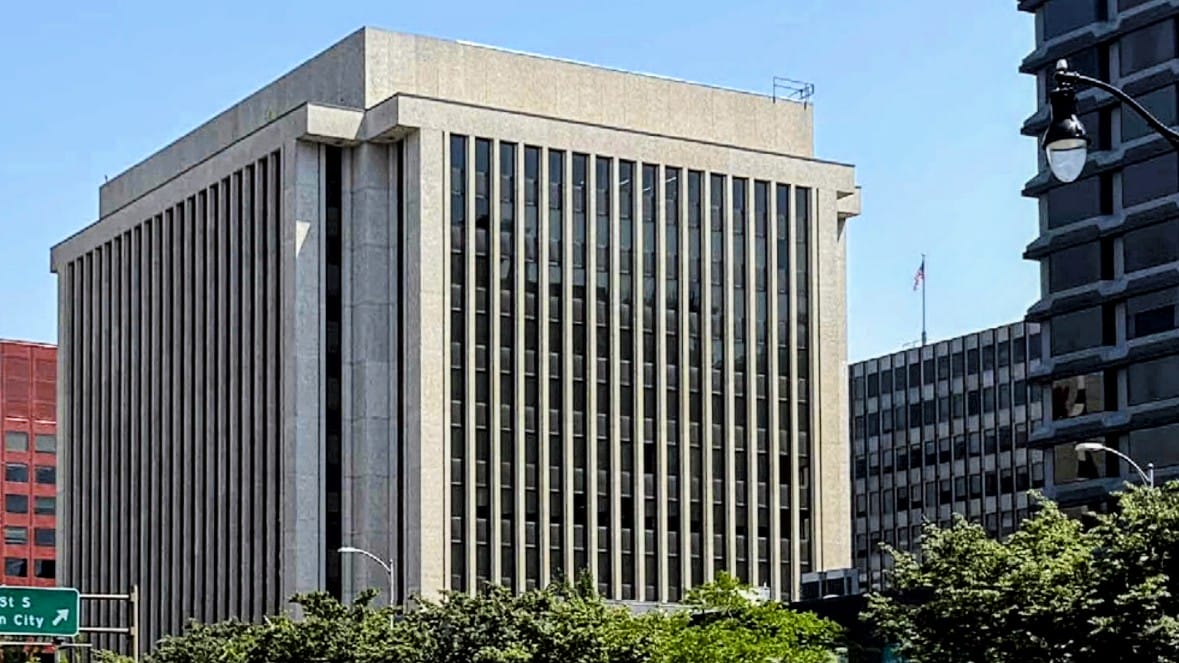
JBG Smith won approval to adapt a pair of empty, 11-story buildings constructed in the 1960s for housing — despite some residents’ objections about the limited community benefits that come with such projects. Under the plan, which County Board members unanimously supported at a Saturday meeting:
- 1800 S. Bell Street will be turned into a 129-unit residential building with ground-floor retail
- 1901 S. Bell will be repurposed for use as 186 residential units plus retail
Both will use the existing underground parking connected to the buildings.
“Adaptive reuse is a benefit,” Board Chair Matt de Ferranti said leading up to the vote. The projects will remove empty office space at a time when the county’s office-vacancy rate remains above 20% and approaches 30% in the vicinity of the two structures.
In addition, “it will activate the site,” said Tenley Peterson, representing the Planning Commission at the meeting.
“It will bring more people, more businesses, more retail opportunities in addition to more housing near transit and more tax revenue,” she said.
However, Peterson said, the recent flurry of adaptive-reuse projects typically have not provided the type of new neighborhood amenities that come when developers propose major new construction projects.
Tarsi Dunlop, president of the Crystal City Civic Association, said that her neighborhood and the broader National Landing area have been a hotbed for office-to-residential conversions, but has received few new amenities as a result.
“We object to the lack of community benefits,” she told board members. “Restaurants and retail are great, but where are the amenities like Center Park, a library and a theater?”
She said the county government’s enthusiasm for the Bell Street proposals shows that “long-term cultural benefits are again being sacrificed on the altar of short-term economic benefits.”
At the meeting, county officials acknowledged neighborhood concerns, saying they would be addressed in coming months in the development of the county’s latest capital improvement plan.
Not long ago, the idea of turning office buildings into housing was not only unknown in Arlington, but those who proposed it — such as perennial County Board candidate Audrey Clement — found their ideas derided as unfeasible.
But the evolving workforce environment, coupled with Covid, saw older office buildings fall out of favor as more employees worked from home. The changes caused both property owners and the county government to reconsider their positions.
Two years ago, County Board members did an about-face, approving an adaptive-reuse policy as one prong of a strategy to address the evolving world of commercial real estate.
“What we did in 2024 was say ‘let’s lift the gates, let’s open the barriers,'” Board member Takis Karantonis said at the May 16 meeting.
Karantonis, who before election to office served as executive director of the Columbia Pike Revitalization Organization (now the Columbia Pike Partnership), said proponents of the concept were right to push it forward.
“We learn as we go,” he said. “I never thought that a building like 1800 [S. Bell] was a viable adaptive-reuse candidate … I’m excited to see that I’m wrong.”
