

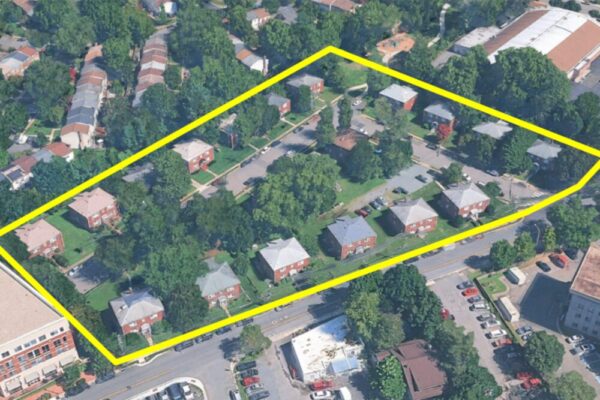
Falls Church leaders are weighing a few options as they decide the fate of a major affordable housing project.
City officials plan to rehabilitate or redevelop at least a portion of the 40 fourplex apartment buildings on the Virginia Village site through a future partnership with a housing developer. A work session on Monday focused on refining the request for proposal that will be put out, soliciting partnerships.
The document must be “flexible and open enough … to not stifle any creative options” developers might want to propose, Mayor Letty Hardi said.
“There’s all these tradeoffs — a lot of different things we’re weighing,” City Council member Justine Underhill said.
The draft request for proposal lays out three alternative development scenarios for prospective partners to address:
- Rehabilitation of the city-owned properties with a potential minor expansion effort, such as adding an additional floor or bump-outs to buildings
- Low-intensity redevelopment that would include razing the city’s properties and rebuilding up to four levels
- Larger infill redevelopment that would demolish the city-owned buildings and replace them with properties potentially up to seven stories tall in some areas
“We are asking them to think seriously … to really go through a thought process” in developing proposals, City Manager Wyatt Shields said.
Those submitting proposals also will be requested to offer hybrid plans that combine elements of the three scenarios. City officials also are seeking ways to put daycare or early-childhood education on the site, as well as develop civic spaces for community use.
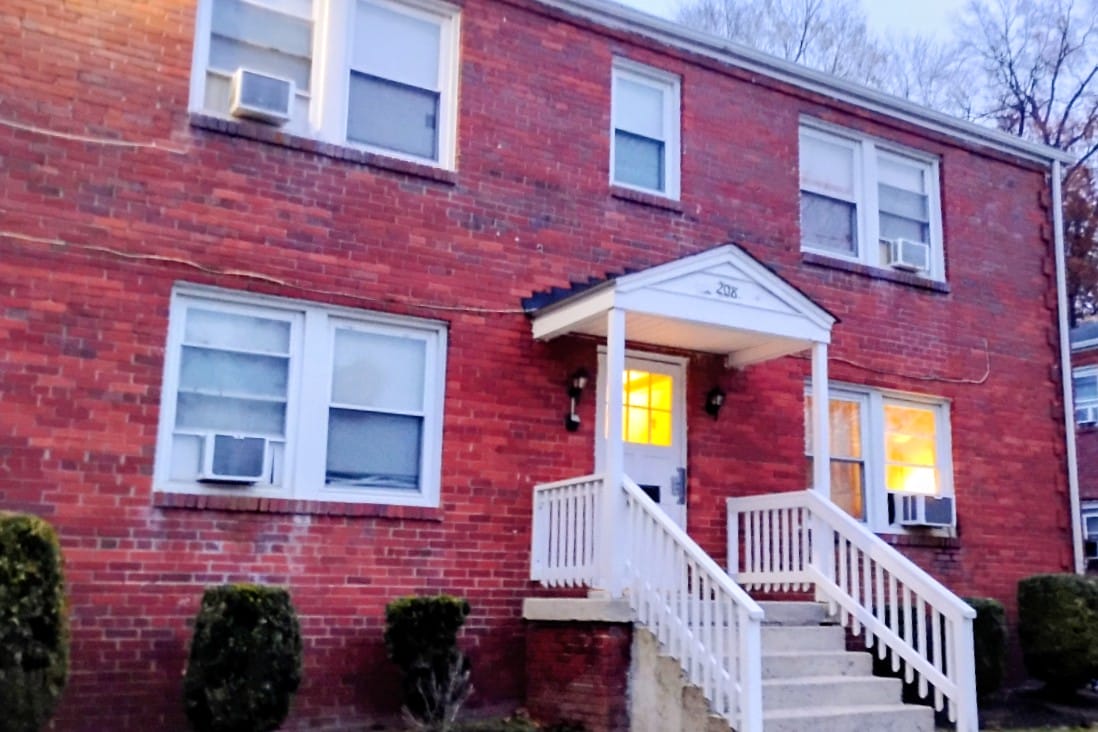
The original list of options proposed by staff had included a no-build alternative focused entirely on improving the existing, 1940s-era apartment building. That ran into a buzzsaw of opposition from those saying it missed the whole point of the project: increasing the stock of affordable housing.
On June 1, Shields acknowledged that “it wasn’t a realistic proposal.”
The city has contracted with the real-estate advisory firm Jones Lang LaSalle to provide support services for developing the request for proposals and reviewing the responses.
If all goes according to plan, Council members will approve final wording for the request on June 22, and it will be issued shortly thereafter. Staff are proposing a timeline that includes a meeting with interested development partners in mid-July and a deadline for proposal submissions by the end of that month.
A working group would evaluate the plans and recommend a preferred option to Council members.
Under the draft schedule, Council members would receive the recommendation in September. Council members would be able select a different proposal or reject them all, and it’s possible no potential partner will choose to submit a proposal.
“If respondents don’t think that any of the scenarios are viable, we’d like to know why, so that we can learn and go forward,” Shields said.
Much of the process would transpire behind closed doors, but the finalists could be asked to present their plans in a community forum.
City officials are racing to get a development partner and final agreement in place by early next year. That would meet the timetable for 2027 state low-income tax credits to help finance the project.
That truncated timeline has drawn some pushback both inside Council and out, and at the June 1 meeting, several officials said alternatives to tax credits should be considered to help finance the project.
Some also raised questions about whether the city would give away the land it owns, sell it to the chosen development partner, or offer it as a long-term ground lease. Others focused on what zoning changes on the Virginia Village site would be required to accommodate redevelopment, both of properties owned by the city government and in private hands.
Without obtaining more properties, the redevelopment effort would be piecemeal, since there are only a few contiguous lots now under city control.
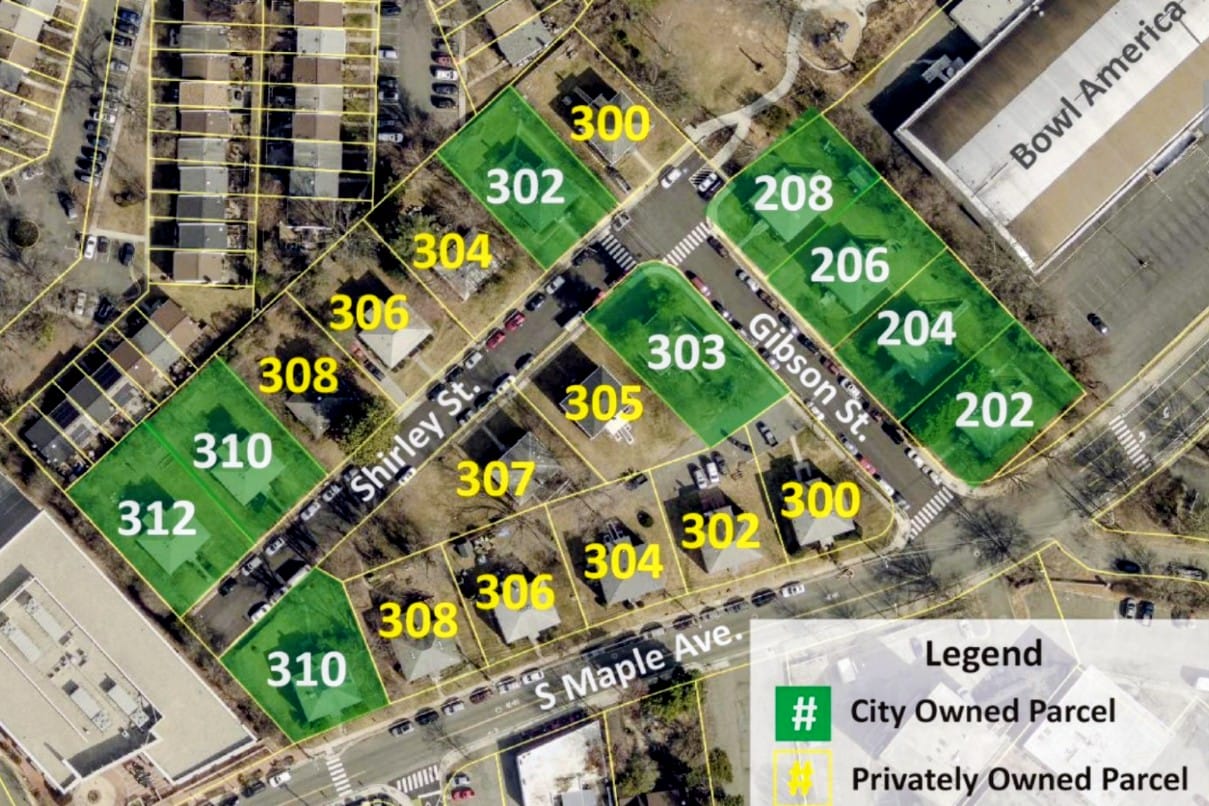
Of the 20 fourplexes comprising Virginia Village, the city, through its Economic Development Commission, owns nine:
- A four-parcel strip at 2002-2004-2006-2008 Gibson Street
- A two-parcel strip at 310-312 Shirley Street
- Individual parcels at 302 and 303 Shirley Street and 310 S. Maple Avenue
The owner of one additional lot, located at 300 Shirley Street, has contacted city officials with a request to potentially collaborate in the redevelopment. City officials have previously expressed interest in reaching agreements with the remaining property owners to support the project in one form or another.
A recent Falls Church News-Press editorial urged city officials to consider using eminent-domain powers to obtain all the properties currently in private hands, giving the city a much larger site to work with. Such an approach could face legal scrutiny, and Council members did not discuss the possibility at the June 1 meeting.
At the meeting, Erin Flynn urged her Council colleagues not to lose sight of the potential budget implications, positive or negative, in moving forward with redevelopment.
“We can’t have our heads in the sand,” she said.
Council member Laura Downs asked staff to not forget residents who currently live in the Virginia Village apartments.
“We have assured people that they wouldn’t be, for lack of a better term, kicked to the curb — that we would look out for them,” she said.
