

Falls Church leaders this week took a major step forward on a key affordable housing proposal, but ongoing divisions may imperil getting to the finish line.
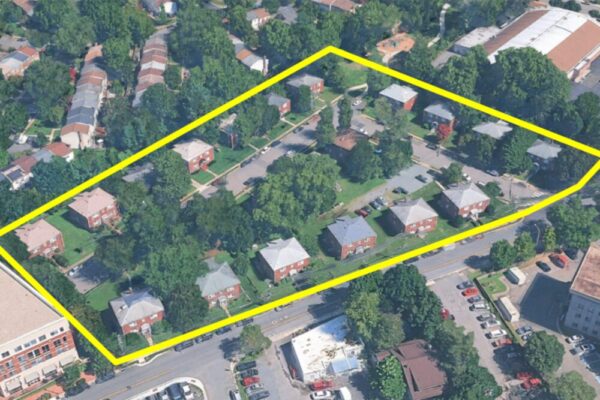
Council members voted 6-1 authorizing staff to release a request for proposal (RFP), seeking development partners for the apartment buildings owned by the city in the 4.5-acre Virginia Village community.
City plans call for redeveloping the nine parcels, in a project that could range from refurbishment of the 1940s-era buildings to multistory, mixed-use replacements. In a Council meeting that started the evening of June 22 and ran to nearly 1 a.m., a coalition emerged among Council members to move the RFP process and deal with the details later.
“If we really believe in affordable housing, as everybody says, we want to invite the maximum creativity,” Mayor Letty Hardi said.
Proposals responding to the RFP are due by Aug. 7. They will be evaluated by a panel that will recommend a top proposal to Council members.
Acknowledging there were significant differences of opinion about future development on the Council and community, Hardi said the goal in coming months should be “trying to balance all those constituencies and get something done.”
It may prove to be a tough balancing act. Council member David Snyder, though supporting the RFP process, warned of “unproductive and unnecessary division in the community” if residents feel that an outcome already has been determined.
Erin Flynn cast the lone vote against releasing the RFP to potential partners. She said there were other ways the city could gauge potential opportunities at Virginia Village without taking that procedural step forward now.
Determining a development partner is one of two major actions city leaders will need to take on the Virginia Village plan in coming months. The second will be determining any zoning changes for the parcels to enable development to move forward.
At the June 22 meeting, Council members took several unsuccessful shots at finding the four votes needed to move any zoning proposal to a later public hearing and future discussion.
They ultimately, and unanimously, settled on advertising a proposal that would limit development to six stories on portions of the site along S. Maple Avenue, with lower maximum heights as the site slopes back toward the Winter Hill neighborhood.
But that limitation is not cast in stone. A number of Council members said they would consider 7-story development under certain conditions.
Among them was Justine Underhill, who said:
“I would prefer a six-story building, but if one of the tradeoffs is we get no family-sized units, that’s something that I’d want to know. Or if it turns out we can get ground-floor retail, but have to go to seven stories, that creates a more walkable, nice environment. Or if we get a civic space on the ground floor.”
Council member Marybeth Connelly also said a six-story maximum height was preferable but other possibilities should be considered.
“I want to make sure we’re not foregoing other things,” like some of the possibilities Underhill laid out.
Setting an unchangeable limit of six stories would tie the hands of potential partners and limit community discussion of options, Hardi said.
“There might be a really good seven-story option that provides a lot of open space, that might meet many community objectives,” the mayor said. Without maintaining some flexibility on the height issue, “we’d never see that proposal,” she said.
Snyder and Council member Arthur Agin pressed for guarantees that submissions from potential development partners would be made public with enough time for feedback to be obtained before a final selection.
“We need to be clearer with the public and give as much opportunity for public information [and] comment as the procurement law allows,” Snyder said.
Agin added, “We want the developers to be as open as possible.”
Agin asked staff why the draft RFP didn’t tell potential development partners to include drawings of their proposals as part of the executive summaries that would be shared with the public. City planning staff said that had been their intent but it had been inadvertently left off; the oversight, they said, would be corrected before the RFP was issued.
By 1 a.m., the Council chambers was nearly devoid of the public. But when the meeting started hours before, it was packed. Some came to support affordable housing in general, but others had complaints about the specific process being undertaken.
“I don’t know what the rush is,” local resident Laura Gogal said. “This is a rare opportunity — I don’t know why we don’t take the time we need to make sure we’re doing it correctly.”
In moving forward under the current timetable, Falls Church leaders are “not serving the citizens of the city well,” Gogal said. Her view was that zoning changes should precede, not follow, selection of a development partner.
Rohini Winters distilled her view on the project to two words: “slow down.”
Outside of those directly impacted in Virginia Village and Winter Hill, “the rest of the city has not had much opportunity to weigh in,” Winters said. She also urged city officials to remove the most intense redevelopment alternative — which Winters dubbed the “big ugly building” option — off the table.
“It doesn’t fit in the Little City,” she said.
Proponents of the aggressive timeline say it positions Falls Church and its future development partners to compete for state tax credits, often a key component in financing affordable housing. Those credits typically are only awarded once per year, and applications must be in during springtime.
In the end, Council members kept all three development options on the table:
- Rehabilitation of the city-owned properties with a potential “minor” expansion, such as an additional floor or bump-outs
- Low-intensity redevelopment that would include razing the city’s properties and rebuilding up to four levels
- Larger infill redevelopment that would demolish the city-owned buildings and replace them with properties up to the limit of six or potentially seven stories
Sally Gillette, the city attorney, confirmed that if Council members don’t like the proposals that come in, members would be within their authority to reject them.
“We have the right to decline all and start over — that’s a fundamental protection for the public,” Snyder said.
Snyder also offered advice to potential development partners: review the conflicting views on display at the June 22 meeting.
“I hope anyone that is thinking of proposing takes the time to see this hearing and understand where our community is,” he said.
Virginia Village is located immediately southwest of the Bowl America at Annandale Road and S. Maple Avenue. Of the 20 fourplexes comprising the neighborhood, the city’s Economic Development Commission owns nine:
- A four-parcel strip at 2002-2008 Gibson Street
- A two-parcel strip at 310-312 Shirley Street
- Individual parcels at 302, 303 and 310 S. Maple Avenue
The owner of a 10th lot, located at 300 Shirley Street, has contacted city officials with a request to potentially collaborate in the redevelopment. In the past, city officials have expressed interest in reaching agreements with other property owners to support the project in one form or another.
City officials have ruled out using eminent-domain powers in an attempt to acquire additional parcels.
A guided site tour for prospective development partners on Wednesday, July 22 at 9 a.m. Potential partners can participate, but are not obligated to.
