

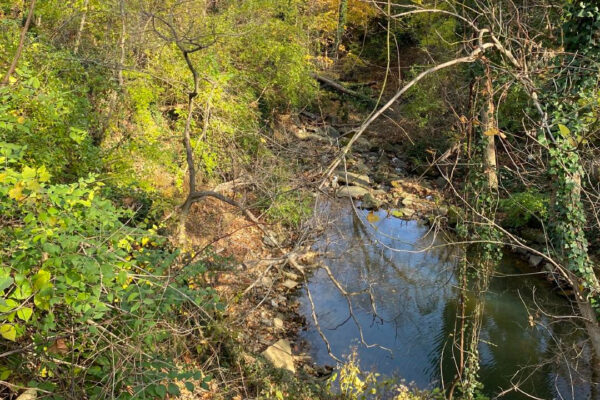
A wooded inlet known as “Dead Man’s Hollow” once carried a reputation for gruesome and bizarre occurrences near present-day Rosslyn.
Local historian Michael Schaffner shared his research on the notorious place, located northwest of what is now Gateway Park, at a recent Arlington Historical Society event. He delved into available records to see if it lived up to its reputation as sometimes being the site of a murder a month or even more frequently.
That was the narrative offered by three county historians in their summation of the site’s sordid history: Eleanor Lee Templeman in 1959, Frank Ball, Jr., in 1964 and Cornelia B. Rose in 1976. Schaffner, however, found far fewer instances of deadly attacks or bodies dumped there during the period between 1890-1910 when the site was at its most notorious.
There were a few, but “it’s not from murders that Dead Man’s Hollow got its name,” he surmised.
Schaffner suggested an alternate theory: the name came because tides and the indentation in the shoreline caused the inlet to be the place where bodies that had been floating in the Potomac came to rest and were discovered.
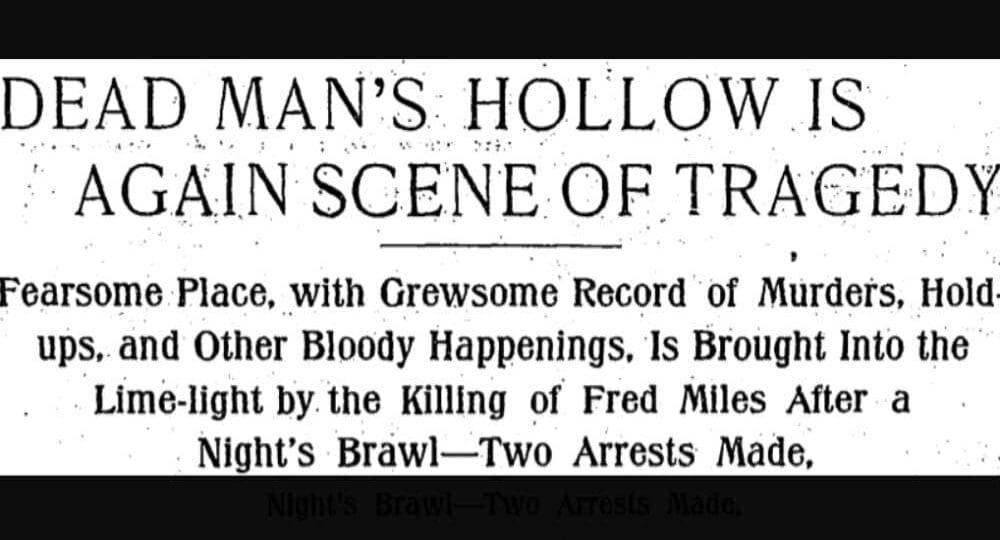
The site is near present-day N. Oak Street between George Washington Memorial Parkway and Langston Blvd, not far from where the Aqueduct Bridge had stood from 1843-1932. Schaffner advised against visiting.
“Don’t go there — the sides are very steep and if you fall in it would be very hard to rescue you,” he said.
Regardless of the reasons for Dead Man’s Hollow’s name, the area was not a place to visit at night. Covering one of the incidents that occurred there, the Richmond Times-Dispatch said that while active during the day:
“The scene … is lonely and dismal enough after dark owing to the dense woods and the sparseness of the population. The Washington police have said often that the place is not safe after dark, especially for young women and lone pedestrians.”
The Richmond News Leader declared that the site had a “gruesome record of tragedies, holdups and other bloody happenings.”
“It has in the last 15 years been the scene of more blood affairs than any other spot in Alexandria County,” the News Leader reported in discussing the death of a 32-year-old man who was killed when struck by a rock during a brawl in 1906.
(What is now Arlington was known as Alexandria County until 1920, when the General Assembly changed it.)
According to News Leader coverage:
“The hills rising from the road are covered by deep, gloomy woods and rank vegetation that shut off all light of the sun in the day and the moon and stars at night. [Silence is] disturbed by nothing at night save the lonely hoot of a stray owl.”
The reporter on that story surmised that the name Dead Man’s Hollow originated about 1890 when a man named Cunningham had been found “with his throat cut from ear to ear” during a robbery. No arrests were made.
In 1904, even the family of Commonwealth’s Attorney Crandal Mackey, whose home was nearby, was caught up in the mayhem.
According to News Leader coverage:
“A colored girl, a servant in the family of Prosecuting Attorney Mackey, was accosted in the Hollow when returning to her employer’s residence late at night and stabbed 18 times by a colored man. She was left for dead, but revived several hours after being stabbed. Staggering to Mr. Mackey’s, she told her story.”
The commonwealth’s attorney, who seemed to love nothing more than assembling a posse to go after criminals, took matters into his own hands, according to coverage:
“Mackey, mounting his horse, went to the scene and caught the colored man before he had time to escape. He was identified and sentenced to two years in the penitentiary.”
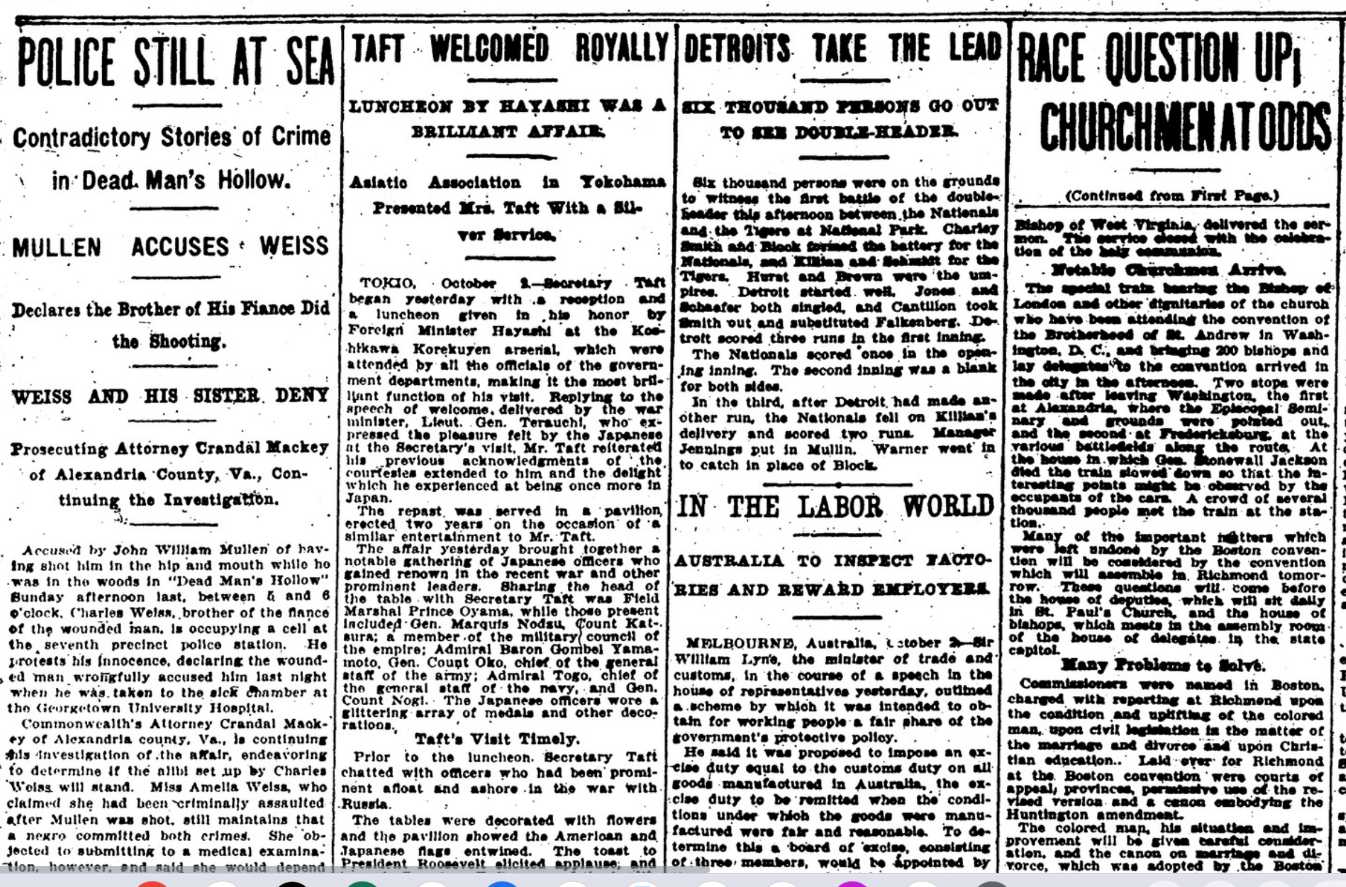
Perhaps the most notorious incident related to Arlington’s Dead Man’s Hollow came in late September 1907.
It revolved around 24-year-old John Mullen of D.C. and his 17-year-old fiancée, Amelia Weiss, who lived with her parents not far from the Mackey home in Rosslyn.
The couple was taking an afternoon stroll in the area when one or more men attacked Mullen, assaulting him and shooting him in the mouth and leg. In the melee, Weiss was also injured.
While Mullen lay unconscious in a D.C. hospital, Weiss told police in the city that one or two Black men had been the assailants.
Police in D.C. made an arrest, but when Weiss came to the station, she could not make a positive identification, media reports of the time said. When she walked into the street, however, she pointed to a Black passerby and accused him of being part of the attack.
Investigations were taking place on both sides of the Potomac, with decidedly different responses. While police in D.C. were beginning to doubt Weiss’s story and zero in on members of her family as the assailants, Mackey continued to side with her version of events.
“Although Commonwealth’s Attorney Mackey is inclined to put full faith in the story as told by Miss Weiss, police of this city [Washington] are inclined to think that the crime may have been committed by somebody not a Negro,” the Richmond Times-Dispatch reported in its coverage.
The incident became a front-page saga across Virginia. In coverage several days after the attack, the Portsmouth Star reported that Mullen had regained consciousness in the hospital and told police it might have been one of Weiss’s brothers who attacked him.
His fiancée was unshakable in her version of events, according to the same article, discounting what Mullen said after coming out of his coma.
“She declares that his impression [that it was a family member] is preposterous,” the reporter wrote.
Mackey, meanwhile, seemed flummoxed. “It is quite evident to me that someone connected with the case is not telling all,” he was quoted as saying.
D.C. police first arrested Weiss’s brother Emile, then her brother Charles, but both had airtight alibis. The evidence then pointed to Weiss’s father, Jacob, who refused to leave his home in Arlington for questioning in D.C.
Jacob Weiss was held at the Alexandria County jail, with his daughter confined in the same facility, albeit in a nicer room, as a witness. The (Washington) Evening Star reported that the wedding between Mullen and Weiss was off. “She says she will not marry him now under any consideration,” the newspaper reported Oct. 6, 1907.
At this point, the victim appears to have washed his hands of the entire matter, telling police he would never again set foot in Virginia or participate in any trial, except to testify for the defense of any Black man who might, in the future, be charged with the crime of assaulting him.
With Mullen unwilling to testify, Jacob Weiss was released.
Having been bamboozled by the Weiss family, Mackey told the Evening Star that he “did not feel kindly disposed toward the persons who had been trying to make it appear that a colored man had shot Mullen and assaulted the girl.”
“The case, he said, should serve as an object lesson against lynching,” the newspaper reported from its conversation with Mackey. “Had a colored man been arrested and partly identified the Sunday night the shooting occurred, in the opinion of the commonwealth’s attorney, the excited people might have attended violence.”
As Schaffner related at the Historical Society meeting, there is a postscript to the story. It can be found in the March 14, 1908, edition of the Alexandria Gazette.
The newspaper reported that a marriage license had been issued in D.C. to John Mullen and Amelia Weiss, and that owing to the bride being under the age of 18, her father had signed paperwork giving his permission for the ceremony to take place.
It must have made for interesting Thanksgiving family dinners, Schaffner noted in his presentation.
Efforts by Mackey to clear vice from Rosslyn in the early 1900s are among the most often-told tales of Arlington history, and as the gambling, horse-racing, cheap liquor and prostitution were moved out, coverage of incidents at Dead Man’s Hollow became few and far between.
In the 1940s, the Arlington Chronicle occasionally brought the name into print when referencing highway construction in the area. That newspaper had long been associated with Mackey, whose long life ended with his death in 1957, age 91.
In case tales of Arlington’s Dead Man’s Hollow are not enough to satisfy ghoulish desires this Halloween season, there are similarly named locations in Pennsylvania, Kentucky and Oklahoma, each with its own legends to share.
The Virginia Chronicle initiative of the Library of Virginia provided research materials for coverage, as did the D.C. Public Library.
