

County Board members have approved a sizeable increase in the cost of charging electric vehicles at county-owned facilities, saying it sets the program up for long-term success and expansion.
“It will enable us in the long term to make more of those investments,” Board member Maureen Coffey said on Oct. 20 as the charging fee was increased from 17.46 cents per kilowatt-hour (kWh) of electricity provided to 30 cents per kWh.
The vote was unanimous, and followed a staff recommendation to increase the fee to a level high enough to recoup electricity, operational and capital costs. The increase goes into effect Nov. 1.
Coffey said full cost recovery was the fastest way to expand the current network of government charging stations.
“That does cost us significant amounts of money,” she said.
Recovering costs allows the effort to expand while not requiring taxpayers to subsidize it, Board member Susan Cunningham said.
“We owe it to ourselves to mature it into something that’s self-sustaining,” she said.
A lone public speaker urged Board members to set the rate at 21.7 cents per kWh, which would recover electricity and operating costs but not capital costs. The speaker also unsuccessfully lobbied for giving EV owners the first hour of charging for free, something done by the Falls Church government at its City Hall charging spaces.
Board members ultimately decided to stick with the staff recommendation of 30 cents, which is in line with fees charged at government charging stations in Fairfax and Prince William counties and “remains below most commercial rates in the county and the region,” staff said in a memorandum to Board members.
Cunningham said local governments need to avoid undercutting commercial providers, whether intentionally or inadvertently.
“We shouldn’t be trying to supplant the private market, which is setting costs based on the overhead they’re experiencing,” she said.
The county government offers 51 charging ports for the public, available at the following locations:
- Arlington Mill Community Center
- Aurora Hills Community Center
- Central Library
- Courthouse Plaza
- Fairlington Community Center
- Long Bridge Aquatic Center
- Lubber Run Community Center
- Madison Community Center
- S. Irving Street Group Home
All use Level 2 chargers, which on average take seven to eight hours to fully charge passenger vehicles, according to one estimate.
Board members also made adjustments to the “dwell fee,” which is charged to drivers whose vehicles are parked in charging areas after their session ends.
Currently, the dwell-fee rate of $3 per hour is imposed throughout the day, but starting Nov. 1 it will be discontinued from 10 p.m.-7 a.m. That will allow drivers to keep their vehicles in EV-charging spaces overnight without accruing further costs.
The dwell fee kicks in 15 minutes after a vehicle is fully charged.
Also at the meeting, Board member Takis Karantonis asked staff to press one of its two EV-charging vendors — ChargePoint — in future negotiations to remove a 25-cents-per-session charge for use of its equipment.
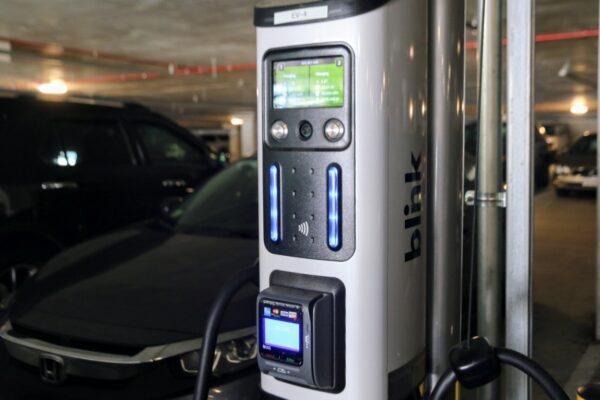
The second vendor, Blink, earlier agreed to remove its per-session charge, but ChargePoint declined to amend its contract.
The ordinance revision approved on Oct. 20 gives County Manager Mark Schwartz and staff the power to adjust the fees based on changes to the Virginia Energy Purchasing Governmental Association (VEPGA) rate schedule, which is how the county government is charged for its electricity consumption.
Board members also will discuss charging rates as part of their annual budget preparations each spring, Cunningham said.
