

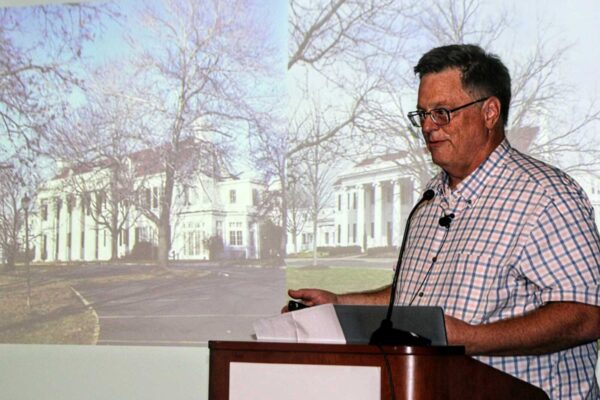
As a 16-year-old student at Washington-Lee High School in 1981, Eric Dobson opted to fulfill a requirement in his American Civilization class by traveling around Arlington with his father’s 40-year-old Minolta camera.
Little did he know that he was chronicling history in the process.
It was a time of transition for the county — Interstate 66 was being constructed, the Metro system was new and commercial development was changing the landscapes of neighborhoods like Rosslyn. But for Dobson, an Arlington native, the project was just a fun thing to do.
“I love taking pictures,” he told a packed house in the Central Library auditorium on Nov. 10, where Dobson presented a retrospective on the now 45-year-old project.
“Even in 1981, change was starting to happen in Arlington,” he said, although it had yet to take hold in areas like Ballston, where “not a lot was going on” at the time.
In Rosslyn, however, “that’s where stuff was going on,” said Dobson, who recently retired after a career in urban planning and economic development.
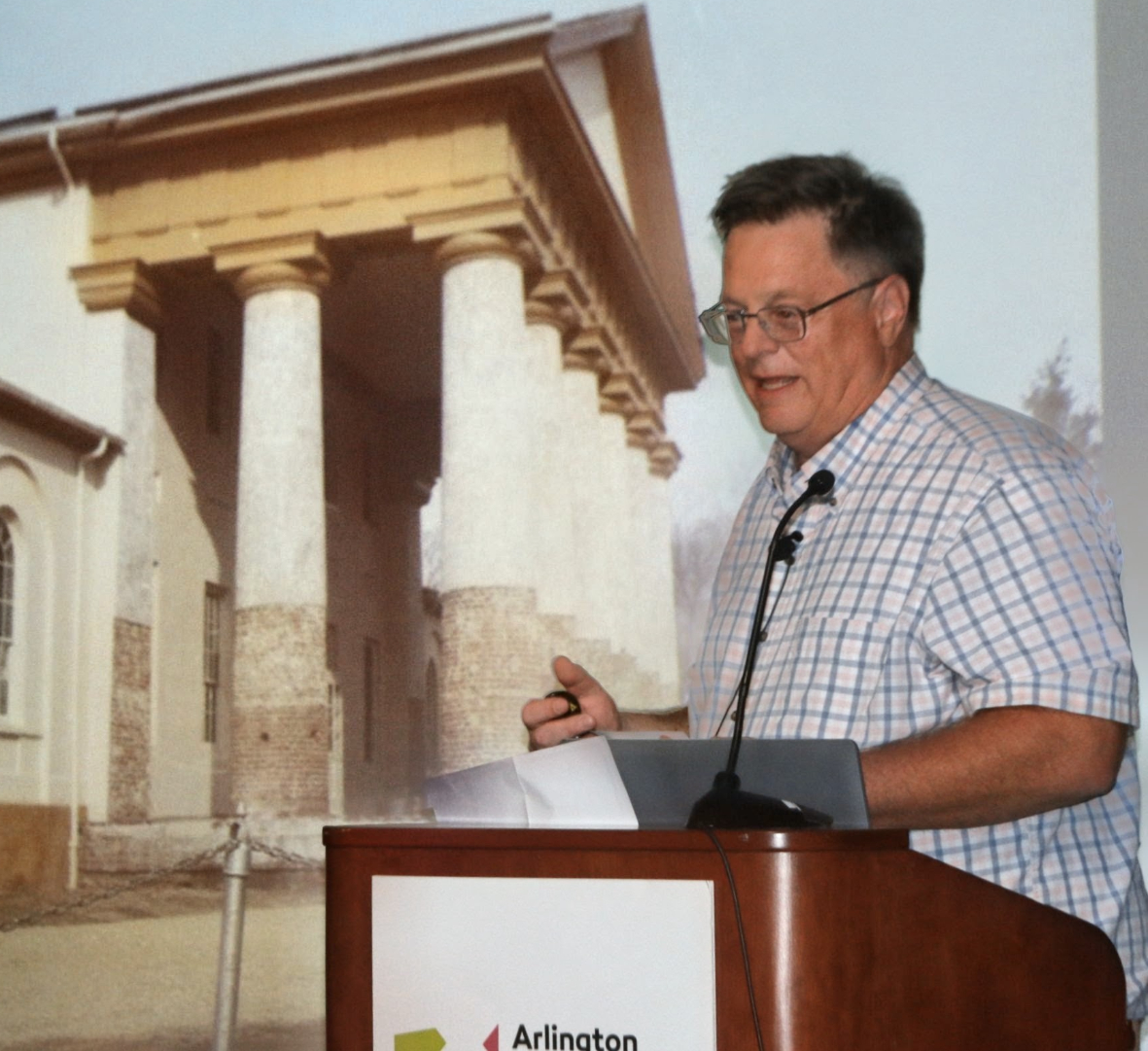
While the future was quickly rushing in throughout 1981, some of Arlington’s past remained — and not all of it evoked good memories.
One of the photos from 1981 showed the American Nazi Party headquarters on Franklin Road. The organization, led by George Lincoln Rockwell, had made the county its home in the 1950s-60s.
Even after Rockwell’s murder in 1967, the fringe group continued as a local presence that varied from annoying to menacing.
Dobson and Elisa Johnson, the classmate he worked on the project with, decided they needed a photo of the Nazi Party building.
“As we pulled up, this little Goebbels jumped out and said we couldn’t take pictures,” Dobson recalled.
“We jumped in Lisa’s car and took off,” but he had gotten the shot, he said.
Dobson recalled the two-hour American Civilization course, which combined English and history, as “a fantastic class” with great teachers. Students were assigned to “create something” they considered important, which led to the photography project.
Even then, the 16-year-old was working to learn about local history. He was a frequent visitor to the Virginia Room at Central Library, now known as the Charlie Clark Center for Local History.
Even though Dobson was under the age limit, director Sara Collins always made sure he could gain access.
Arlington had about 150,000 residents in 1981, 100,000 fewer than today. The year’s most notable events included the near-assassination of President Reagan, the first mission of a space shuttle and two major televised weddings: of Prince Charles to Lady Diana Spencer and, on “General Hospital,” of Luke and Laura.
Growing up in Waverly Hills, Dobson spent his entire public-school career in Arlington. “It was a great education,” he recalled.
Locally, Dobson has served on the Planning Commission and has been a member of the Cherrydale Citizens Association, Clarendon Alliance and Preservation Arlington.
“He does a lot of great preservation work,” said Heather Crocetto, the archivist for the county library system.
Dobson encouraged local residents to contribute to the historical record by bringing materials to the Charlie Clark Center for potential preservation.
“If you’re cleaning house, get it over to the center … they’ll decide,” said Dobson, who recently donated a cache of 13,000 photos to the archives.
The first audience question following Dobson’s presentation: What was his grade on the project?
Dobson laughed. “I assume it was an A+, but I really don’t remember,” he said.
