


The housing market in Arlington held up well in October despite economic headwinds and the federal shutdown.
One key indicator: The average sales price for single-family detached homes approached $1.5 million — down from an unexpectedly high amount in September but still well above year-over-year figures.
The average selling price of the 79 detached properties going to closing last month was $1,446,964, up 10.8% from October 2024, according to figures reported Nov. 11 by Bright MLS, the region’s multiple-listing service.
The average sales price in September had been more than $1.8 million, an outlier from recent monthly reports that, like October’s, have tended to be in the $1.5 million range. That’s more than three times the national single-family selling price of $426,000 recently reported by the National Association of Realtors.
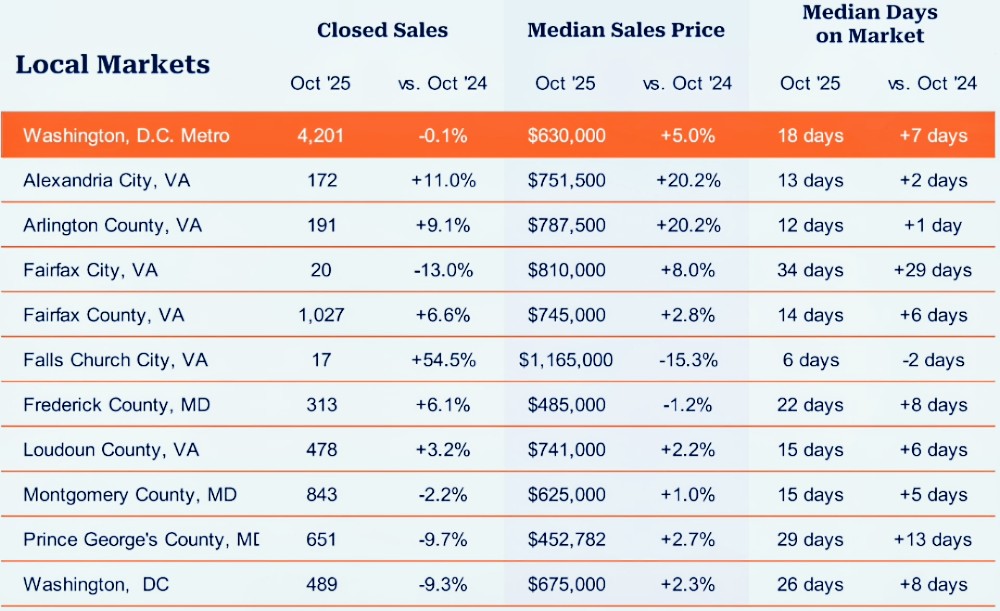
A total of 191 residential properties changed hands in Arlington last month, up 9% from the 175 transactions of September. The overall average sales price of $958,153 was up 19% year-over-year.
That increase was boosted, in part, by a larger percentage of single-family detached homes in the overall sales mix for the month. That segment represented 41.3% of all sales for the month, up from 29.1% a year before.
In other segments of the market, the average sales price for attached homes was $610,329, up 4.8%, while the average sales price of condominiums was $423,903, down 3.9%
Counting all sales, the average per-square-foot cost for Arlington properties in October was $503, up slightly from $500 a month before and from $496 a year ago. The monthly figure remains on par with the year-to-date average per-square-foot cost of $504.
Total sales volume for the month was $183.5 million, up 30.7% from $140.4 million a year before.
Homes that sold in October spent an average 32 days on the market between listing and ratified contract, up from 26 days a year ago. Homes garnered 97.3% of listing price, down from 99.3%.
At the end of the month, there were 472 properties listed countywide, up 64% from a year before.
Homes that went to closing in October typically represented agreements that had been made before the federal shutdown began Oct. 1. Despite the expected end of the shutdown this week, economic concerns for the region persist.
“While the D.C. area housing market has been fairly resilient, we are definitely seeing some cracks,” said Lisa Sturtevant, chief economist for Bright MLS.
“Even though mortgage rates are at their lowest level in 13 months, homebuyers are still very cautious,” Sturtevant said. “Many prospective homebuyers are watching the news of weakness in the economy and are carefully monitoring their own economic situations.”
Northern Virginia home sales were in positive territory for the month, but declines were reported in D.C. and the inner Maryland suburbs.
Across the region, year-over-year sales were effectively unchanged — 4,201 in October 2025 vs. 4,207 in October 2026.
Figures represent most, but not all, homes on the market. They are based on data from MarketStats by ShowingTime.
October 2025 figures are preliminary and are subject to revision.
D.C.-area home prices dipped much more than nationwide: Quarterly declines are not unusual as the housing market transitions from the first half of the year into the second. But the drop in the D.C. region was 3.6% — six times the 0.6% decline nationally.
The median single-family home price in the region was $657,200 in the third quarter, according to the preliminary data. That’s down from $681,900 in the second quarter, according to National Association of Realtors (NAR) data.
Nationally, the third-quarter rate of $426,000 was down from $428,500 in the second quarter, according to the new figures.
In each case, median sales prices were up year over year, rising 2.3% from $642,500 in the D.C. region and 1.7% from $419,500 nationally.
Nationally, 77% of the 230 tracked metropolitan areas showed year-over-year increases in the new data, with 4% of markets posting double-digit increases, according to the national trade organization.
Median existing single-family home price by region rose year over year by the following margins:
- Northeast: $540,100 (+6.0%)
- Midwest: $331,100 (+4.2%)
- South: $372,800 (+0.5%)
- West: $633,900 (-0.1%)
“Markets in the supply-constrained Northeast and the more affordable Midwest have generally seen stronger price appreciation,” said NAR chief economist Lawrence Yun. “Price declines are occurring mainly in southern states, where there has been robust new home construction in recent years.”
The 10 priciest markets in the country in the third quarter were:
- San Jose-Sunnyvale-Santa Clara, Calif. ($1,915,000; +0.8%)
- Anaheim-Santa Ana-Irvine, Calif. ($1,400,000; +0.1%)
- San Francisco-Oakland-Hayward, Calif. ($1,315,000; +0.5%)
- Urban Honolulu, Hawaii ($1,127,900; -0.9%)
- Salinas, Calif. ($1,019,900; +6.3%)
- San Diego-Carlsbad, Calif. ($1,009,500; 0.0%)
- Los Angeles-Long Beach-Glendale, Calif. ($954,100; +0.7%)
- Oxnard-Thousand Oaks-Ventura, Calif. ($935,700; -1.2%)
- San Luis Obispo-Paso Robles, Calif. ($931,800; -1.9%)
- Bridgeport-Stamford-Norwalk, Conn. ($844,900; +7.8%)
Fourth-quarter figures are expected to be released on Feb. 4.
State Realtors expecting slow winter season: A new survey of members of the Virginia Realtors trade organization suggests the commonwealth’s winter home-sales market could be as cool as the temperatures.
The monthly online flash survey garnered 1,011 responses from real-estate professionals from Oct. 29 to Nov. 9, including 718 that had been involved in at least one transaction in the preceding 30 days.
Asked to look three months into the future — late January to early February — the level of expected buyer activity totaled just 13 on a 0-to-100 scale, the lowest of the year, and expected seller activity was 15, the lowest since January.
Asked where they believe prices will be in three months’ time, 23 percent expected an increase, 43 percent a decline and 25 percent no change in average sales prices.
The responses may have much to do about the time of year, as late December through late January or early February is typically the slowest time of year for the state’s housing market.
The monthly survey does not break down sentiment by geographical region.
