

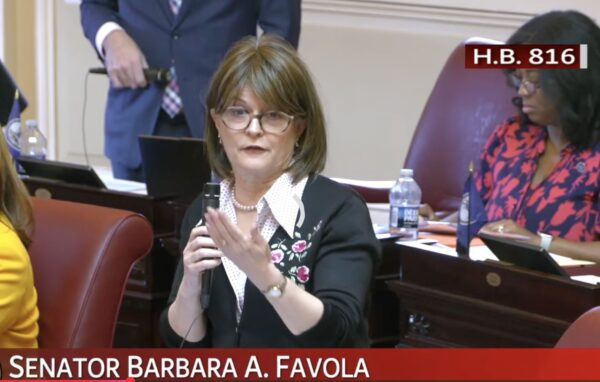
A bill seeking to permit by-right multifamily development in commercial zones was defeated in the Virginia Senate yesterday (Thursday) despite limitations proposed by Arlington’s state Sen. Barbara Favola (D-40).
The Senate voted 17-22 on HB 816 by Del. Dan Helmer (D-10). The House did not vote on the companion bill SB 454 by state Sen. Schuyler VanValkenburg (D-16) but referred it back to the House Counties, Cities and Towns committee.
The pair of bills would require local zoning ordinances to permit by-right multifamily and mixed-use residential development on a portion of commercial or business zoning district land. The amended bills call for localities to allow by-right development on at least 50% of commercially zoned land — less than the 75% originally proposed.
According to the bills, eligible by-right developments would go through localities’ administrative approval processes and not require a special exception, special use or conditional use permit — processes that typically require public hearings and board approvals.
Before the bill’s defeat in the Senate, Favola proposed amendments to limit the by-right multifamily developments to the building heights and density allowed by-right in those commercial zones. Favola says that would allow localities to negotiate items like affordable housing for bonus densities during the review process.
“Anything above that by-right envelope, the developer would have to go through a review process with the county,” Favola said on the Senate floor yesterday. “That’s an important distinction because the developer would be gaining additional height above the by-right and additional building envelope, and traditionally, localities negotiate some public benefits when they are giving a benefit such as an additional density.”
The bills had received other amendments in House and Senate committees.
The by-right requirement in local zoning ordinances would apply to cities or towns with 20,000 or more people, and communities of more than 7,500 people in population centers like Northern Virginia.
The provisions wouldn’t apply in underdeveloped areas with at least 60% tree canopy coverage, areas without water and sewer installations, locations near military installations, in heavy industrial or manufacturing zoning areas, and voter-approved casino locations. Projects in historic districts would still go to review boards.
Both bills proposed an effective date of July 1, 2027, one year after most bills from the 2026 Virginia General Assembly session will take effect. The House version also incorporated a Senate committee’s recommendation of a July 1, 2031 sunset date.
Populous localities that the bills would impact have testified against the legislation in Senate and House committee hearings. In Senate and House committee hearings, a representative for Arlington County shared the county’s opposition to the legislation as it was currently drafted.
Arlington County declined to comment to ARLnow, citing a policy against commenting on pending legislation.
Other locality representatives that have testified against the bills came from the Virginia Association of Counties, the City of Alexandria, Fairfax County, Loudoun County, Prince William County, Chesterfield County, Henrico County, Prince George County and the First Cities coalition of 17 historic cities.
Opposition centered around by-right development taking away local authority on development planning. One concern is removing proffers typically negotiated through localities’ development review processes.
“What you’re doing here is doing an upzoning, where you’re taking out the conditional zoning and proffers that a locality would negotiate to address those impacts,” Joe Lerch, director of local government policy at the Virginia Association of Counties, said.
The bill sponsors have advocated for the bill as a strategy to address Virginia’s housing affordability challenges.
“Teachers, firefighters, cops, service workers, tradesmen, they can’t afford to live where they work, and they are being increasingly priced out of the state,” VanValkenburg said on the Senate floor yesterday. “I think Virginia needs to be a place where everybody can afford to live, whether that’s homeownership or renting.”
Other organizations have testified in support, such as the Northern Virginia Chamber of Commerce, Virginia Housing Alliance, Pew Charitable Trust, Home Builders Association of Virginia, Virginia Poverty Law Center and Southern Environmental Law Center.
“By-right does not mean a free pass, and I think that’s really important that these developments in targeted areas will still have to comply with [the] historic district, environmental regulations, all those really granular details that come with site planning and subdivision plans,” said Andrew Clark, whose organization, Home Builders Association of Virginia, helped work on the bill.
Alex Horowitz, housing policy project director at the Pew Charitable Trusts, said states like Texas and North Carolina that have added housing around commercial corridors have seen rents drop.
“Virginia’s rents are 30% higher than the national average,” Horowitz said. “Virginia has an unusually low amount of land zoned for apartments. Only 5% of residential land in Virginia allows apartments.”
With a focus on advancing HB 816 and SB 454, Helmer and VanValkenburg opted to withdraw their other companion bills that would set targets for increasing Virginia’s housing stock.
Another key housing bill advancing in the General Assembly involves removing the rezoning step for affordable housing developments on church-owned properties.
SB 388 has been passed by both chambers but is going to a conference to work out a disagreement over amendments. The House version (HB 1279) seeks reenactment by the General Assembly in 2027 before the bill can take effect.
