

Traffic-safety proponents on Tuesday (June 30) hailed a new Virginia law they believe will provide another tool to address reckless “super-speeders” on Virginia roadways.
Legislation adopted by the General Assembly last year goes into effect July 1, permitting judges to enroll those charged or convicted of certain speeding offenses in a new program using technology to limit vehicle speeds.
It relies on “intelligent speed assistance” — in-car technology, about the size of a deck of cards, that uses global-positioning technology to contain a vehicle’s speed to the posted limit.
The effort operates under the same principle as interlock devices requiring those facing or convicted of drunk-driving offenses to pass a breath test before a vehicle can be started.
Using technology to address aggressive drivers “has a great deal of promise,” said Michael Cassidy, retired chief judge of the Fairfax County General District Court.
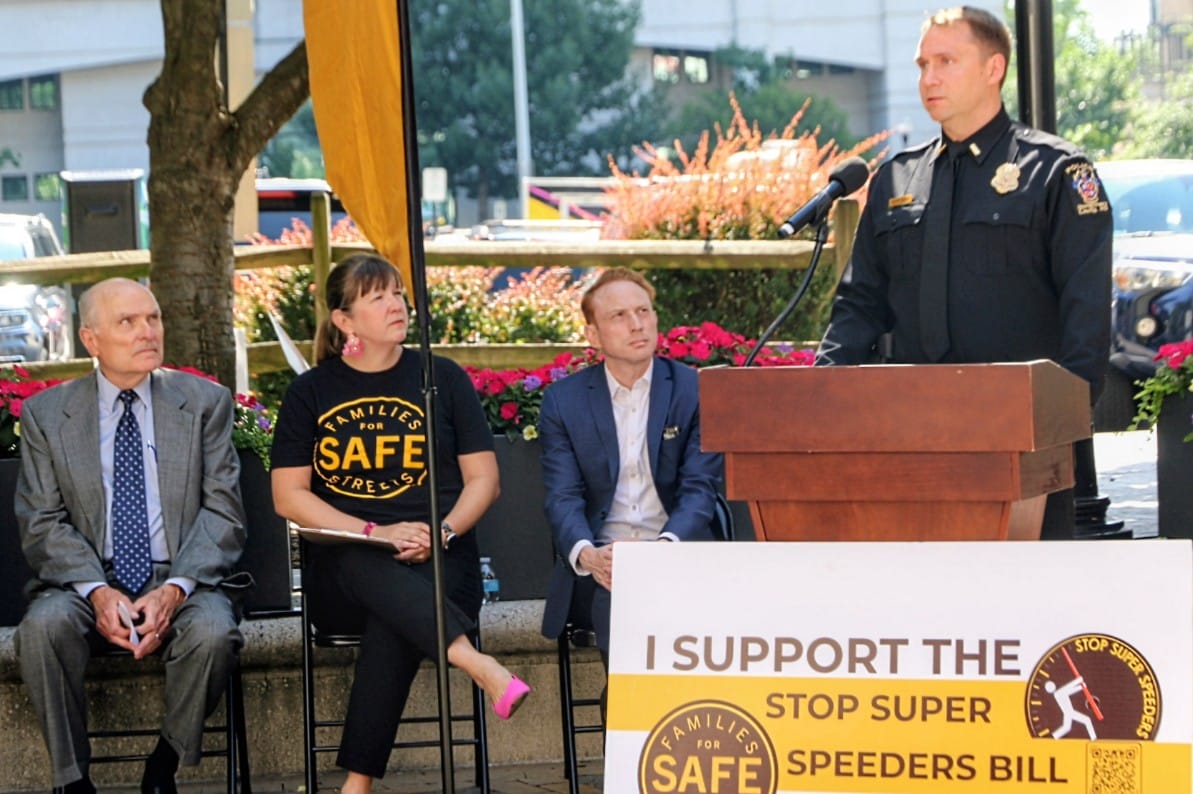
Cassidy was among speakers at a presentation sponsored by D.C. Families for Safe Streets, held at Courthouse Plaza in Arlington.
Virginia becomes the first jurisdiction in the region to implement the strategy. Both Maryland and D.C. have enacted legislation and are taking final steps toward implementation.
Giving options for drivers with a tendency to speed aggressively to reform represents “another tool in the toolbox,” said Montgomery County Police Lt. Patrick Kepp.
Kepp has first-hand experience with the impact of aggressive speeds. In 2023, he was struck on Interstate 270 in Maryland by a driver estimated to be traveling 160 miles per hour.
The incident cost Kepp both his legs. He now gets around using prosthetics.
The driver, a 19-year-old Maryland man, had been baiting local law-enforcement agencies for months. Though acquitted of attempted murder, the suspect was convicted of multiple lesser offenses and was sentenced to 22 years in prison.
Both Cassidy and Kepp said some drivers have become more aggressive since Covid.
“The speeds that are being reported … are not something I thought was possible,” said Cassidy.
Once, drivers clocked at more than 100 mph were rare, but “now it seems to be common,” the retired judge said.
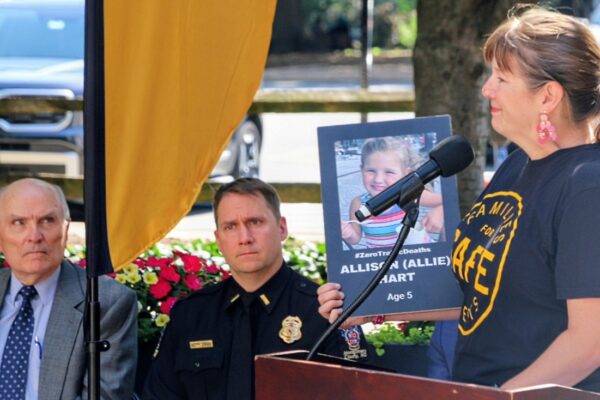
Bringing home the toll taken by aggressive drivers was Jessica Hart.
In September 2021, her 5-year-old daughter Allie was killed by a van driver in a school-zone crosswalk in the Brookland section of the District of Columbia.
“She was an absolutely amazing little girl,” said Hart, who was pregnant at the time of the incident. “A driver took away her life before she could meet her brother, before she could learn to read.”
Kepp said incidents like his and Hart’s helped spur action by legislators across the region.
“Our laws were woefully weak until some of the changes we were able to make,” he said.
“This is a growing movement across the country,” said Hart, pointing to 20 states plus the District of Columbia that are considering or have implemented measures in an effort to deter and rehabilitate fast drivers.
“It really means a lot to families that have had this horrible, horrible experience,” Hart said.
Thomas Chapman, who since 2020 has served on the National Transportation Safety Board, said 40,000 Americans are killed on the roads each year, with more than a quarter of all fatalities involving excess speed.
“It’s one of our most persistent challenges,” Chapman said.
Taking action against those who drive recklessly “is a key step … in addressing the scourge of excessive speed on our roads,” he said.
Virginia’s measure was patroned by Del. Patrick Hope (D-1). While passing both houses of the General Assembly on a largely bipartisan basis in early 2025, it came with a delayed implementation date to enable the legal and technological framework to be put in place.
Under provisions of the Virginia legislation, participation in the program by those facing charges of reckless driving or similar offenses is voluntary in some cases, mandatory in others:
- It permits enrollment in the program as an alternative to suspending a person’s driver’s license upon conviction of certain speed-related offenses
- It requires a court to order enrollment for anyone convicted of reckless driving and found to have been driving in excess of 100 mph, unless the court has otherwise ordered the suspension of the person’s driver’s license
Mandatory use of the equipment can last for as long as six months in many cases. Tampering with it constitutes a separate criminal offense.
In Virginia, reckless driving is considered a Class 1 misdemeanor punishable by up to 12 months in jail, a maximum fine of $2,500, or both, in addition to a loss of driving privileges.
Reckless driving in the commonwealth is defined as traveling 20 or more mph above the speed limit or “recklessly or at a speed or in a manner so as to endanger the life, limb or property of any person.”
