

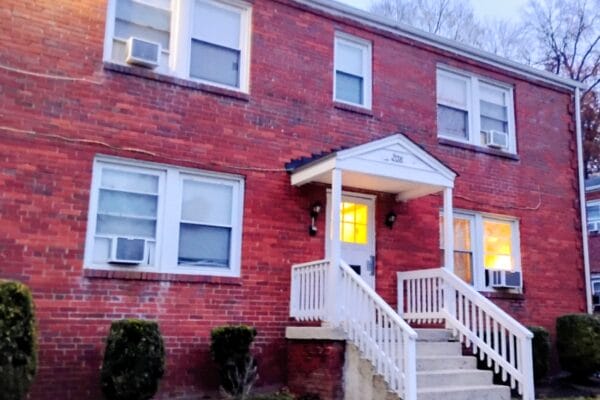
Falls Church leaders are about to hit the launch button on their most significant affordable-housing effort.
City Council members on Monday, July 27 are slated to appoint a seven-member screening committee to rank prospective partners for redeveloping portions of the Virginia Village site.
The panel is likely to consist of three city-government staff members, members of three city advisory commissions and one Council member. Marybeth Connelly appears to be the consensus choice for representing the Council on the panel.
The selection committee is slated to start evaluating proposals on Aug. 6. The deadline to deliver a report and identify a preferred housing partner is Sept. 8.
At that point, the matter rests with Council members, who are aiming to select a development partner and agree to an interim development agreement by the end of that month.
Council members will have the final say and will have access to the materials provided to, and minutes of, the advisory body.
“The intent is to share all their information with the Council so that any disagreements or differences of opinion, those would be shared with Council,” City Manager Wyatt Shields said at a July 20 work session.

Representatives from the Economic Development Authority, Planning Commission and Housing Commission will be part of the seven-member advisory panel. Council member David Snyder unsuccessfully pressed to add a representative of the Winter Hill community, which is located adjacent to Virginia Village.
“It would be useful to have that additional person,” said Snyder, who said the seven-member panel has no one specifically looking out for the interests of those living in and around the site.
Connelly said it was an “interesting” suggestion, but declined to embrace it.
“These seven [planned] members will cover all the waterfront, as it were,” she said.
Council members also expressed hesitation about a proposal floated by City Attorney Sally Gillette to have the advisory panel’s meetings recorded and made available to Council members. Mayor Letty Hardi expressed a fear of information overload, saying she believed the final report from the advisory panel, coupled with background material, would be sufficient for Council members.
“I trust the process,” she said.
Connelly had a different concern about recording the advisory panel’s sessions, which will not be open to the public.
“A recording is something that is easily leaked — by mistake, even,” she said.
The process of determining a development partner is happening as city officials are working to craft zoning changes for the 20-building Virginia Village site. Any changes allowing for higher density or other options are expected to apply both to the nine four-unit apartment buildings owned by the city and the 11 that remain in private hands.
Potential zoning changes were discussed at length at the July 20 work session, with final action set for Oct. 26.
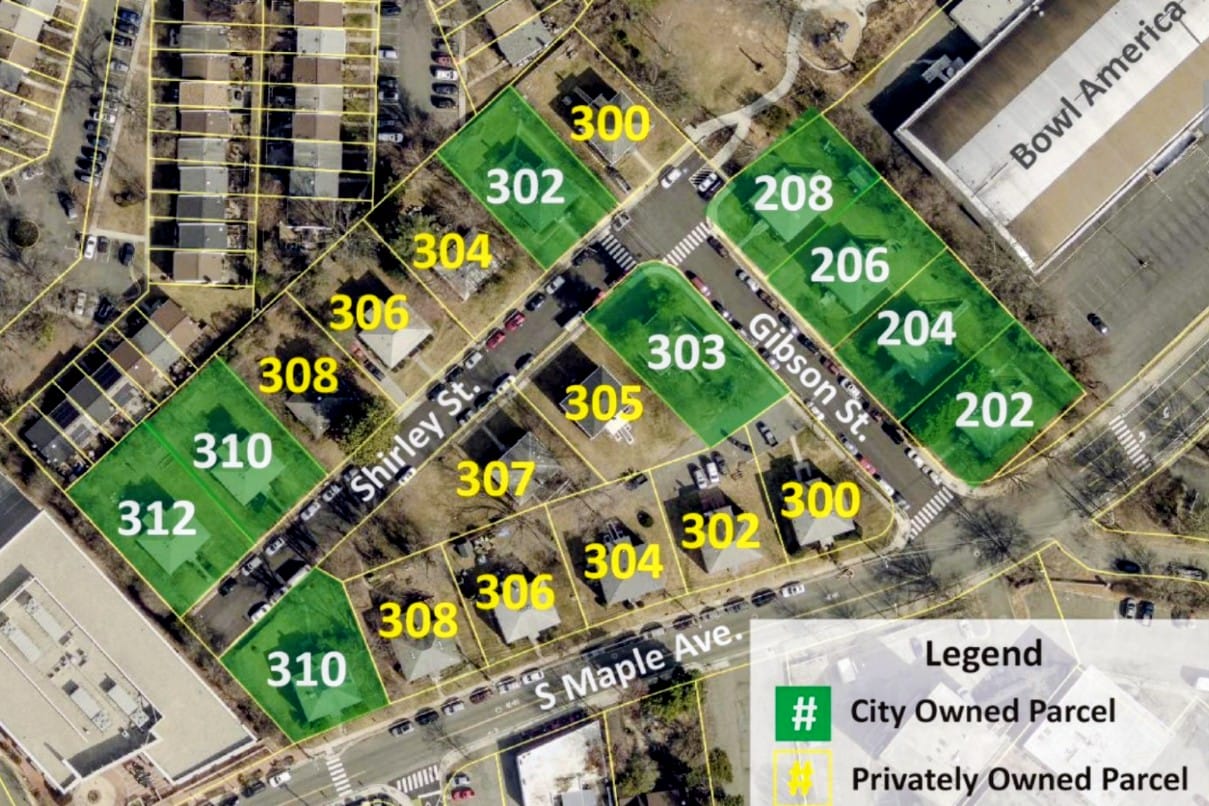
Virginia Village is located southwest of Bowl America at Annandale Road and S. Maple Avenue. Of the 20 fourplexes comprising the neighborhood, the city’s Economic Development Authority owns these nine:
- A four-parcel strip at 2002-2004-2006-2008 Gibson Street
- A two-parcel strip at 310-312 Shirley Street
- Individual parcels at 302, 303 and 310 S. Maple Avenue
Owners of the parcels still in private hands potentially could be brought in as partners. City officials appear to have ruled out using eminent-domain powers to acquire the remaining properties from their owners.
City officials have asked prospective development partners to consider three options when offering plans to transform the publicly owned portion of Virginia Village:
- Rehabilitation of the city-owned properties with a potential “minor” expansion, such as an additional floor or bump-outs
- Low-intensity redevelopment that would include razing the city’s properties and rebuilding up to four levels
- Larger infill redevelopment that would demolish the city-owned buildings and replace them with properties potentially up to seven stories tall in some areas
Connelly said there were safeguards in place to protect the city’s interests, up to the signing of a final development plan, expected next spring.
“If at any point in this process we are uncomfortable with where we’re headed, we can take our foot off the gas,” she said. She added, “If we need to pause, there’s nothing that says we have to keep going. That safety net is there.”
Shields, however, cautioned against stopping the process for any but the most extreme concerns, citing potential damage to future relationships with housing providers.
City officials are hoping to make the spring deadline for a formal partnership. If they can do so, the partners can apply for state housing tax credits to help fund the project.
A delay in finishing the agreement would require the partners to either wait a year for the next application cycle, or attempt to find alternative funding sources.
Residents can sign up for text or email alerts from the city government to keep apprised of the process.
