

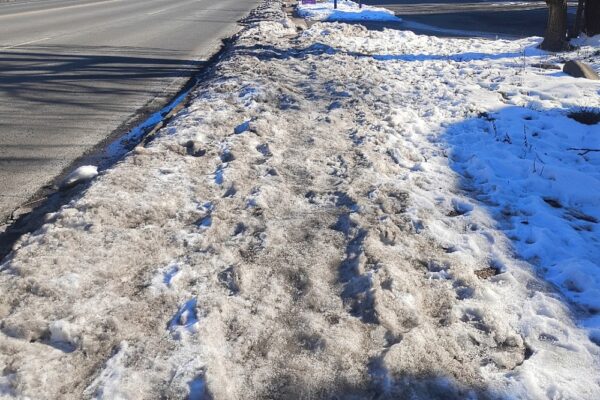
Falls Church officials plan to concentrate outreach efforts on commercial and retail corridors in their efforts to maintain snow-free sidewalks this coming winter.
However, city leaders will have to wait for legislative approval before attempting to levy fines on those who fail to follow snow-removal guidelines.
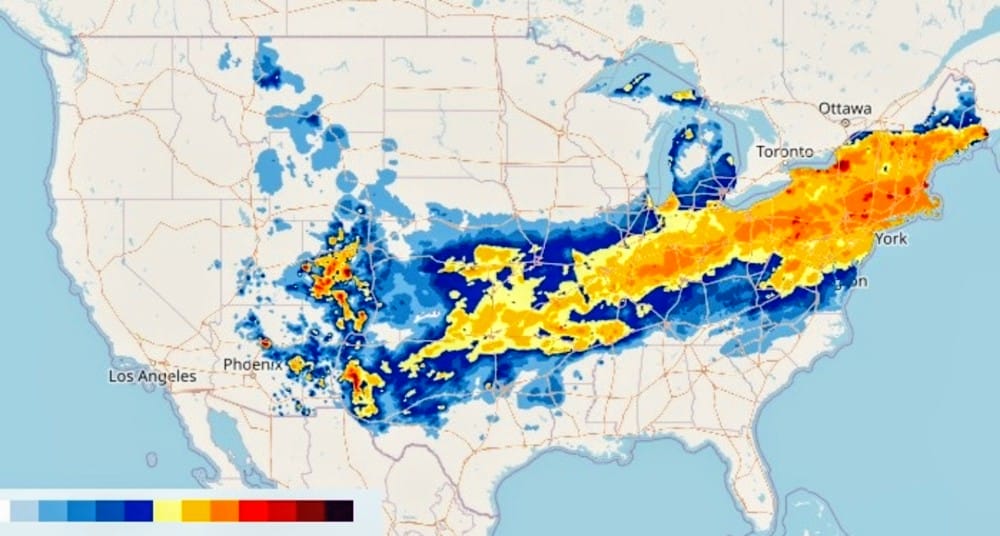
City staff in late July outlined options for avoiding a repeat of last winter, when some sidewalks were impassable for weeks after the region was hit with a knockout punch of snow, followed by sleet, followed by freezing temperatures in late January into February.
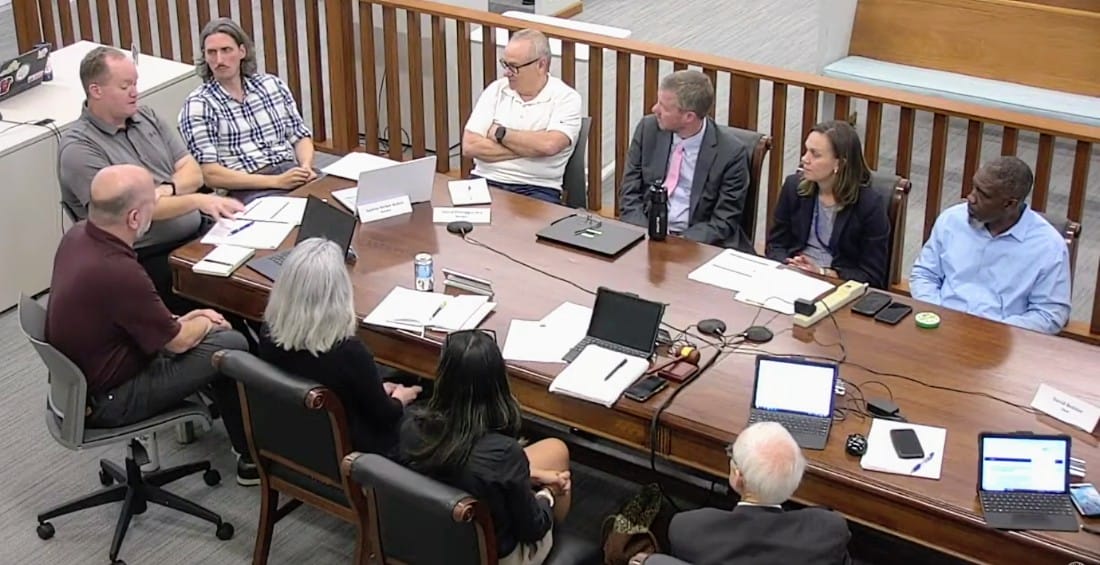
“This was hopefully an anomaly,” City Council member Erin Flynn said at a July 20 work session between Council members and the Citizens’ Advisory Committee on Transportation.
Whether it was or not, Council member Arthur Agin said that the city government needs to lay out clear requirements for everyone who owns property adjacent to sidewalks.
“Let them know, ‘you need to have a plan, you need to be ready for this,'” Agin said.
In response to the storm, Council members in May directed staff to evaluate options, with a focus on the city’s growing commercial corridors.
The city code includes requirements for clearing snow, allowing for citations of up to $500 for residential properties and $750 for commercial properties if landowners repeatedly fail to clear sidewalks within a specified period after snow stops falling.
The problem is, the city appears to lack the legal authority to impose these fines. The Code of Virginia allows Northern Virginia counties, but not cities or towns, to issue citations of up to $100 for violations of snow ordinances.
City officials plan to lobby the General Assembly to add all Northern Virginia localities to the list, and to clarify language so the fines can be up to $100 per day rather than $100 per snow event.
Any measure adopted in the 2027 legislative session would not go into effect until next July, meaning city officials will need to rely on the cooperation of property owners rather than the threat of fines or, as some downstate jurisdictions do, making failure to remove snow from sidewalks a misdemeanor criminal offense.
As part of a plan outlined at the July meeting, and set for more discussion at the Council’s Aug. 24 work session, the city would send out inspectors 24 hours after the snow stops falling, primarily focused on commercial corridors.
Snow-response teams would take photos of areas where sidewalks remained uncleared, and would notify property owners of the city’s regulations.
That would be a change from previous years, when city personnel waited for complaints from the public before addressing a specific property. After the January 2026 snowstorm, approximately 60 complaints were filed, with about two-thirds involving commercial properties.
Current snow-removal regulations are somewhat complicated, officials acknowledge:
- Residential properties: Snow and ice must be removed within 12 hours after snowfall ends, or within 12 hours after sunrise if snow falls overnight
- Commercial properties: Snow and ice must be removed within six hours after snowfall ends, or within six hours after sunrise if snow falls overnight
A staff proposal up for Council consideration would impose a blanket 24-hour period from the end of snowfall for snow to be cleared from all properties.
As part of a range of options offered to Council members, staff said revisions to current rules also could include:
- Having the city clear snow from sidewalks left untouched after the deadline passes, charging property owners the costs involved
- Setting up “service improvement districts” in commercial corridors, with property owners being taxed and, in return, receiving defined city benefits that could include sidewalk snow removal
Neither of those options drew much enthusiasm from staff. Each offered “different challenges for actual implementation,” said Andy Young, the deputy city manager for external operations.
The staff report for the July 20 meeting acknowledged concerns about getting the city government more involved in snow-removal efforts than it already is:
Snow events are some of the most taxing times of year for city staff, with many operations staff working long hours to deliver on core responsibilities of clearing snow from city streets and municipal facilities. Adding this sidewalk snow-clearing responsibility onto that staff workload is not viewed as practical.
The city could pursue a contract solution, but due to the uncertain nature of the scale and timing of this work, staff do not feel it could secure a reliable contract to complete the work in a way that would meet community expectations.
At the July 20 meeting, Council member David Snyder pressed city staff to compile and publish a list of contractors that offer snow-clearing services.
“I don’t think it’s beyond the city’s capability to do that,” Snyder said. “If we’re going to tell people they’ve got to do it, then we’ve got to give them a way.”
Snyder also raised an issue that seems to impact all Northern Virginia localities after large winter-weather events — plows forcing accumulated snowfall from roadways to sidewalks because there was little other place to put it:
“What I saw repeatedly was, the streets were great, but [the snow] was all dumped on the sidewalks. You clear a sidewalk and the next day it’s dumped right back on the sidewalk. [It’s] totally unfair to require residential owners to deal with that kind of circumstances — or commercial owners.”
Agin voiced concern that, particularly in commercial areas, some property owners met the letter but not the spirit of the snow-clearing ordinance. He pointed to instances where one-foot paths had been cleared on seven-foot sidewalks.
At the work session, Council members praised the city’s public-works staff for clearing streets following January’s snow. Mayor Letty Hardi said she hoped Falls Church could “get to a place where as the city evolves, our sidewalks are just as accessible as our streets.”
Following the Aug. 24 work session, Council members will discuss potential changes to existing policies at their Sept. 14 meeting, with action possible as early as Sept. 28.
