

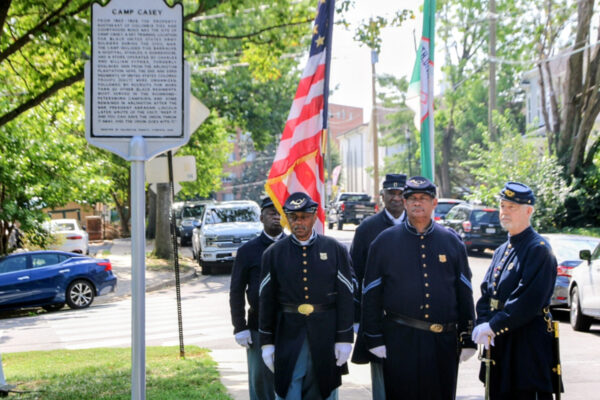
A new marker in Penrose honors 5,000 Black U.S. Army troops who trained in Arlington during the Civil War.
From 1863-64, two military regiments trained at Camp Casey: the 2nd and 23rd U.S. Colored Infantries. A historic marker adjacent to Towers Park at 801 S. Scott Street, two blocks north of Columbia Pike, was dedicated on Saturday.
“It’s always exciting when public spaces are recognized as historic spaces,” said Blake Lindsey, historian at Fort C.F. Smith Park, who represented the county government at the noon ceremony.
Also on hand were reenactors representing the 23rd U.S. Colored Infantry. Among them was retired U.S. Navy Capt. Edward Gantt.
After the war and for succeeding generations, those who had served in the U.S. Colored Troops became “forgotten people, invisible people,” Gantt said.
The contributions of Black soldiers on behalf of the Union were “definitely not in the history you learned in Virginia in the 1950s-60s,” he said.
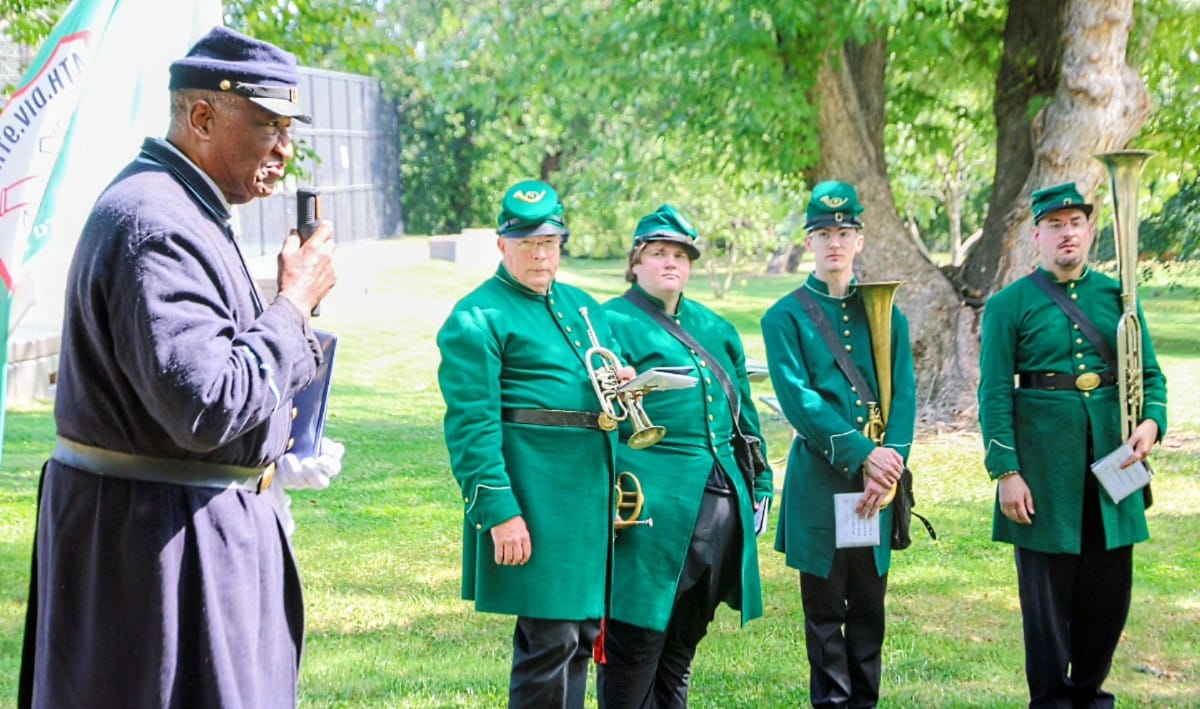
“We’re here to recover some of that missing history. It’s 160 years late, but we still owe it to you,” said Gantt, who noted that four members of the actual 23rd U.S. Colored Infantry shared his surname and may have been related.
“I assume we have a common ancestor,” he said.
Until recent years, Arlington was just as neglectful as the rest of Virginia in recognizing the role of U.S. Colored Troops.
“I wish I had known a lot of this stuff when I was in school,” said Scott Taylor, a county native who heads the Black Heritage Museum of Arlington.
The 2nd U.S. Colored Infantry was raised in November 1863. After training, it was dispatched to Florida, participating in the Battle of Natural Bridge, the second-largest Civil War engagement in the state.
The 23rd U.S. Colored Infantry was raised from December 1863 to July 1864. It moved south, and near Spotsylvania its members became the first members of the U.S. Colored Troops to engage Robert E. Lee’s Army of Northern Virginia.
The 23rd later was dispatched to the U.S.-Mexico border, serving under Gen. Philip Sheridan in 1865 and ensuring that a coalition of French and Mexican troops did not attempt an invasion of Texas.
A majority of troops from both the 2nd and 23rd came from Virginia, Gantt said. Fears by military leaders and common soldiers that Black troops sent into battle wouldn’t fight were quickly shown to be in error, he said.
Camp Casey also provided employment opportunities for those formerly enslaved who had self-emancipated and traveled to areas under Union control. After the war, the area became home to Freedman’s Village and, by the late 1800s, several African-American neighborhoods.
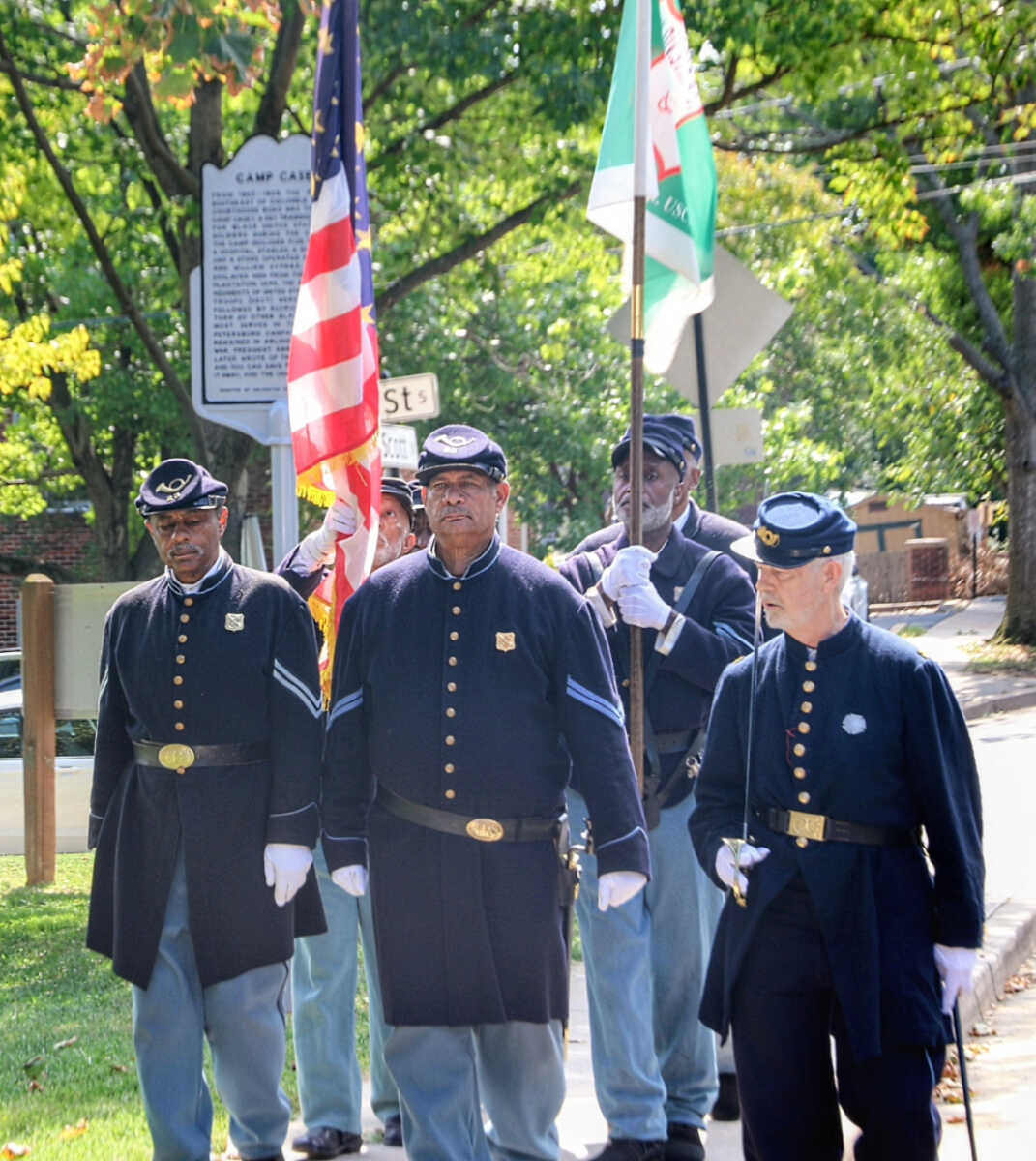
The Butler-Holmes subdivision in what became Penrose was cofounded by William Henry Butler, a veteran of the 2nd U.S. Colored Infantry.
Said Alex Sakes, president of the Penrose Neighborhood Association:
“With the dedication of this new historical marker, Camp Casey and the soldiers who trained here will finally receive some of the recognition they so richly deserve for their heroism in defense of our Union more than a century and a half ago. Without Camp Casey’s connection to 2nd Regiment soldier William Henry Butler — and his sacrifice and foresight — the neighborhood we now know as Penrose may very well never have come to fruition.”
Camp Casey had been named for Civil War Maj. Gen. Silas Casey (1807-82). According to the Arlington Historical Society, the camp “consisted largely of tent rows, wooden barracks, cookhouses, parade grounds, and supply areas laid out in orderly grids.”
According to the Historical Society:
“At Camp Casey, recruits were officially enrolled, medically examined, issued uniforms and equipment, and trained in infantry tactics. White officers led most U.S. Colored Troops regiments, but Black noncommissioned officers held key leadership roles within companies. Training adhered to established manuals and focused on discipline, battlefield maneuvers and weapon handling.”
The camp was dismantled in the aftermath of the war; no physical traces remain on the site.
Much of the research for the historical marker was conducted by Michael Schaffner. He and other historic-preservation advocates pressed for the marker to be of the older, upright metal type, since these are more durable than tabletop markers that have become the norm across Arlington in recent years.
The 8th Green Machine Regiment Band of George Mason University provided period music as part of the event. The Arlington Historical Society, Arlington NAACP and several local religious organizations also participated.
County Board members were meeting on Sept. 19, and were unable to participate in a number of community events transpiring that day.
