


A dip in rental costs brought on by the pandemic had long-term effects on apartment costs in Arlington, a new analysis suggests.
An Arlington housing market unaffected by the pandemic would have been about 2% costlier than the current one, according to analysts at Apartment List.
Extrapolating based on the 2.1% growth rate in rents in Arlington from 2017-19, analysts estimated that in a world where the pandemic never happened, Arlington’s median rent would have stood at $2,665 in August, compared to $2,612 in reality.
In February 2020, the last pre-Covid month and the baseline month for the analysis, Arlington’s median rent was $2,213.
The pandemic and work-from-home transitions sent many renters in urban areas scurrying to find other places to live. By January 2021, Arlington’s median rental price had dropped to $1,901, or 15.3% less than would have been expected with normal growth rates.
Then the turnaround began.
By July 2022, the median rent of $2,458 had risen above projections by about $8, or 0.3%, as Arlington once again became a hot rental market.
Prices fluctuated over the ensuing year, but from July 2023 to June 2026, Arlington’s rental costs were above what analysts would have anticipated based on traditional rental growth patterns.
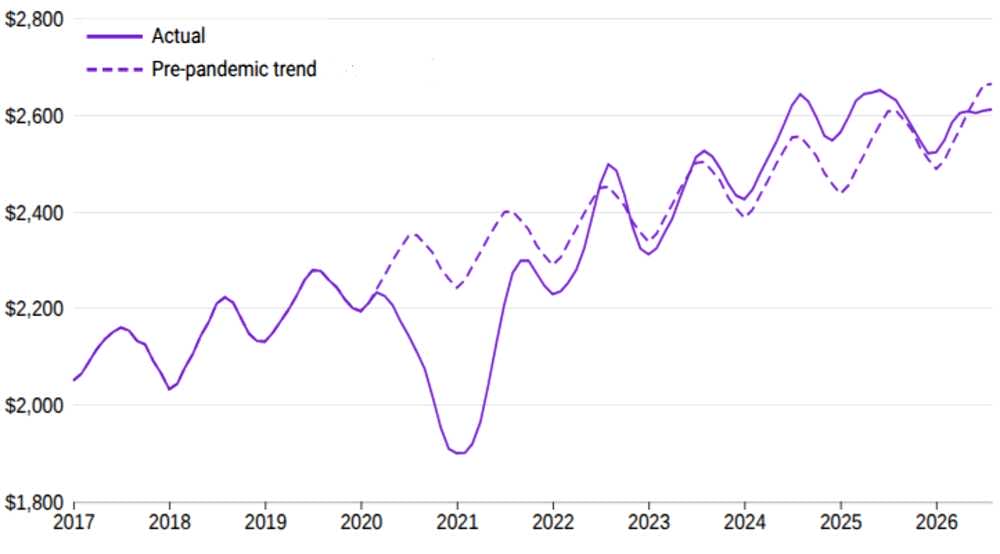
But over the summer of 2026, the local market’s cooling sent the trend line below where it would have been expected to be.
The Apartment List analysis incorporates typical seasonal variation. Asking rents are normally most expensive in spring and summer and cooler in fall and winter.
The 2.1% growth rate used for the Arlington projections was slightly below the 2.5% national annual increase in median apartment rental costs recorded from 2017-19.
Across the D.C. metro area as a whole, Apartment List analysts said the median overall apartment rent of $2,174 regionwide in August would have been $2,229 had the market continued the 2.5% national growth rate seen from 2017-19.
Nationally, the pandemic’s impact has been varied.
Of the nation’s 25 most populous metro areas, 12 currently have median rents higher than if the market had followed a steady 2.5% annual appreciation rate since 2017, according to the analysis. The remaining 13, including the D.C. metro area, had lower rents than would have been expected with no pandemic.
“Rents may have skyrocketed in 2021 and 2022, but the gradual cooldown of the ensuing years has now offset those increases to the extent that the national median rent has converged back to a long-run trend of slow and steady growth,” Apartment List analysts said.
The impacts of the pandemic are most pronounced in the nation’s most urban areas, which saw a sharp decline in 2020 followed by a comeback — sometimes a rapid one — as the country began to get back on its feet.
Nationally, the Apartment List analysis suggests the pandemic’s long-term impact on apartment costs is close to nonexistent. The median national rent in August was $1,390, just $5 below what it would have been had a stable 2.5% growth rate been the norm.
But what a ride it has been to get to that point.
“Since 2020, the rental market has whiplashed between skyrocketing rents and price declines, and those alternating hot and cold spells have now offset each other,” Apartment List analysts wrote.
Yet some areas have seen significant deviations from what would have been expected in a non-Covid world.
In the Buffalo, N.Y., metropolitan area, the median rent is 37% higher than it would have been had rents increased at historic norms, while in the Austin, Texas, metro, rents are 15% below that expected level.
